
Researchers in China have developed an innovative robotic snake to monitor power lines, execute repairs, energy harvesting, and transmit crucial information to energy professionals
The snake-like robots wrap around power lines and use onboard cameras and sensors to detect hazards such as damaged wires, worn components, and abnormal temperatures.
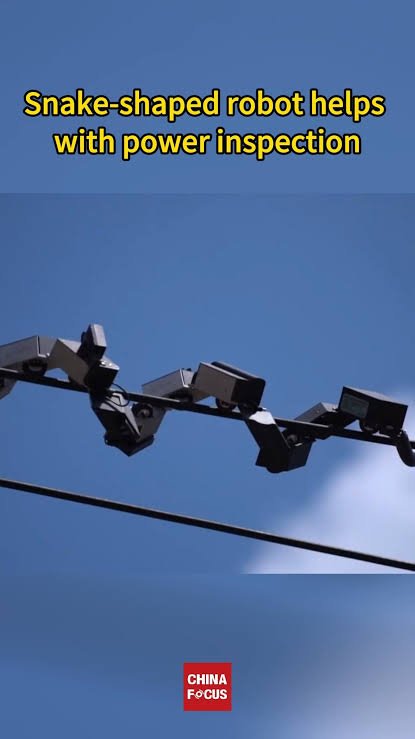
Picture Showing China’s Robotic Snake deployed on an Electric Energy Grid Line in Kunming District China – Photo Credit: China Focus
Developed by the Guandu District Power Supply Bureau, the robotic system has already inspected more than 80 miles (130 kilometers) of power distribution lines. According to its developers, the technology delivers inspection efficiency three times higher than traditional manual methods.
How the Robotic Snake works
China’s robotic snakes are highly flexible, multi-jointed machines designed to mimic biological slithering. They allow utilities to perform “industrial minimally invasive surgery” in spaces too narrow for humans or traditional rigid machines.
1. Slithering Locomotion: Unlike traditional robots with wheels or tracks, these devices are made of modular, independently driven segments. By twisting, turning, and coordinating these joints, the robots can achieve serpentine movement. This allows them to thread through complex, obstructed environments—such as the inner workings of an aviation engine, the cramped panels of a space station, or winding along suspended power lines.
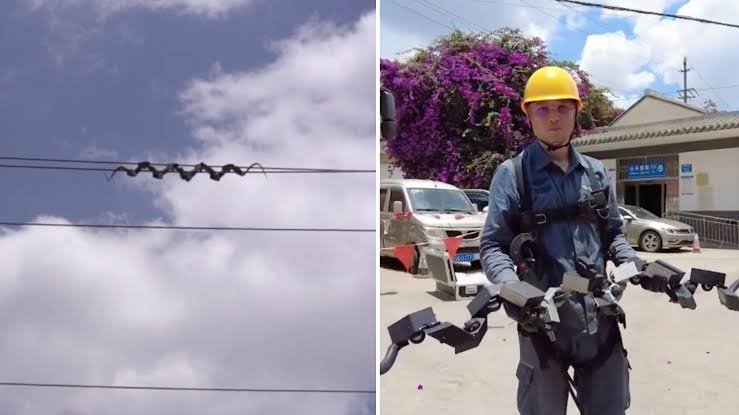
Picture Collage Showing the Robotic Snake deployed in action and A worker holding the Robotic Snake in Kunming District China – Photo Credit: China Focus
2. Specialized Onboard Systems for Power Grid Inspections: Depending on their specific mission, the snake robots carry targeted payloads for Power Grid Inspections Deployed in mountainous or “no-fly” drone zones, these snakes coil around high-voltage cables. Their heads feature thermal and optical cameras to spot worn parts, damaged wires, and abnormal heat buildup.
3. Energy Harvesting: For tasks that require long-distance travel, like power line inspections, the robots are built with non-contact power-harvesting devices in their tails. This allows them to draw energy directly from the electrified lines they are sliding along, keeping them operational for extended periods without needing a battery change.
The system is three times more efficient than manual inspections, reducing the need for labor-intensive, hazardous work while improving reliability and safety.
Power utilities in southwestern China are already using robotic snakes to inspect power lines, showcasing a new approach to infrastructure monitoring in environments where drones face limitations.
The snake-like robots have been deployed in Kunming, the capital of Yunnan province, where they move directly along power lines while inspecting critical electrical infrastructure. Equipped with cameras and sensors, the robots can identify faults such as broken wires, worn components, and abnormal temperature changes that could signal potential failures, reports the South China Morning Post (SCMP).
SUBSCRIBE TO SEEDUFYTECH NEWSLETTER
[sureforms id=’2360′]