

The Ruby Wheelchair is designed to help users navigate staircases while seated, with an assistant helping maintain balance.
A flight of stairs can make an ordinary building difficult to access for someone who uses a wheelchair. Ernest Majenge, known as “The Wheelchair Doctor,” developed the Ruby Wheelchair to help address that barrier.
Its wheels shift from a regular rolling setup on flat ground to a segmented system for staircases. The user helps move the chair by pulling handles on the wheels, while an assistant helps maintain balance.
From Repair Beginnings to Product Innovation

Majenge, originally from Matlakeng near Zastron in the Free State, holds qualifications in internal auditing and accountancy. He did not start out as an engineer. In 2018 he launched 911 The Wheelchair Doctor as a repair and customisation service after seeing how long it took people in Soweto and surrounding areas to get broken chairs fixed, how expensive those repairs could be, and how poorly standard wheelchairs performed on gravel roads or in buildings without level access. What began as a 24-hour repair operation gradually grew into product development.
Designing for Off‑Road and Urban Use
Ruby Wheelchair is not just stair-capable, it’s also rugged and adaptable. Majenge developed versions that work both on flat surfaces and over challenging terrain, aiming to serve townships, rural communities, and farms. This dual-mode form makes Ruby suitable for people in areas where infrastructure is inconsistent but mobility is urgent.
Overcoming Design and Market Challenges
Majenge admits his early prototypes failed due to making assumptions without testing market needs. Learning from that, he refined the wheelchair design through user feedback and iterative testing. Today, each wheelchair takes around 24 hours to assemble and transform from standard wheels to stair-friendly ones.

Serving Underserved Markets Globally
By early 2023, Ruby wheelchairs had already sold in France and across South Africa, with capacity to build about four units per day. Majenge aims to produce 10,000 units within a year. His focus spans urban stair access to rugged rural mobility, where standard wheelchairs fail.
The Ruby Wheelchair is a manual chair whose wheels switch function according to the terrain. On flat ground they roll normally. For stairs they transform into a segmented or star-shaped configuration that grips each step.
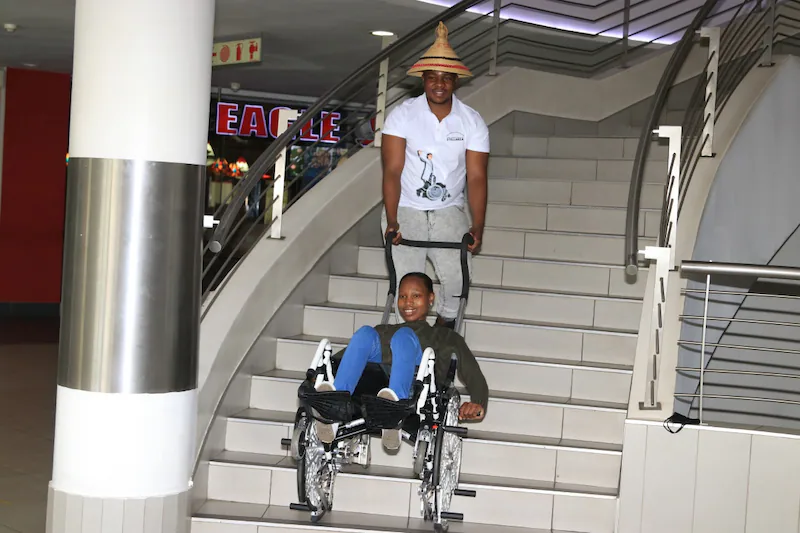
The seated user contributes to propulsion by pulling on handles attached to the wheels, while an assistant helps maintain balance and control the ascent or descent. The design is deliberately simple and fully mechanical with no motors, batteries or complex electronics so it remains usable in places where power is unreliable and maintenance resources are limited.
The same robust construction also makes the chair better suited to the sandy, gravelly and uneven surfaces common in many South African communities.
The Ruby is a clear example of grassroots engineering responding to a concrete access problem. It does not replace the need for proper ramps, working lifts and inclusive building design. Those remain essential. What it does offer is a practical interim option for the many places where architectural barriers still exist.
Majenge’s own framing is straightforward: movement is a basic human right, and solutions should be designed for the environments people actually live in rather than ideal laboratory conditions.

The larger question the invention quietly raises is structural. Why do so many buildings continue to treat stairs as the only or primary means of entry? Until that changes, innovations like the Ruby Wheelchair will keep filling a gap that should not exist. In the meantime, a Soweto-based inventor has shown that local knowledge, persistence and attention to real terrain can produce mobility tools that work where imported designs often fail.