
Nigeria today is plagued with wanton cases of building collapse especially in Big cities like Lagos, Abuja, Jos etc. These buildings fully developed in most cases suffer complete collapse with the buildings inhabitants suffering various degrees of injuries, torn muscles, broken bones and many paying the ultimate price.
Building Collapse in Nigeria is no longer a strange news. On average, four buildings collapse in Lagos state Nigeria alone each year, resulting in approximately 31 casualties annually. This strange occurrence which usually comes as a surprise in developed countries has sadly become a normal event in Nigeria. Today, many people living inside tall buildings in Lagos, Abuja could be living inside potential coffins as these buildings may collapse anytime and bite the dust anytime its structural elements can no longer hold the building together in one piece.
In modern times, Artificial Intelligence (AI) has shown great benefits in mass surveillance. This puts a huge question forward: Could AI Be Used TO Detect Building Collapse in Nigeria Before They Occur? The answer to this question is very important for a country like Nigeria witnessing at least 1 case of building collapse every month.
Causes of Building Collapse in Nigeria
-Poor Structural Designs: One of the key causes of Building collapse in Nigeria arises from poor and incomplete structural designs. This comes from lack of in-depth knowledge on building structural design thereby resulting in the production of buildings designed below par in terms of much required structural strength in the buildings Foundation and Super-Structure.
So far as a building is designed below its minimum and maximum load bearing capacity, that building is surely going to collapse in a matter of time. Sometimes, the Building can withstand this weight for up to 10 years or more before collapsing completely. A good Example is the Primary School Building Collapse which occurred in Jos Plateau State in 2024 killing over 20 primary school students and injuring over 200 primary school students while writing their exams. It will be worthy to note that this particular building was developed in 2018 almost 8 years later, it collapsed to the ground kiling and injuring many young innocent school children. Another example is The partial collapse of a 12-story beachfront condominium in Surfside, Florida a shock to the United States nation with 98 people confirmed dead, it is one of the deadliest structural collapses in American history. The root cause of the structural failure has yet to be determined, but reports show that this tragedy could have been prevented.
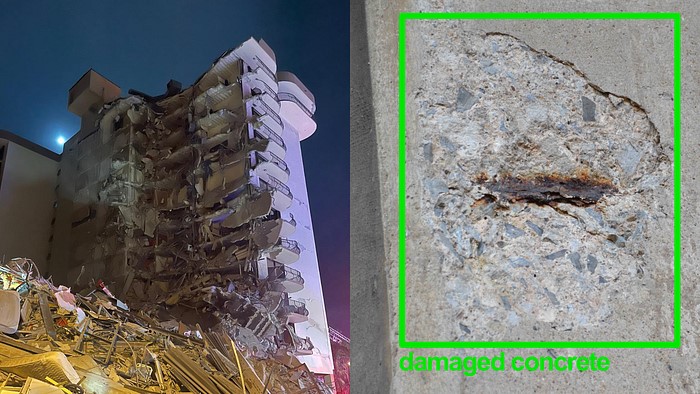
Left photo showing the aftermath of the Surfside condominium building collapse which fell on June 24, 2021. Right photo showing detection of “concrete cancer” by an AI detector. Left photo by Miami-Dade Fire Rescue Department. Right photo by Achim Hering on Wikimedia under the Creative Commons Attribution
-Use of Inferior Building Materials: Another key factor behind the rapid number of collapsed buildings in Nigeria is the use of inferior building materials which do not meet up to international standards. In Nigeria today, corruption is the order of the day and this corruption exists in almost every quarter of the economy including the building materials market. In Nigeria today, a 12mm Diameter Re-bar looks and measures to 10mm in diameter while a 2×3 wood used for roofing measures just 1.5×2 in actual size. This decline in the quality of building materials means that Buildings will be produced with insufficient strength necessary for the buildings longevity.
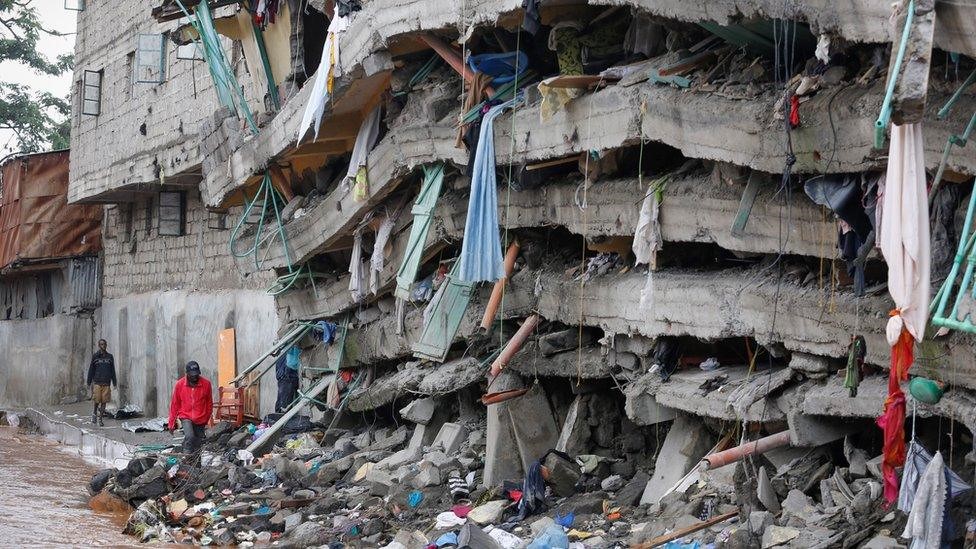
Picture Showing Dozens of people feared trapped under the rubble of a collapsed building in Nairobi- Photo Credit: BBC 2016
-Prevalence of Quacks and Non-Building Professionals on Construction Sites: The Nigerian construction industry today, is highly characterized by the presence of Non-Professionals , Quacks and Unlicensed individuals spearheading and supervising the construction of many complex Building projects. This comes as the Country is highly diversified in ethnicity thereby eroding trust and forcing clients to Favor the services of a fellow tribesman who may be lacking in necessary construction knowledge/experience over a fully fledged licensed Building Professional. In Abuja and many parts of Nigeria, several complex construction projects are currently handled by Quacks/Non-Professionals lacking the necessary skills and Professional oversight all in the name of “Man Know Man”. These acts continue right up to the completion of the structure however building collapse speaks only one language which is – ‘BOOM!’
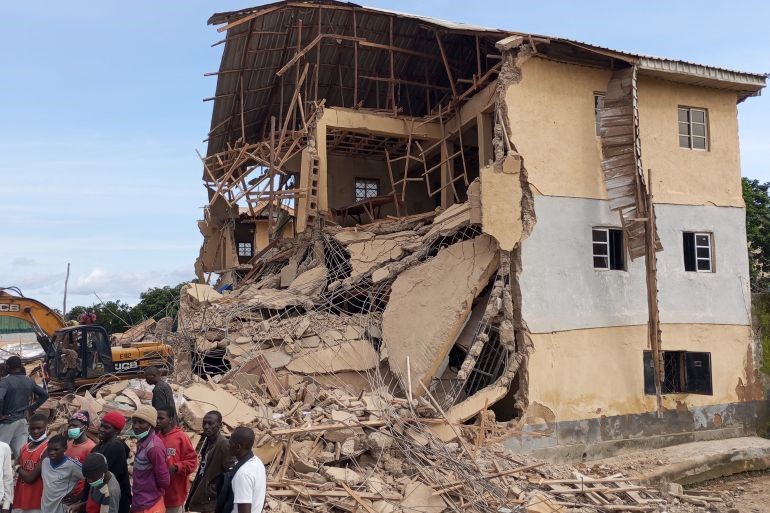
Picture showing the site of the Plateau State Primary School Building Collapse. The state government of Plateau blamed the tragedy on the school’s ‘weak structure and location near a riverbank’, and urged schools facing similar issues to shut down [Muhammad Tanko Shittu/AFP]
-Lack of Soil Test at the Foundation Stage: In Nigeria today, most developers are eager to hurriedly kick-off, develop and complete their housing projects while minimizing as much costs as possible. This means that most developers fail to carry out soil testing at the foundation stage. These soil tests are very important before the commencement of any building project as the test results determines the level of underground stability, soil load bearing strength and ultimately determines the type of foundation to be used for that particular project. In places like Lagos state, a coastal region in Nigeria, many Professional developers serially decry the Prescence of huge underground movements in the soil which leads to several soil tests in order to properly determine the correct foundation design specification and maximum load bearing capacity.
-Sharp Practices Occasioned by Greedy Developers: Many cases of Building collapse in Nigeria today originate from sharp practices carried out by greedy developers hoping to make a quick buck. These developers, cut costs where they should not and apply greedy additions to structures under development ultimately ending up in collapsed buildings. A good example can be seen in the case of Late Mr Femi Osibona a developer and CEO of 4-Score Homes Nigeria Limited. Femi Osibona now late, received approval for the development of a 15 Story Skyscraper located at Gerrad road Ikoyi Lagos State. Upon foundation design and construction up to the 15th floor, Femi used his connections in the regulatory department to extend his skyscraper to 21 floors knowing fully well that the buildings foundation was designed to accommodate only 10 floors. One fateful day, late Femi Osibona led a group of property investors, colleagues and friends on a tour visit on his Skyscraper building under construction and nearing completion. During the inspection tour, a loud bang! Was suddenly heard and the Skyscraper collapsed completely killing Mr Femi and 22 other persons right on the Skyscraper construction site.
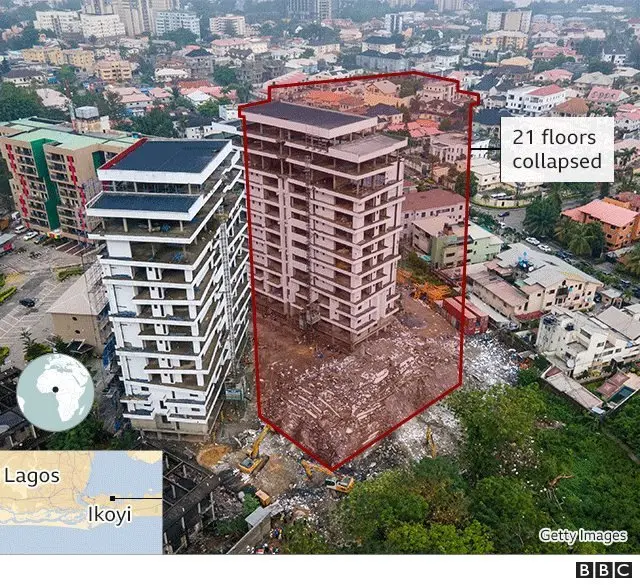
Picture Showing the Site of the Building Collapse that Killed 4-Score homes limited CEO Mr Femi Osibona- Photo Credit: Getty Images BBC
Types of Building Collapses
Building collapses are typically categorized by their failure pattern, often resulting from structural weaknesses, poor materials, or external forces like fire or explosions. Major types include Pancake, V-shape, Lean-to, Cantilever, and Tented collapses. These failures can be progressive, where an initial local failure leads to a chain reaction causing partial or total collapse.
-Pancake Collapse: This type of building collapse occurs when load-bearing elements fail, causing floors to fall straight down upon one another often leading to total building collapse. The case of the Skyscraper Building collapse at Gerrad Road Lagos state is a good example of a pancake collapse.
-V-Shape Collapse: This type of building collapse happens when the center portion of a building falls while the outer walls remain partially standing, creating voids on either side.
-Lean-to Collapse: In a Lean to collapse, one side of a floor or roof collapses while the opposite side remains supported, often creating a single triangular void. A good example is the primary school building collapse which occurred at Jos Plateau State.
-Cantilever Collapse: A cantilever collapse occurs when a structural failure occurs mostly where one end of a slab or beam is still supported while the other end falls.
-A-Frame (Tented) Collapse: This type of collapse Develops when the center of a floor or roof remains supported while the outer walls fail, forming an “A” shape.
-Progressive Collapse: A progressive collapse occurs when a chain reaction triggers in a building. In a progressive collapse, the failure of one component causes surrounding elements to fail, often leading to total collapse.
Building Collapse Warning Signs
No matter how poorly built a building is, it will show up signs of potential collapse before it occurs. Potential collapse indicators include vibrations in floors, sagging floors, tilting walls, cracking walls, broken glass, doors that won’t open, and severe structural movement.
Could AI be deployed to Detect Building Collapse before it Occurs?
Artificial Intelligence leverages predictive analytics and machine learning to enhance decision-making in sustainable construction. AI-powered building collapse detection uses machine learning and computer vision to analyze structural data, aerial imagery, and surveillance footage to identify structural weaknesses before failures occur. AI-powered tools can analyze vast datasets to forecast energy demands, optimize material use, and detect structural inefficiencies. Today, AI in building management and sustainable construction optimizes projects by enhancing design, automating scheduling, and improving safety through predictive analytics and Robotics. Cities like Baltimore today use AI to detect collapsed or hazardous rooftops from aerial images to warn emergency personnel. These systems, including convolutional neural networks (CNNs) and IoT sensors, achieve over 90% accuracy in detecting damage, providing real-time warnings to engineers and emergency responders.
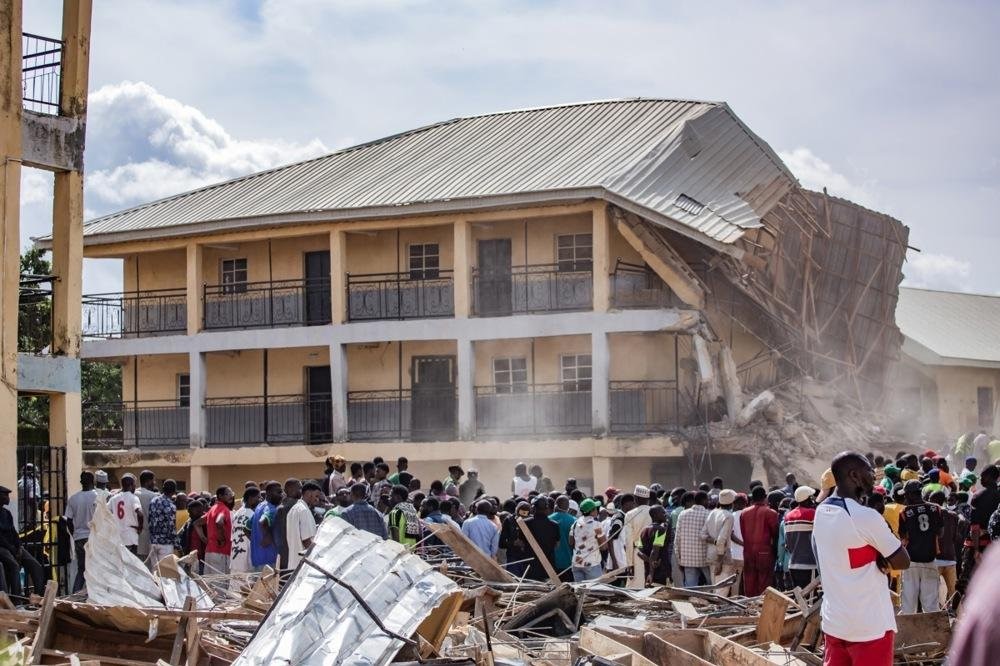
Picture showing the Plateau State Primary School Building Collapse with onlookers and sympathisers-Muhammad Tanko Shittu/AFP
Internet of Things (IoT) enhances sustainability by enabling real-time monitoring and optimization of building operations, with sensors embedded in smart buildings that collect data on energy consumption, lighting, and HVAC systems, allowing facility managers to identify inefficiencies and implement corrective measures. Today, 3D Point Cloud Algorithms like DS-Net are used to detect building roof deformations and inclinations, often outperforming traditional methods. In smart cities like Amsterdam, IoT-enabled systems optimize energy distribution and reduce emissions by monitoring traffic patterns and coordinating public transportation schedules. Smart cities, such as Masdar City in Abu Dhabi, represent a larger-scale application of these technologies. By integrating IoT, AI, and renewable energy systems, Masdar City minimizes its environmental impact while promoting efficient and safe urban living.
Has AI Been Deployed to Detect Building Collapse Before It Occurs Before?
AI models show brilliant capabilities to analyze data to detect structural issues early before collapse occurs using supervised machine learning models. What are Supervised Machine Learning Models? Supervised machine learning models are algorithms that learn from labelled data, where the input (features) and corresponding desired output (labels or targets) are provided. These models are trained to recognize patterns and relationships in the data, allowing them to make predictions or classifications on new, unseen data.
The Korea Institute of Civil Engineering and Building Technology has developed a smart AI sensor that detects signs of ground or structure collapses and a real-time remote monitoring system. The development of the sensor and system began with a search for a method of instant sensing of the collapse of slopes or buildings caused by ground movement for immediate response. This led to the development of a smart sensor that turns on a LED warning light upon detecting ground movement. The sensor can be easily installed 1m to 2m apart in areas susceptible to collapses. They detect changes in slope as subtle as 0.03°. Upon sensing signs of a collapse, they immediately turn on an LED light to give a warning. The sensors are easy to install, with the cost of installation and operation more than 50% lower. What is more, they can run for almost a year without battery replacement thanks to their ultra-low power consumption. The sensors are expected to be widely used in areas with distinct seasonal variations because they endure and function well even at extreme temperatures of −30℃ to 80℃.
How it Works
The sensors are installed 1m to 2m apart in areas susceptible to collapses. They detect changes in slope as subtle as 0.03°. Upon sensing signs of a collapse, they immediately turn on an LED light to give a warning. The sensors have highly-efficient optical transmitting lens technology, so the LED alert is visible to the naked eye even at a distance of 100 meters at day or night. When the warning light turns on, those in the situation room can remotely ascertain what is happening in the affected area in real time. This helps them take additional measures such as sharing the developments of the collapse with the appropriate authorities.
To prevent false alarms, an algorithm in the sensors analyzes and evaluates the risk based on the conditions of the monitored locations. The sensors can be used at sites of construction, public works, tunneling work, dilapidated buildings, and historical properties, as well as mines, underground structures, areas susceptible to landslides, and so forth.
How Nigeria Can Leverage AI To Detect Building Collapse before they Occur and Save Human Lives
For a country like Nigeria where Corruption, Greed, and Sharp Practices takes center stage, detecting building collapse before it occurs, requires an all hands on deck approach, backed with strong Legislations, and adequate Facility Management. Nigeria as a developing Nation must deploy strict legislations and Artificial Intelligence backed collapse detecting mechanisms at the Pre and Post construction stages of each and every tall building in the country to achieve net-zero causalities from building collapses in country.
In the light of this, Nigeria can adapt The Korean Institute of Civil Engineering and Building Technology developed a smart AI sensor that detects signs of ground or structure collapses and a real-time remote monitoring system in existing structures and new structures yet to be developed. These smart AI collapse sensors could be installed in foundations, beams, columns and floors of new and existing buildings thereby detecting the strength of the building’s and elements. Upon detection of anomaly load patterns, defects and potential building collapse signals, these sensors will automatically send out warning alarm signals to the buildings inhabitants for evacuation and automatically communicate the monitoring control rooms for outreach to emergency authorities for immediate action. If these measures are successfully implemented and carried out, fatal casualties originating from building collapses in the country will be completely eliminated.






Leave a Reply