
Nigeria prepares to head to the Polls to elect new Leaders come 2027 but AI Disinformation posses a huge threat that raises the possibility of mass electoral media Disinformation and result manipulation. This huge threat posed by AI Deepfakes and AI Social Media Disinformation could ultimately result in an election marred by violence and the breakdown of Law and order in Nigeria.
Key Takeaways:
-Nigeria prepares to head to the Polls in 2027 to elect new Leaders
-AI is constantly becoming a tool for carrying out Mass Electoral Disinformation in Elections in different parts of the world
-How AI Could shape Nigeria’s General Elections in 2027
-Potential Dangers AI could pose in Nigeria’s 2027 General Elections
Artificial Intelligent Disinformation posses a great danger to Nigeria’s 2027 general elections as AI Disinformation through the use of AI Deepfakes and Social Media could mislead millions of Nigerian electorates into making wrong electoral choices and accepting wrongly fabricated election results in 2027.
Today, Controversial uses of Artificial Intelligence (AI) in elections have made headlines globally. Whether it’s fully AI generated contenders, incarcerated Politicians using AI to hold speeches from prison, or deepfakes used to falsely incriminate candidates, it’s clear that the technology is here to stay. Yet, these viral stories only show one side of the picture. Beyond the headlines, AI is also starting to be used in the quieter parts of elections, the day-to-day work of electoral management – from information provision and data analysis to planning, administration and oversight.
AI is also contributing to broader changes in the electoral environment that extend far beyond the process of electoral administration. Political actors are increasingly experimenting with AI-enabled tools in electoral campaigns, from micro targeted, online advertising and chatbots to answer voter questions to synthetic images, audio and video deepfakes. While not all examples are used with a harmful intension, in many contexts they have been used to confuse voters, defame competing candidates or manipulate public debate, resulting in public disillusionment and fatigue around what can be trusted in the electoral news cycles.
In electoral contexts, AI-generated content not only increasingly shapes information through algorithmic amplification. Rather than changing people’s opinion, a growing concern is that mis- and disinformation are directed at electoral administration to confuse voters where and when elections take place or what the requirements are, which can gravely undermine the perceived integrity and legitimacy of elections. Furthermore, misinformation and deepfakes also disproportionately target female politicians and journalists which results in chilling effects that deteriorate women’s political representation.
Cases of AI Deepfakes and Social Media Deployed in previous times for Electoral Mass Disinformation
-Brazil “Dona Maria” Deepfake AI Political Tool
A good example of AI Disinformation can be seen in Deepfake Political tool “Dona Maria”. Dona Maria is an AI Disinformation tool which has been developed and deployed in Brazil elections to sway gullible electorates. Dona Maria has strong opinions about politics. The AI depicts a Black, elderly woman, she is a popular voice on social media in Brazil, critical of the left-wing government of Luís Inácio Lula da Silva. A few months before the presidential election, in which Lula will face Flávio Bolsonaro, the son and political successor of far-right former president Jair Bolsonaro, Dona Maria gets as much engagement on Instagram as popular politicians.
But Dona Maria doesn’t exist. She is a character created by a 37-year-old Uber driver from the countryside of Rio de Janeiro. Daniel Cristiano dos Santos uses Google Gemini and Flow to bring the character to life, as revealed by BBC Brasil. For $4 per video, he has “Dona Maria” comment in an outraged tone on topics such as rising food prices, the arrest of Venezuela President Nicolás Maduro, and tariffs imposed by President Donald Trump, blaming Lula.

Photo of Deepfake AI Tool named “Dona Maria” used for widespread Electoral Disinformation In Brazil – AFP
”I’m already fed up with this s**t, Brazil. And the slug [a reference to President Lula] is silent. Now that people are getting f**ked by foreign tariffs, he’s quiet as a clam,” the character says in one of the videos, which reached over 8 million views and more than 20,000 comments. The reactions to the video suggest that most people seem to believe the character is real.
Black, elderly, and female, “Dona Maria” strategically represents a demographic that is expected to play a decisive role in the next elections and one that today overwhelmingly supports Lula.
”She is a figure that generates an artificially created sense of recognition and belonging, and that connects with a large share of the current government’s voters,” says Fernanda Rodrigues, a researcher at the Institute of Reference in Internet and Society (IRIS).
-AI Disinformation Campaigns in Hungarian 2026 Elections
The campaign for Hungary’s April 12 elections has been marred by disinformation. Prime Minister Viktor Orban’s party, Fidesz, has deployed a series of outrageous AI-generated videos to target his main rival Peter Magyar and his Tisza party, while a vast campaign orchestrated by fake accounts has emerged on TikTok and Facebook.
In the run-up to crucial elections on April 12, Hungarian Prime Minister Viktor Orban’s party, Fidesz, and its supporters have been sending out false videos, often generated by AI. One of them shows a Hungarian father, supposedly forced to fight for Ukraine, being executed.
In the run-up to the election, an AI-generated disinformation campaign also emerged on TikTok.
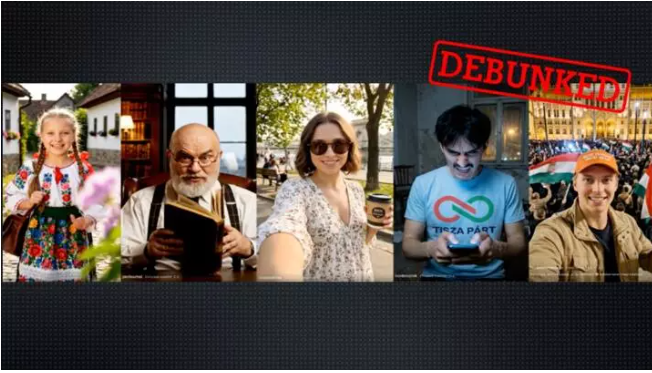
Screengrabs of AI-generated videos shared on TikTok that are hostile to the Hungarian political party Tisza and its leader Peter Magyar. Screengrab by Lakmusz. © Lakmusz/ FRANCE 24
In a report published on April 3, TikTok said that they had detected six networks, including a total of 400 accounts, attempting to influence the Hungarian elections. Most of these accounts showed support for Orban’s party.
Some of these videos have gone viral, garnering more than 10 million views on TikTok. They are part of a coordinated movement – in just two days, no less than 22 accounts, all part of the same network, were created. NewsGuard is still unsure who is behind them.
-2024 UK General Election AI Mass Disinformation
Another case of AI Disinformation can be seen in the 2024 UK General Elections where TikTok users were fed misleading election news in the 2024 UK General Elections. BBC found
Young voters in key election battlegrounds were ceaselessly recommended fake AI-generated videos featuring party leaders, misinformation, and clips littered with abusive comments, the BBC found.

Misinformation about Sir Keir Starmer and Rishi Sunak is among the content promoted to young voters’ TikTok feeds
Thousands of views promoted unfounded rumours that a major scandal prompted Rishi Sunak to call an early election and the baseless claim that Sir Keir Starmer was responsible for the failure to prosecute serial paedophile Jimmy Savile.
Satirical, fake AI-generated clips were released showing Rishi Sunak declaring, “Please don’t vote us out, we would be proper gutted!” and making unevidenced claims about how the Conservative leader is spending public money – including how he will send his “mates loads of dosh”.
TikTok has boomed since the last election UK General Elections. According to media regulator Ofcom, it was the fastest-growing source of news in the UK for the second year in a row in 2023 – used by 10% of adults in this way. One in 10 teenagers say it is their most important news source.
The logic of AI in Politics and Elections is very dangerous because it can normalize these synthetic characters as a legitimate tool for political persuasion. AI could be used to manipulate public opinion by exploiting Black identities as a façade of legitimacy and a form of violence.
How AI Could shape Nigeria’s General Elections in 2027
The 2023 presidential election saw a historic low voter turnout of 26.72%, which is a clear sign of public disinterest and disenchantment with the political system. It is against this turbulent backdrop that a new, powerful variable has been introduced, Artificial Intelligence (AI). The Independent National Electoral Commission (INEC) made history in May 2025 when it announced the creation of a specialized AI unit within its ICT Department. This move signals an ambitious technological shift, a clear intention to harness the power of AI to modernize elections and, in their words, make them “more credible, transparent, and efficient”.
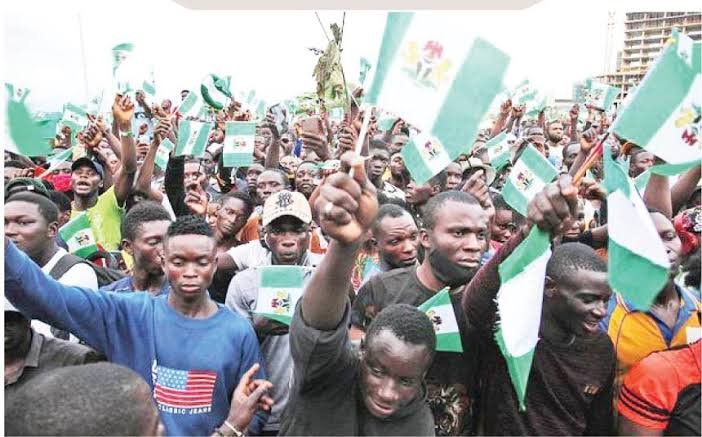
Photo showing campaign faithfuls and voters at a campaign rally in Ogun State 2023. Photo credit – Josh Olagbaniyan
The optimistic vision for AI in Nigeria’s elections is compelling. Proponents see it as a powerful tool to address the systemic weaknesses that have plagued past polls. INEC’s stated goals for its new AI division focus on moving from reactive problem-solving to proactive, data-driven management of the entire electoral cycle. At the heart of electoral credibility is the assurance that each vote is cast by a legitimate voter and counted accurately. AI offers several avenues to strengthen this core function as follows.
Voter List Management – An accurate voter register is the bedrock of a fair election. International best practices suggest AI is particularly well-suited for this task. As outlined in a report by International IDEA, AI algorithms can meticulously audit and “clean” voter rolls by detecting duplicate registrations, flagging incomplete data, and identifying statistically improbable entries for human review. This automates a historically cumbersome and error-prone process.
Voter Accreditation – Building on the foundation of the Bimodal Voter Accreditation System (BVAS) AI-powered biometrics could offer faster and more accurate facial and fingerprint recognition. This would significantly reduce the possibility of voter impersonation and speed up the accreditation process on election day, a key bottleneck in previous elections.
Results Management – AI systems could be designed to monitor incoming results from thousands of polling units in real-time. By analyzing data streams, these systems can flag statistical anomalies such as unusually high turnout in one area or results that deviate significantly from historical patterns that might indicate tampering or error, allowing for immediate investigation.
Vote Buying Detection and Flagging – In previously held Nigerian elections, vote buying is always highly evident. Political Parties are known to set special financial packages for vote buying at Local Government wards and councils. In the 2019 General Elections, votes were bought by the All Progressive Congress APC for as low a N1000 per vote in places like Edo State, Benue State and other parts of Nigeria. AI surveillance systems could be deployed on election sites to monitor track and flag cases of vote buying by designated party members at election venues in States, Local Governments, councils, and ward areas.
Potential Dangers AI could pose in Nigeria’s 2027 General Elections
Electoral Disinformation is already causing crisis in Nigeria. Last week, the All Progressive Congress party APC held their national primaries to elect flag bearers for the Presidential, Senatorial, House of Representatives and House of Assembly seats across Nigeria. The primary election was marred with cases of Disinformation particularly witnessed in theAll Progressives Congress (APC) primary ticket for the Pankshin/Kanke/Kanam (PKK) Federal Constituency in Plateau State race between Yusuf Gagdi and Dr. John Tongshinen the later Dr. John Tongshinen was earlier declared the winner of the Polls only for the result to be overtuned and cancelled by the APC electoral leaders citing Disinformation as the reason for this decision. Ultimately, Yusuf Gagdi was announced as the winner of the House of Representatives seat Pankshin/Kanke/Kanam (PKK) Federal Constituency in Plateau State.
The most immediate and alarming threat is the weaponization of generative AI to manipulate public opinion. This goes far beyond simple “fake news.” Nigerian media has already flagged deepfakes as a” looming crisis” for the 2027 general election. Malicious actors can now easily create hyper-realistic but entirely fabricated videos or audio clips. Imagine a deepfake video of a leading presidential candidate appearing to announce their withdrawal from the race on the eve of the election or a fabricated audio recording of an INEC official admitting to a conspiracy or a fabricated video of the INEC Chairman announcing a second runner-up in the election as the winner. The potential to sow chaos, incite violence, and irrevocably damage reputations with the use of deepfake is immense. Generative AI enables the mass production of targeted, context-aware misinformation at a scale and speed that human fact-checkers cannot possibly match.
SUBSCRIBE TO OUR NEWSLETTER
[sureforms id=’2360′]
Nigeria has a population of over 100 Million active social media users which could fall prey to AI Electoral Disinformation. Today, AI Deepfakes, ChatBots and Social Media Disinformation Campaigns are constantly being deployed by electoral arsonists to spread fake news, election lies and drive results to their favor. Nigeria must deploy strict AI censoring and regulatory measure come the Polls in 2027 or risk wide spread Disinformation, rising tensions and renewed violence in different parts of the country.




Leave a Reply