
Africa’s construction industry employs millions of people across the continent. In Africa today, the construction industry is the largest employer of labor. From construction material producers, to construction site workers such as Masons, Carpenters, Tillers, Laborers etc.The construction industry in Africa, ensures that over 30 Million households can afford barely 2 square meals as the construction Industry is the Largest employer of human resources in the continent.
The Nigerian construction industry employs between 8 million and 10 million people, making it one of the largest job-generating sectors in the country right after agriculture. The sector contributes roughly 4% to 6.4% of Nigeria’s national GDP. Because of the nation’s massive infrastructure deficit, major public works and housing projects remain the leading drivers of job creation. Approximately 65% to 70% of the construction workforce operates in the informal sector, primarily as manual laborers and artisans, which often means lacking job security or official benefits.
Similarly, South Africa’s construction industry employs approximately 1.2 to 1.3 million people, with around 62% in formal roles and 38% in informal roles. In Gauteng province alone, roughly 347,000 locals work in the construction sector.
Today, the coming of AI and Robotics in construction has seen the invention of several mind blowing construction Machines and Tools that automate construction works with great precision in record time speed. These construction machines perform and complete tasks which would ordinarily take a human worker a long time to complete in record short time while minimizing wastage and achieving higher precision.
For Construction Investors, Manufacturers and Profit driven Stakeholders, these inventions in construction, are game changers that reduces long human labor chains while maximizing profits using AI and Robotic automation. However, for millions households, this means food-insecurity and hunger due to millions of lost construction jobs.
For a developing continent like Africa which is battling with severe challenges in ethnic diversity, corruption, food insecurity and terrorism, replacing the human labor workforce with AI automated Machines could bring about several negative effects which might increase insecurity, fighting and unnecessary blood shed around different communities in Africa.
The African Continent today is faced with a huge 52 Million housing gap that requires hasty attention and affordable housing developments to combat this rising housing shortage. This huge housing gap in Africa, could be combated by adopting Lean Construction Methods and Automated Technologies that reduces the usage of a high number of already very expensive construction materials and AI powered Machines that eliminates the huge costs involved with human labor.
However, adopting Lean construction and AI powered Robotics for mass housing development in Africa will put over 30 Million households in grave food crisis, increase disease outbreaks, and ultimately trigger fighting, insecurity and innocent blood shed in Africa.
Advanced AI and Robotic Technologies Currently Revolutionizing Construction in Developed Countries across the World
Automatic Brick Laying Machine ( SAM 100)
Traditional masonry, one of the most manual stages of construction, already has a robot capable of taking over part of the repetitive work that previously depended solely on human labor. The SAM100, short for Semi-Automated Mason, was developed by Construction Robotics to work on masonry projects with bricks and mortar. According to records from Construction Robotics and applications in projects in the United States, the SAM100 is described as a robot capable of placing an average of 1,200 to up to 3,000 bricks per day, using a combination of conveyor belt, robotic arm, and mortar system.
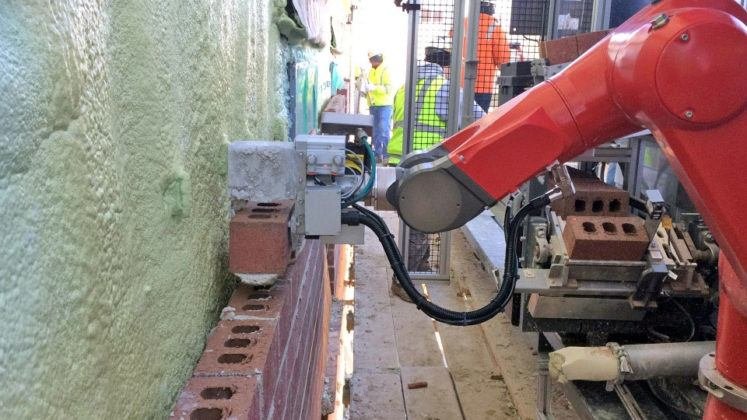
Picture Showing the Sam 100 Automatic Bricklaying Machine used to lay Blocks for the development of Modern House – Photo Credit: Public Domain
Construction Robotics describes the equipment as a system designed to assist the mason in lifting and placing bricks, while the human professional remains responsible for the preparation, monitoring, and final quality of the wall. The robot does not completely eliminate the worker, but shifts the human role to operation, supply, control, and finishing, while the machine repeats the heavy movement thousands of times a day.
SAM100 robot applies mortar, positions up to 3,000 bricks per day and changes traditional masonry with semi-automated operation. At Auburn University, in Alabama, the robot was also used in the construction of the Jay and Susie Gogue Performing Arts Center. The project coverage reported that the equipment was capable of placing more than 3,000 bricks per day on site.
3D-Printing
3D printing in construction (3DCP) utilizes large-scale, computer-controlled machinery to extrude materials most commonly concrete or mortar layer by layer to fabricate buildings and components. It drastically cuts down labor, speeds up project delivery by up to 50%-90%, and reduces material waste.
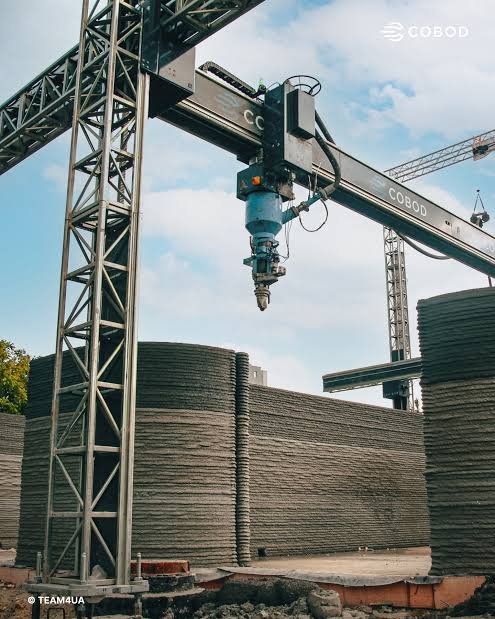
Picture Showing a 3D Printing Machine by COBOD constructing the walls of a Modern House – Photo Credit: COBOD
Today, the built environment is responsible for a third of the world’s waste and every year around 100 billion tonnes of raw materials are extracted and used in the buildings and construction sector.
However, 3D printing will only use the building materials and exact quantities needed for each element, resulting in little to no material waste, making it eco-friendlier and reducing the environmental impact compared to traditional construction.
How AI and 3D Printing Are Transforming Construction, Design, and Invention
One of the most exciting applications of AI-assisted design is 3D house printing. Across Europe, the United States, and Asia, large-scale printers are constructing homes using cementitious materials that can be recycled, reinforced, or bio-based. These systems dramatically reduce waste, labour, and build time. In some projects, full dwellings are completed within 48 hours of automated printing.
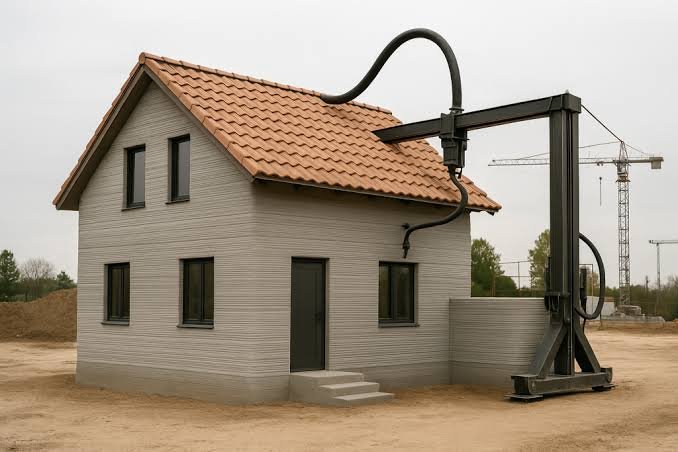
Picture Showing a Fully Built Duplex in Australia completed using 3D-Concrete Printing Machine – Photo Credit: Amazon
Australia’s first large-format 3D printers are now being trialled for residential and emergency housing. Local manufacturers and research institutions are exploring how robotics, additive manufacturing, and AI can be integrated to produce housing solutions that are faster, cheaper, and more sustainable, especially in regional and remote areas where skilled labour is scarce.
Construction 3D printer prices range from $180,000 to over $1,000,000 for heavy-duty industrial systems. Smaller gantry or educational models cost between $10,000 and $80,000. The price varies based on the printing system, scale, and mobility required.
Key Benefits of 3D-Printing Machines for Mass Housing Development
- Rapid Production: As 3D printers can begin producing construction components within a matter of hours, this can accelerate the manufacturing and building process. As a result, each stage of the design process and production can be made quicker and cheaper.
- Design Freedom: It enables architects to create highly complex, curved, or parametric designs that would be difficult or prohibitively expensive to build using standard timber or brickwork.
- Sustainability: By using precise material deposition and exploring eco-friendly mixes, 3D printing significantly reduces carbon footprints and structural waste.
- Cost-Effectiveness: One of the most notable advantages of 3D-printed houses is their reduced cost. By minimizing material waste and cutting down on labour needs, 3D printing can significantly lower construction expenses, making affordable housing more accessible.
- Speed & Efficiency: Simple structures and micro-homes can be printed in a matter of days rather than months.
Automatic Tilling Machines (P900)
Automatic tiling machines range from handheld, battery-powered suction tools for manual installation to fully autonomous, AI-driven construction robots that map rooms, apply mortar, and lay heavy floor tiles with millimeter-level precision.
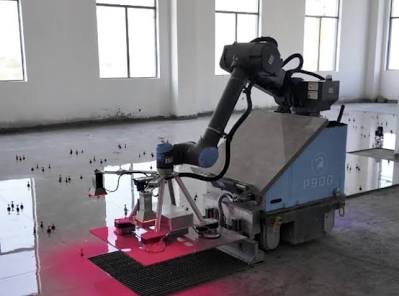
Picture Showing an Automatic Tilling Machine (P900) in action – Photo by Jerry Smith
Advanced machines (such as the P900 by Partner Robotics) built for large, commercial surfaces. They automatically spread adhesive, apply the tile, and adjust for flawless leveling. The Machine Ensures uniform grout lines and eliminates uneven edges (known as lippage). In terms of Speed, the Autonomous P900 robot can lay anywhere from 80 to 120 standard tiles per day, consistently working without fatigue thereby reducing Labor by minimizing the physical strain of heavy tile lifting and placing.
Impact of Advanced AI and Robotic Machines on Africa’s Construction Industry
AI and robotics are disrupting Africa’s construction sector by displacing routine manual labor while creating new, higher-value technical roles. While automated systems like Brick Laying robots, 3D Construction Printers threaten low-skilled jobs, AI-driven project management and drone surveying simultaneously require upskilled workers to boost site productivity and safety.
Today in Africa, the construction industry is the largest employer of labor in the continent with over 80 Million Jobs directly and indirectly tied to construction. AI and Robotics bring with a range of impressive, benefits in terms of Automation, Precision and Efficiency however, large scale Job Losses are imminent if Africa blindly adopts all kinds of AI and Robotic Technologies for mass housing development.
Areas Which Will See Huge Potential Job Losses in The African Construction Sector include:
Un-Skilled Construction Workforce
-Construction Labourers: Construction sites in Africa today are heavily populated with unskilled laborers that handle tasks such as; foundation excavation, carrying of bricks/blocks to point of use, mixing of cement, and movement of construction materials on Large construction site.
On average, the construction of a 4-Bedroom Bungalow in Nigeria employs the services of up to 150 Labourers working at different intervals throughout the development of the building. Today, the advent of Robotics machines puts these Labourers in grave danger as this AI powered technology will surely put these workers out of jobs and leave them struggling to feed their families.
Skilled Construction Workforce
-Masons/Bricklayers: With AI Robotic powered Machines like the automatic Bricklaying machine deployed for construction purpose in Africa, Millions of Construction Masons and Bricklayers will be put out jobs.
-Carpenters: Modern AI Powered Robotic Machines like 3D Printers can produce the walls of a 4-Bedroom Bungalow complete using Steel Form works which are adjustable and reusable. This ultimately signals a potential growing job crisis for construction carpenters and wood manufacturers.
-Tillers: Today, automatic AI Powered Tilling Robots can automatically fix up to 3000 floor tiles in record time and high precision. These automatic AI Powered Robots eliminates the need for human floor tillers thereby raising eyebrows on glooming job losses for human skilled floor tillers.
SUBSCRIBE TO SEEDUFYTECH NEWSLETTER
[sureforms id=’2360′]
How AI and 3D Printing Are Transforming Construction, Design, and Invention
/ AI, Innovation / By Scott Perry






Leave a Reply