
African Technology providers are making giant waves across the continent and raising large volumes of external and internal funding for expansion, growth and sustainable development.
Today, African electric vehicle firm Spiro has raised US$215 million in equity financing to expand its battery-swapping and electric mobility infrastructure across Africa, the company said Monday.
The investment round which saw the Kenyan electric vehicle firm raise a record $215 million was backed by institutional investors in Europe and Africa, including Denmark’s Impact Fund, underscoring growing interest in Africa’s clean transport and energy sectors.
“This past year marked a defining strategic milestone for Spiro,” Gagan Gupta, founder of Spiro and chair of Equitane, said in a statement. “Across seven active markets, our deployment of 100,000 electric vehicles and 2,500 smart-swap stations has turned sustainable mobility into an affordable, everyday reality.”
Gupta explained that the company’s next growth phase would focus on delivering sustainable transport alternatives to millions of riders across the continent.
Spiro, which operates in Kenya, Rwanda, Uganda, Togo, Benin, Nigeria and Cameroon, said the new funding will support the expansion of its battery-swapping network, strengthen local manufacturing and assembly operations, and accelerate its entry into new markets, including the Democratic Republic of Congo and Ethiopia.
The company however failed to disclose the valuation tied to the investment round.
The funding comes at a very crucial time for Africa as African countries seek to reduce dependence on imported fossil fuels, improve energy security, promote Local manufacturing and modernize urban transportation as population, fuel prices, and demand for affordable mobility grows.
Lars Bo Bertram, CEO of Impact Fund Denmark, said the investment reflected confidence in Africa’s electric mobility market.
Electric motorcycles are emerging as a major growth segment in Africa, where two-wheelers dominate urban transport and delivery services in many cities.
Spiro Founded in 2022 as a rebrand of M Auto is Africa’s Largest electric vehicle (EV) assembler and battery-swapping network. It operates across several African countries, including Nigeria, Kenya, Uganda, Rwanda, Benin, and Togo. The firm operates manufacturing plants in Kenya, Rwanda and Uganda, as well as a battery recycling facility in Nigeria.
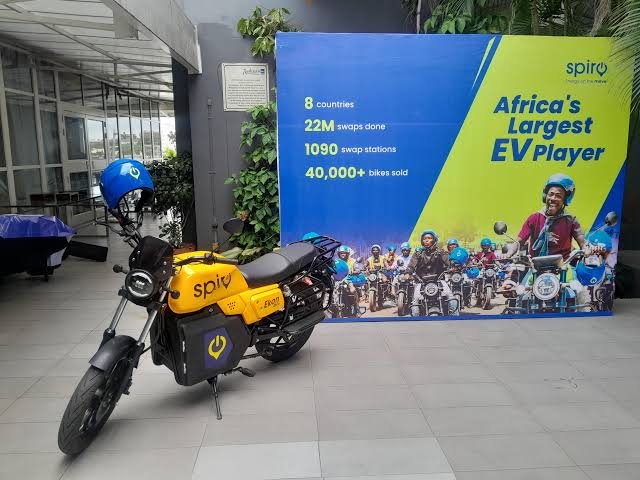
Picture showing a Spiro EV Motorcycle parked outside Spiro Headquarters in Kenya – Photo Credit: Spiro
The company was founded by the African Transformation and Industrialization Fund (ATIF), which is backed by Abu Dhabi-based investment firms and chaired by Indian entrepreneur Gagan Gupta. The company is heavily funded by major institutional investors, including the Fund for Export Development in Africa (FEDA)—the investment arm of Afreximbank.
Africa’s electric mobility market remains relatively small compared with China and Europe. Still, analysts say the sector is expanding quickly as governments introduce cleaner transport policies and startups develop business models tailored to local markets, including battery-swapping systems that reduce charging times and upfront vehicle costs.
Spiro said riders using its electric motorcycles can cut daily transport costs by up to 40%, saving as much as $2 per day compared with conventional gasoline-powered motorcycles.
What this $215 Million Equity Raise Means for Spiro and Africa
Spiro’s continental headquarters and main assembly plant is located in Nairobi, Kenya, specifically in the Westside Towers on Lower Kabete Road. The company also maintains significant corporate and operational hubs in Dubai, Cotonou, Benin, and a Nigerian corporate office in Victoria Island, Lagos
Spiro electric motorcycles, while designed to lower fuel costs and reduce emissions, face significant adoption and operational hurdles. The primary issues involve remote battery deactivation, limited charging networks, and high operating expenses
Africa-based electric-motorbike startup Spiro had been revolutionizing urban mobility across Africa for years by offering innovative, eco-friendly and sustainable micro-mobility solutions.
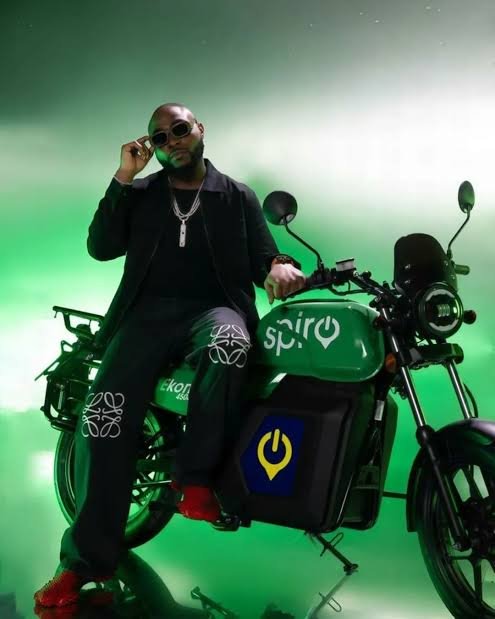
Popular Nigerian Music Superstar David Adeleke known as Davido signs a partnership with Spiro EV to setup his own branded Spiro EV Motorcycle venture – Photo Credit: Punchng
Driven by a desire to offer a cleaner, sustainable and healthier future, Spiro had been transforming the African transportation landscape with its pioneering electric bikes and battery swapping technology.
With over 17,000 bikes deployed, 10 million battery swaps and 600 swapping stations across Benin, Togo, Nigeria, Kenya, Rwanda and Uganda as of May 2024, Spiro is at the forefront of Africa’s transition to sustainable transportation.
https://www.emerald.com/eemcs/article-abstract/doi/10.1108/EEMCS-04-2025-0173/1316118/Spiro-reshaping-urban-mobility-across-Africa?redirectedFrom=fulltext
The company said it is also developing solar-powered battery-swapping stations and second-life battery storage systems and this giant $215 Million dollar equity raise will help the company to advance and achieve this goal.
Furthermore, this giant $215 Million dollar equity raise backed by Institutional investors will help the company to expand its operations to new hemispheres and open more rooms for employment for Africans across the continent.
Operations
Spiro’s operational model focuses on vertically integrated electric mobility, combining:
EV Assembly: The company assembles its signature electric two-wheelers locally in several African countries.
Battery-Swapping Infrastructure: Spiro operates thousands of “smart-swap” stations where riders can quickly exchange depleted batteries for charged ones.
Financing & After-Sales: It partners with digital microfinance institutions (like Dot in Nigeria) and local third-party franchisees to make the bikes affordable and ensure continuous technical support.
Recorded Challenges Faced with Spiro’s Electric Motorcycles
Key challenges include:
1. Remote Deactivation & Ownership ConcernsInactive Battery Lockouts: Riders have raised alarms over Spiro remotely deactivating batteries if the bike sits unused for a period of time (typically around 45 days). This “kill switch” policy often requires riders to tow their bikes to a station at their own expense, crippling daily incomes.
Dependency: The pay-as-you-go model leaves users vulnerable, as their livelihoods depend entirely on a swapping system and access they do not own or control.
Battery & Infrastructure Swapping Costs: Although electric vehicles eliminates fuel costs, battery swap fees add up. In regions like Nigeria, frequent daily swaps (e.g., 6 to 8 swaps) can result in notable daily expenses, cutting heavily into a rider’s take-home pay.
Network Density: Riders often express the need for more swapping and charging centers to comfortably embark on longer journeys without range anxiety.
Battery Lifespan & Supply Chain: Batteries degrade over time and relying heavily on imported battery components leaves operations vulnerable to supply chain disruptions and volatile costs.
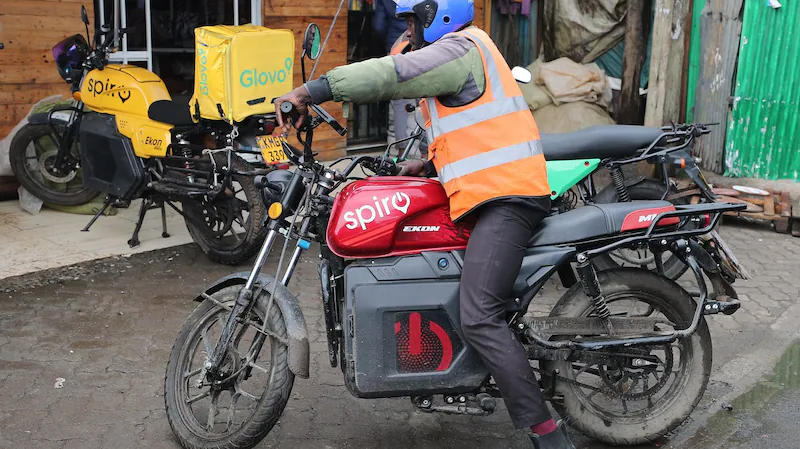
A rider sits on an electric Spiro motorcycle in Nairobi, Kenya, Tuesday, Feb. 24, 2026. (AP Photo/Henry Naminde, File)
High Initial/Overall Costs: Compared to traditional internal combustion engine (ICE) motorbikes, the high upfront purchase price remains a barrier.
Grid Dependence: Expanding electric mobility is inherently difficult in regions where large portions of the population are off the electricity grid.
Government Support: The e-mobility policy environment is still developing. Operators are lobbying governments for targeted incentives like free registration and trade-in discounts to make the transition smoother.
SUBSCRIBE TO SEEDUFYTECH NEWSLETTER
[sureforms id=’2360′]






One response
[…] month, SeedufyTech reported how Spiro raised a record $215 Million Dollars to increase electric vehicle manufacturing and scale […]