
A Nigerian U.S.-based Scholar and Control engineer, Mr Kenechukwu Nwajiaku, alongside his research team, have developed an intelligent robotic control system that bends and twists skeletal fixation plates to fit patients’ jaws or bones precisely thereby bridging a huge gap in Fracture and Bone Surgery.
Speaking to News Agency of Nigeria (NAN) in a Phone Interview on Saturday, Nwajiaku disclosed that his innovation combines robotics, machine learning, and advanced control technology to shape patient-specific surgical plates accurately, potentially making reconstructive surgery easier and more precise.
“The system uses a Gaussian Process-Enhanced Model Predictive Control framework, known as GP-MPC, to predict how a fixation plate will respond while being bent and twisted.
“Reconstructive surgeons use fixation plates to restore damaged facial and jaw bones following trauma, cancer, congenital conditions or surgical treatment.
“These procedures can affect a patient’s appearance and essential functions, including speaking, chewing, breathing and swallowing, making accurate plate shaping important to surgical outcomes,” he said.
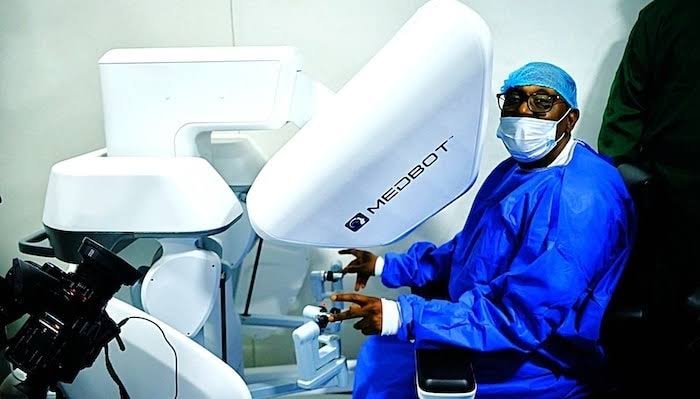
Engineer Kenechukwu Nwajiaku, explained that Medical Surgeons often shaped the plates manually to match each patient’s anatomy making the process laborious, time consuming and inefficient because the metal may partially return toward its original form after force is removed, a behavior known as “springback”.
“Our system predicts the plate’s response, compensates for springback and determines the deformation required to produce the desired shape.
“Working in control and automation taught me that machines do not always behave in the real world exactly as mathematical models predict.
“This inspired me to combine advanced control systems with machine learning so that machines can learn from data, account for uncertainty and make more accurate decisions,” he added.
The Nigerian-born US based engineer noted that the framework combines physics-based modeling with Artificial Intelligence & Machine Learning to improve the robot’s accuracy and consistency.
“Physics helps us understand how the system should behave, while machine learning accounts for what the simplified model may be missing.
“Combining them creates a control system that is better equipped to handle the nonlinear and uncertain behaviour of the material.
“The peer-reviewed study conducted at Case Western Reserve University evaluated the technology through computer simulations and experiments on a physical robotic testbed.
“In combined bending-and-twisting tests, the GP-enhanced system improved deformation accuracy by approximately 22 per cent along the bending axis and 34 per cent along the twisting axis compared with conventional Model Predictive Control.
“The system also recorded low variability during stochastic simulations, suggesting reliable performance under uncertain conditions,” he said.
Nwajiaku stated that further development and clinical validation would be required before the technology could be introduced into widescale routine surgical practice, noting that the findings demonstrate the immense potential of Artificial Intelligence and Robotics to precise and automated production of patient-specific surgical components.
“I am inspired by the possibility that the same principles used to make industrial machines more intelligent and precise can be applied to challenges that directly affect people’s lives,” he said.
Nwajiaku, whose research interests include artificial intelligence, machine learning, advanced control systems, robotics, digital-twin technologies, and intelligent automation, added that similar technologies could support other medical and industrial processes requiring precise material shaping and reliable decision-making.
“I want my work to contribute to intelligent systems that solve real problems and create benefits beyond a single laboratory or organisation,” Nwajiaku said.
This invention comes at a very critical time where Africa is battling declining Medical and Health care professionals.
The Robotic Invention points toward a future in which surgical expertise, robotics, physics-based prediction, and machine learning converge to enable safer, more precise, and patient-specific reconstructive procedures.