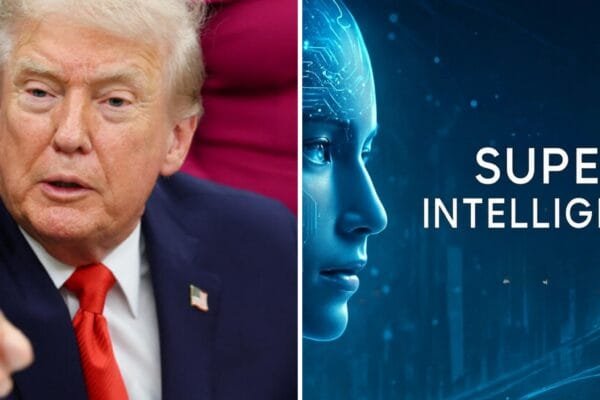
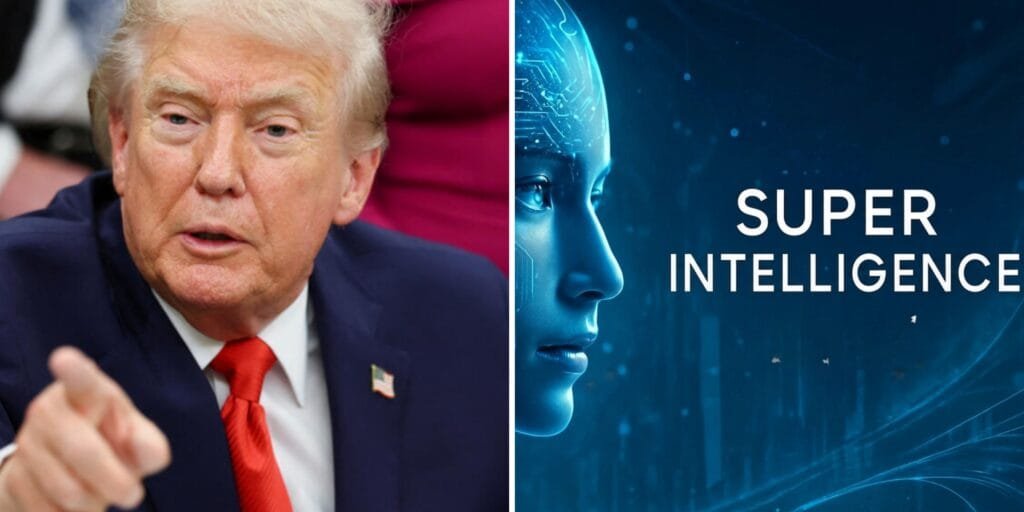
In a speech delivered to the 81st United Nations General Assembly on September 22, 2026, U.S. President Donald Trump declared that artificial intelligence would henceforth be referred to as “super intelligence” in all United States government documents.
The announcement, which also urged the rest of the world to adopt the same terminology, marked a striking linguistic and political intervention in one of the most consequential technological debates of the era.
Trump said “From this point forward, all of United States documents, and hopefully the world’s, will be changed to use the much more accurate term ‘super’ as opposed to artificial. So it’s super intelligence,” Trump said. He argued that the word “artificial” makes the technology sound fake when, in his view, it is “actually amazing.” He framed the rebranding as both more elegant and more truthful, welcoming audiences to “the new world of super intelligence—SI.”
The statement was not an isolated flourish. It arrived after several days of Truth Social posts in which Trump had floated alternative names such as Superior Intelligence, Extreme Intelligence, and Supreme Intelligence and invited followers to vote. Supreme Intelligence was later dropped, reportedly because of associations with the Supreme Court and weaker poll performance. By the time he reached the UN podium, the preferred formulation had settled on “super intelligence” or “superintelligence.”
Trump’s remarks comes amid intensifying public and expert concern about the risks of advanced AI systems. In the weeks leading up to the speech, high-profile warnings had circulated, including a resignation by an Anthropic researcher who stated that people building frontier models “earnestly believe that it could kill us all by the end of the decade.” Industry leaders and researchers had called for greater caution, voluntary pauses, or stronger safeguards against catastrophic misuse, cyber threats, and loss of control.
Trump rejected these alarms as the latest in a series of what he called Democratic or “Radical Left” hoaxes, placing them alongside earlier claims about Russia collusion, climate change, and other issues.
He noted that the same voices who once predicted existential catastrophe from global warming later rebranded climate change were now warning that AI would kill humanity or that robots would attack.
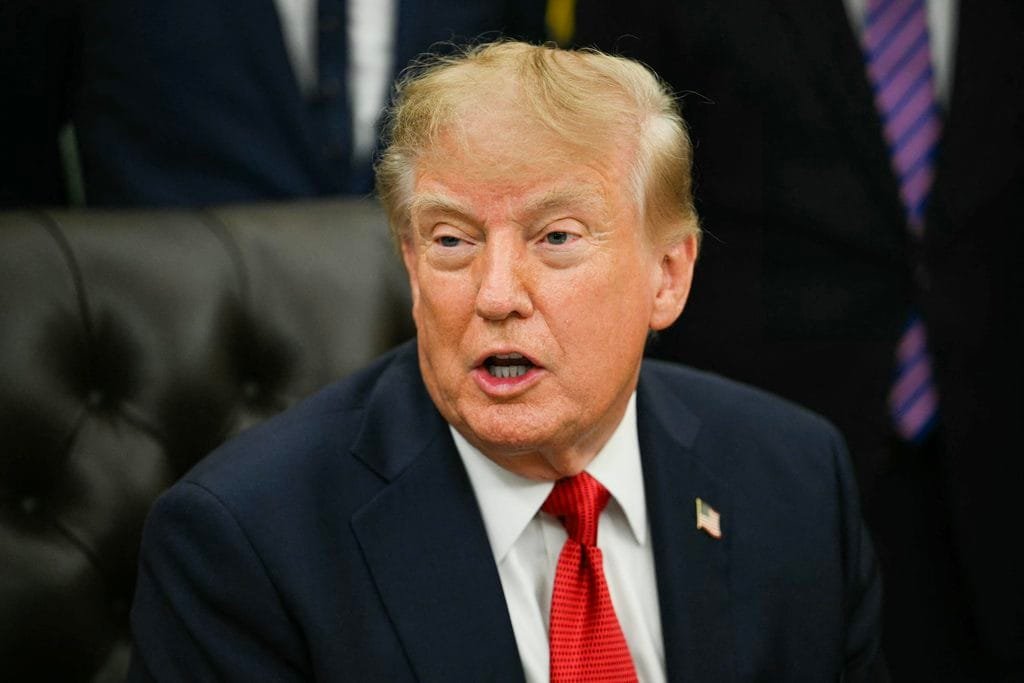
“I’m not going to stifle growth of something that will be bigger than the industrial revolution,” he insisted, adding that many believe the technology’s impact could exceed even that of the internet.
At the same time, he sought to project caution without restraint.
The United States would “watch it closely through the Department of Justice,” he said, and other law-enforcement bodies stood ready to rein things in “if we have to.”
Yet the overarching message was clear: the administration would encourage development rather than constrain it.
“We will only encourage superintelligence. We’re going to encourage it, not rein it in.”Trump repeatedly cast the contest for advanced AI or super intelligence as a zero-sum strategic competition.
“Whoever wins superintelligence wins. That’s the group that wins,” he declared. The United States, he claimed, already led China “by a lot” and every other country, and Washington intended to keep it that way.
Maintaining that edge, in his telling, required rejecting any “globalist scheme” to place the technology under international regulatory control.The language was deliberate. By renaming the field and asserting unilateral American leadership in terminology and policy, Trump sought to shape both domestic bureaucratic language and the international conversation.
He positioned the United States as the primary driver of the technology’s future while dismissing multilateral efforts that might slow progress or impose shared rules.This stance aligns with earlier actions in his second term. The administration had already issued directives accelerating AI adoption across the national-security enterprise, sought early government previews of powerful new models, and emphasized removing barriers to American leadership.
Plans for an “AI Force” modeled on the Space Force and the appointment of an AI “czar” had also been floated in the days before the UN address, underscoring an institutional push to organize and promote the sector.
What’s in a Name?
Language matters in technology policy. The term “artificial intelligence,” coined by John McCarthy in the mid-1950s, has long carried both technical precision and a certain cultural distance implying simulation rather than genuine capability. “Super intelligence,” by contrast, evokes power, superiority, and transformative potential. It echoes concepts long discussed in AI research circles, where “superintelligence” has referred to systems that vastly outperform humans across most domains.

Trump’s usage, however, appears broader: a rebranding of the entire field rather than a specific technical threshold.Whether federal agencies will fully implement the change remains to be seen.
Presidential directives can reshape official terminology in speeches, reports, and some internal documents, but entrenched scientific and technical vocabularies often prove sticky. Industry, academia, and international organizations may continue using “AI” or “artificial intelligence” for clarity and continuity. Still, the White House’s preference will influence how the technology is described in U.S. government communications and may ripple into diplomatic and public discourse.

Critics are likely to view the move as political theater that distracts from substantive questions of safety, alignment, energy demand, labor displacement, and concentration of power. Supporters will see it as a rejection of fear-driven regulation and a signal of confidence in American innovation.
Both sides can agree that the underlying technology continues to advance rapidly, with frontier models demonstrating growing capabilities in reasoning, coding, scientific discovery, and autonomous systems.
The announcement arrives at a moment when AI development is already reshaping economies, military planning, and scientific research.
Compute clusters the size of small cities, energy demands rivaling those of major industries, and models trained on vast swaths of human knowledge have turned AI into a strategic asset comparable to nuclear technology or semiconductor manufacturing.
Nations are racing to secure chips, talent, data, and energy. In that environment, the rhetorical framing of the technology as artificial and potentially dangerous, or as super and essentially beneficial, can influence investment, regulation, and public acceptance.
Trump’s speech also highlighted a tension that has defined much of the recent AI debate: the desire to capture transformative upside while managing downside risks.His solution is domestic vigilance through existing law-enforcement tools rather than new international regimes or precautionary slowdowns.
Whether that approach proves sufficient will depend on the actual trajectory of capabilities, the behavior of leading laboratories, and the ability of governments to detect and respond to emerging threats.
For now, the most immediate effect is linguistic and symbolic. In U.S. government documents, “artificial intelligence” is to become “super intelligence.” The president has invited the world to follow. Whether the new name sticks, and what practical difference it makes, will be tested in the months and years ahead as the technology itself continues its rapid evolution.