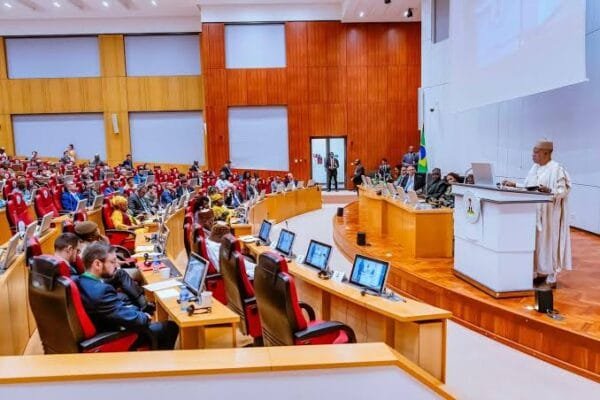
In the bustling corridors of the 81st United Nations General Assembly in New York, Nigeria stepped firmly into the global conversation on digital innovation and sustainable development. Represented by Kashifu Inuwa Abdullahi, Director-General and CEO of the National Information Technology Development Agency (NITDA), the country outlined a clear, practical vision for harnessing technology, particularly artificial intelligence in ways that expand human potential rather than deepen existing divides.
The discussions at the 81st UN General Assembly mark an important milestone. Nigeria has articulated a vision that balances ambition with practicality, global engagement with local ownership, and technological progress with human dignity. As the world grapples with the rapid evolution of AI and digital systems, this inclusive, agency-focused approach offers a valuable model for sustainable development that truly serves people and the planet.
Abdullahi’s keynote came during a high-level dialogue focused on technology, innovation, and social business for sustainable and inclusive development. The session brought together an impressive roster of leaders, including UNGA President Khalilur Rahman, Timor-Leste President José Ramos-Horta, Bhutanese Prime Minister Tshering Tobgay, Brazilian State Minister Wellington Dias, Pakistani Minister of State Bilal Bin Saqib, and Nobel Peace Laureate Professor Muhammad Yunus, founder of Grameen Bank and chair of the Global Committee on Social Business for the Sustainable Development Goals.
The message was unambiguous: the global AI conversation must move beyond simply expanding access to tools. True inclusion requires representation and agency. Developing economies whose languages, datasets, cultures, and social contexts remain underrepresented in current AI systems cannot remain passive consumers. They must become active creators and shapers of the technology.
Abdullahi presented Nigeria’s approach through four interconnected pillars namely Connect, Skill, Compute, and Create. These approaches are designed to build an ecosystem in which every Nigerian can participate meaningfully in the AI economy.
Connect focuses on expanding reliable digital infrastructure so that AI and other digital tools reach rural communities, farmers, small businesses, and underserved populations. Initiatives such as Project BRIDGE and the ambitious nationwide fibre-optic deployment of approximately 90,000 kilometres form the backbone of this effort. Without widespread, affordable connectivity, the promise of digital innovation remains theoretical for the majority of Nigeria’s more than 230 million people.
Skill addresses the human capital gap. Through programmes including Digital Literacy for All (DL4ALL), the Three Million Technical Talent (3MTT) initiative targeting three million digital professionals by 2027, and technical and vocational education and training (TVET), Nigeria aims to equip citizens not only to use technology but to understand, adapt, and innovate with it. The goal is a 70% digital literacy rate by 2027 and 95% by 2030.
Compute recognises that sovereign computing capacity including local data centres, cloud infrastructure, and processing power is essential for data sovereignty, security, and the development of context-relevant AI models. Nigeria’s National Sovereign Cloud Initiative and efforts to strengthen domestic AI capabilities reflect a determination to reduce over-reliance on foreign infrastructure while creating jobs and retaining economic value within the country.
Create shifts the focus from consumption to production. It seeks to foster an enabling environment in which entrepreneurs, innovators, and startups develop commercially viable, locally relevant solutions to real societal challenges whether in agriculture, healthcare, education, or climate resilience. By supporting innovators to turn ideas into sustainable businesses, Nigeria aims to ensure that AI generates tangible economic and social value for its people.
Taken together, these pillars frame AI development as an ecosystem challenge rather than a simple technology-adoption exercise. Connectivity without skills leads to limited use. Skills without computing power limit sophistication. Computing power without a culture of creation leaves a nation dependent on external solutions.
Abdullahi illustrated the transformative potential of inclusive AI with a powerful agricultural example. For a Nigerian farmer, AI does not need to turn every individual into a data scientist. Instead, it can place specialised expertise like weather patterns, soil conditions, pest identification, and market prices within reach through simple, accessible interfaces. The real promise, he argued, is that AI puts expertise in the hands of every Nigerian.
This perspective challenges the dominant narrative that often prioritises rapid deployment of global AI models without sufficient attention to linguistic diversity, cultural context, or local data. When African languages and realities are underrepresented in training data, the resulting systems risk producing biased or irrelevant outcomes. Nigeria’s call for representation is therefore both a matter of equity and a practical requirement for effective, trustworthy technology.
The dialogue also highlighted the broader role of social business and innovation in advancing the Sustainable Development Goals. Professor Muhammad Yunus’s presence underscored the importance of models that combine social impact with financial sustainability an an approach that aligns closely with Nigeria’s emphasis on creating value for citizens rather than merely extracting data or attention.
Nigeria’s participation at UNGA builds on years of deliberate policy and investment. The country has launched a National Artificial Intelligence Strategy, joined the Digital Public Goods Alliance to advance open digital ecosystems, and consistently advocated for inclusive digital cooperation through platforms such as the World Summit on the Information Society (WSIS+20) review.
Domestic programmes reinforce the global messaging. Large-scale fibre deployment, digital literacy campaigns, technical talent development, and the push for sovereign cloud infrastructure all demonstrate that Nigeria is translating high-level principles into concrete action. These efforts recognise that digital innovation is not an end in itself but a means to accelerate progress on poverty reduction, health, education, decent work, and climate resilience—core elements of the 2030 Agenda.
Abdullahi’s intervention was not merely a national statement; it was an invitation to the international community. Policymakers, technology companies, and innovators were challenged to ask two fundamental questions when designing AI systems: Who is represented in the intelligence being created? And who has the agency to shape that intelligence and create value from it?
Answering these questions honestly requires more than goodwill. It demands investment in local data ecosystems, support for multilingual and multimodal models that reflect African realities, capacity-building partnerships, and governance frameworks grounded in human rights and inclusivity. Platforms such as the UN Global Dialogue on AI Governance and initiatives like Digital@UNGA provide spaces for this continued conversation.
For Nigeria, the path forward is clear. By connecting its people, skilling its workforce, building sovereign compute capacity, and fostering a culture of creation, the country positions itself not as a passive recipient of global technology but as an active contributor to a more equitable digital future. In doing so, it advances both its national development priorities and the shared global ambition of leaving no one behind in the digital age.