US Launch World’s Largest Commercial Scale Offshore Wind Farm in Massachusetts to Power over 400,000 Homes (Video)
America’s largest commercial-scale offshore wind farm has completed construction off the coast of Massachusetts, marking a major milestone in the nation’s clean energy transition.
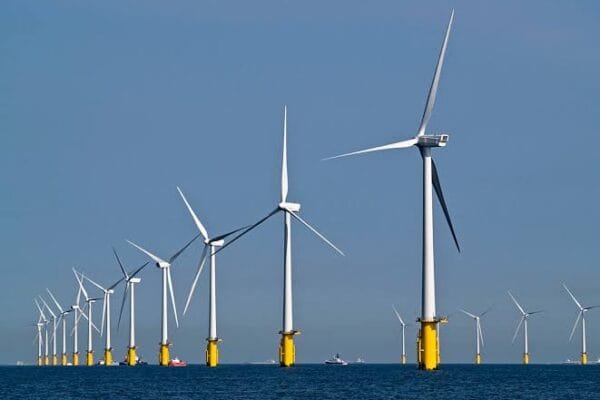
The Vineyard Wind 1 project, a $4.5 billion development, sits approximately 15 miles south of Martha’s Vineyard and Nantucket and about 35 miles from the Massachusetts mainland. With 62 GE Haliade-X turbines now installed and operational, the facility represents the most significant offshore wind achievement in U.S. history to date.
Each of the massive GE Haliade-X turbines is capable of generating up to 13 megawatts of electricity under optimal conditions. Together they deliver a total nameplate capacity of 806 megawatts. Vineyard Wind states that the project is designed to supply clean electricity to more than 400,000 homes and businesses across Massachusetts, a volume of power that meaningfully advances the state’s renewable energy targets and reduces reliance on fossil fuel generation.
The final turbine was completed on March 13, 2026. Even before the last machine was fully erected, the project had already begun delivering electricity to the regional grid. Commissioning of individual turbines continued in parallel with remaining construction work, allowing incremental power to flow as each unit came online. By September 16, 2026, all 62 turbines were capable of producing power, according to statements from both Vineyard Wind and GE Vernova.
The turbines are positioned roughly one nautical mile apart across the lease area. This spacing optimizes energy capture while minimizing aerodynamic interference between neighboring machines. Electricity generated by the turbines is gathered at an offshore substation and then transmitted to shore via two high-voltage submarine export cables. Once on land, the power interconnects with the New England regional transmission system, integrating seamlessly into the broader electricity market that serves Massachusetts and neighboring states.
The path to completion was not without significant challenges. The project experienced serious delays over several years and suffered a high-profile turbine blade failure in 2024. That incident, along with contractual disagreements, led to legal disputes between Vineyard Wind and turbine supplier GE Vernova.
In September 2026 the two parties reached a settlement. GE Vernova withdrew its earlier termination notice, and both companies agreed to dismiss all pending legal claims. The specific financial and operational terms of the settlement remain confidential.
Despite these setbacks, the successful completion of Vineyard Wind 1 carries substantial environmental benefits. Project developers project that the wind farm will reduce carbon dioxide emissions by more than 1.6 million metric tons each year.
That reduction is roughly equivalent to taking approximately 325,000 passenger cars off the road annually. By displacing fossil-fuel generation, the facility contributes directly to improved air quality in the densely populated Northeast and supports Massachusetts’ statutory goals for greenhouse-gas reductions.
Offshore wind occupies a unique position in the U.S. energy landscape. Unlike land-based wind or solar installations, offshore projects can take advantage of stronger and more consistent wind resources found over open water.
The waters south of Martha’s Vineyard and Nantucket experience relatively high average wind speeds, making the site particularly suitable for large-scale generation.
The Haliade-X turbines themselves represent advanced engineering: their enormous rotor diameters and high hub heights allow them to capture energy from higher atmospheric layers where winds are stronger and more stable.
The economic footprint of the project is also noteworthy. Construction of a facility of this scale required thousands of specialized workers over multiple years, including welders, electricians, marine operators, and engineers.
Port facilities in Massachusetts and neighboring states were upgraded to handle the oversized components including tower sections, nacelles, and blades that can exceed 100 meters in length.
Local supply-chain businesses supplied materials, logistics support, and maintenance services. Once fully operational, the wind farm will continue to support a smaller but permanent workforce focused on operations, maintenance, and monitoring.
Integration into the New England power grid required careful coordination with regional transmission operators. The two submarine cables and the onshore interconnection points were designed to meet strict reliability and environmental standards.
Underwater cable routes were planned to avoid sensitive habitats where possible, and construction activities followed extensive permitting requirements intended to protect marine mammals, birds, and seafloor ecosystems. Ongoing monitoring programs will track the project’s interaction with the marine environment throughout its operating life.
Vineyard Wind 1 also serves as a proof-of-concept for the broader U.S. offshore wind industry. For years, European countries have operated large commercial offshore wind farms, while the United States lagged behind despite possessing extensive Atlantic and Pacific coastlines with excellent wind resources.
The successful commissioning of an 806-megawatt project demonstrates that large-scale American offshore development is technically and commercially feasible. Lessons learned from Vineyard Wind 1 regarding foundation design, turbine reliability, cable installation, and regulatory coordination will inform subsequent projects already in various stages of planning and permitting along the East Coast.
The timing of full commercial operation is significant. As of late September 2026, the United States continues to pursue ambitious clean-energy targets at both federal and state levels.
Massachusetts has long maintained some of the most aggressive renewable portfolio standards in the country.
Delivering more than 400,000 homes’ worth of electricity from a single offshore facility moves the state measurably closer to those goals while providing a hedge against volatility in natural-gas prices that have historically influenced New England electricity costs.
Looking ahead, the operational performance of the 62 Haliade-X turbines will be closely watched by industry analysts, investors, and policymakers.
Capacity factor—the percentage of maximum possible output actually achieved over time will determine the true economic value of the project. Early indications from similar European installations suggest that well-sited offshore wind farms can achieve capacity factors significantly higher than many onshore wind or solar facilities, particularly during winter months when electricity demand in New England is highest.
Community engagement has been another important dimension of the project. Residents of Martha’s Vineyard, Nantucket, and mainland coastal communities participated in extensive public consultation processes during the planning and permitting phases.
Visual impacts, potential effects on fishing grounds, and tourism considerations were all subjects of discussion.
Project developers implemented mitigation measures, including carefully chosen turbine layouts and financial arrangements with local stakeholders, intended to balance energy production with community interests.
The $4.5 billion capital investment itself reflects the scale of commitment required for offshore wind. Financing for projects of this magnitude typically involves a combination of private equity, debt, and various forms of public support such as tax credits and long-term power-purchase agreements.
Vineyard Wind 1 secured offtake arrangements that provide revenue certainty, an essential element for attracting the large upfront capital needed to build offshore infrastructure.
As the turbines begin their multi-decade service lives, attention will turn increasingly toward operations and maintenance strategies.
Offshore environments are harsh: salt spray, high winds, and wave action place continuous stress on mechanical and electrical systems. Predictive maintenance using sensors, drones, and specialized vessels will be critical to maximizing availability and minimizing downtime. The settlement reached in September 2026 between Vineyard Wind and GE Vernova may also influence how future warranty, performance, and liability issues are handled across the industry.
For American renewable energy, an 806-megawatt offshore wind farm located 15 miles south of Martha’s Vineyard and Nantucket is now capable of powering more than 400,000 homes and businesses while avoiding more than 1.6 million metric tons of carbon emissions annually.
Despite earlier delays and a turbine blade incident in 2024, the project reached full construction completion in March 2026 and achieved full turbine capability by mid-September of the same year.
The confidential settlement between the project developer and the turbine manufacturer closed a difficult chapter and allowed the facility to move forward into commercial operation.
As the largest commercial-scale offshore wind farm in the United States, Vineyard Wind 1 provides both clean electricity and a practical demonstration that large-scale ocean-based wind power can be successfully developed, constructed, and integrated into the American grid.