The Foundation for Digital Justice has sued TikTok Inc. at the Federal High Court in Abuja, alleging that the social media platform is responsible for the widely reported restricted access that millions of users in Kaduna, Kano, Kebbi and Sokoto states continue to experience.
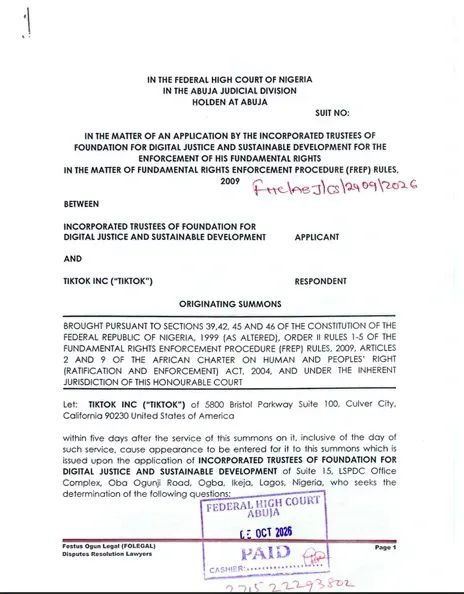
The organisation, in the suit filed at Federal High Court, Abuja, by its lead counsel, Festus Ogun, on October 5, 2026 and made available to PUNCH Online on Tuesday, said the alleged restrictions amounted to violations of Nigerians’ constitutional rights to freedom of expression and freedom from discrimination.
The suit, brought under the Fundamental Rights Enforcement Procedure Rules, 2009, seeks an order directing TikTok to restore access to users in the affected states and stop imposing what the organisation described as arbitrary restrictions on them.
In an affidavit filed in support of the action and seen by PUNCH Online on Tuesday, a legal officer with the Foundation for Digital Justice, Abidat Idowu, said TikTok users in the four states began experiencing difficulties accessing the platform around September 11.
She stated that by September 14, the platform had become “completely restricted and inaccessible to millions of Nigerian Users in Kaduna, Kano, Kebbi and Sokoto States.”
According to the affidavit, the disruption affected users on standard mobile data connections, with feeds freezing while scrolling, videos failing to load and uploads repeatedly stalling.
“These users cannot load videos, refresh their feeds and upload content on TikTok,” Idowu stated.
She further alleged that the restriction had deprived affected users of access to information and the ability to participate in online discourse.
“Millions of Nigerian Users in Kaduna, Kano, Kebbi and Sokoto States are left out of access to information, they cannot disseminate information, they cannot receive information and cannot express their opinions on the Respondent’s TikTok’s platform owing to the restriction and/or disruption,” the affidavit stated.
The organisation said some affected users had been able to regain normal access by using virtual private networks, or VPNs, which can make an internet connection appear to originate from another location.
It also alleged that users in other parts of Nigeria continued to have unrestricted access to TikTok.
“Disturbingly, except in Kaduna, Kano, Kebbi and Sokoto States, users in all other parts of Nigeria continue to enjoy unrestricted and unfettered access and usage of Respondent’s TikTok App,” Idowu stated.
The Foundation argued that TikTok had not explained why users in the four states were allegedly subjected to a different level of access.
“The Respondent has also not provided any explanation for the obvious exclusion, discrimination and restriction of access against all TikTok users in Kaduna, Kano, Kebbi and Sokoto States,” the affidavit said.
The organisation is asking the court to determine whether TikTok’s alleged restriction violates Section 39 of the 1999 Constitution, which protects freedom of expression, and Article 9 of the African Charter on Human and Peoples’ Rights.
It is also asking the court to determine whether the alleged differential treatment of users in the four states violates Section 42 of the Constitution and Article 2 of the African Charter, which provide protections against discrimination.
The Foundation argued that access to TikTok had become significant beyond entertainment, citing its use for communication, journalism, business, civic participation and political and social discourse.
“The Respondent’s platform is very critical for communication, journalism, civic participation, business, political and social discourse in Nigeria and the restriction of millions of TikTok users in Kaduna, Kano, Kebbi and Sokoto States has unduly excluded them,” it said.
It also argued that activities such as posting, liking, reposting and replying to content constituted forms of expression that were affected by the alleged restriction.
The affidavit stated, “restricted accounts like those of millions of TikTok users in Kaduna, Kano, Kebbi and Sokoto States are prevented from making post, viewing any post made on TikTok, replying to post, reposting or liking them.”
It added that “Replying, posting, reposting and liking are all ‘expressive conduct’ that the Respondent’s restriction inhibits.”
The organisation further claimed that the alleged restriction had effectively excluded residents of the affected states from what it described as a public forum.
“By restricting millions of TikTok users in Kaduna, Kano, Kebbi and Sokoto States, the Respondent has excluded citizens of Nigeria resident in the states from a public forum,” the affidavit stated.