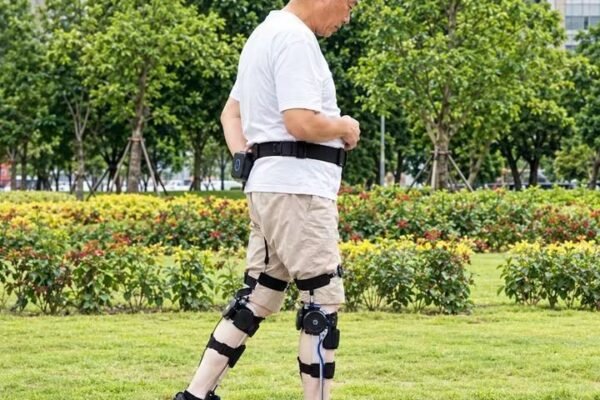
Chinese and Hong Kong researchers have developed a lightweight, battery-free self-powered neuroprosthesis (SPN) that helps stroke survivors with foot drop walk more naturally by harvesting energy from the wearer’s own gait and converting it into timed electrical stimulation of the weaker leg.
Foot drop is a common and disabling post-stroke impairment that occurs when weakened or poorly controlled dorsiflexor muscles especially the tibialis anterior fail to lift the toes during the swing phase of walking.
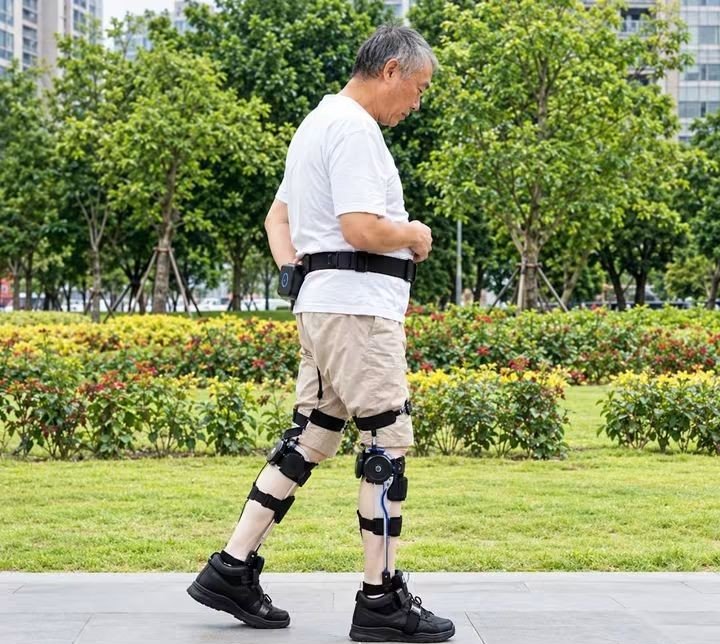
This reduces toe clearance, increases tripping and fall risk, lowers gait efficiency, and diminishes quality of life.
Traditional solutions such as rigid ankle-foot orthoses (AFOs) passively constrain the ankle rather than restoring active movement, which can promote muscle disuse over time.
Battery-powered functional electrical stimulation (FES) systems can activate the appropriate muscles but typically require external power sources, sensors for gait-phase detection, and frequent manual tuning which becomes practical barriers that limit everyday use.
The new SPN, developed by a cross-institutional team from the Hong Kong University of Science and Technology (HKUST), The Hong Kong Polytechnic University, and Huazhong University of Science and Technology, overcomes these limitations.
It is a wearable, gait-timing-adaptive device that needs no external batteries, sensors, or routine calibration. Key contributors include Qiqi Pan, Yuyan Luo, and Zhihe Long along with Zhengbao Yang and others.
How the device works
The system exploits the natural out-of-phase mechanics of human gait.
An energy harvester embedded in the heel of the shoe on the stronger (non-paretic) leg collects mechanical energy during stance.
A gravity-driven, gear-based switch-rail mechanism synchronizes harvesting with gait: heel loading during early-to-mid stance disengages the generator; as the heel rises in late stance, a spring re-engages it to produce electricity.
This energy is conditioned by a miniature power-management circuit and pulse-width modulation module into biphasic stimulation pulses.
The pulses are delivered almost immediately to electrodes on a lightweight below-knee stimulator strapped around the weaker (paretic) calf, activating the tibialis anterior during the subsequent swing phase—precisely when toe clearance is needed.
Each step on the stronger side effectively powers one stimulation cycle on the weaker side “one step, one stimulation”.
The energy harvester itself weighs only 56 g; after removal of some heel material, the net added mass to the shoe is less than 20 g. Users can typically put the device on in about two minutes. Power output ranges from roughly 0.16 W to 1.2 W depending on walking speed and terrain including level ground, slopes, and stairs, which is sufficient to support typical pulsed neuromuscular stimulation parameters.
Because timing and energy delivery are mechanically coupled to the wearer’s own gait, the system adapts automatically to changes in speed or pattern without external sensors or algorithmic control.
Clinical results
In ambulatory stroke survivors who retained some walking capacity, had foot drop, and showed lower-limb impairment (Fugl-Meyer lower-extremity scores 13–27/34; Modified Ashworth Scale for ankle plantarflexors 0–2), the SPN produced immediate, clinically meaningful improvements.
Ankle dorsiflexion angle rose from an average of −1.1° to 6.8°. Outdoor walking tests showed a 67.3% increase in distance covered, a 43.5% increase in speed, and a 71.9% reduction in gait variability. These gains appeared without the need for extensive training or parameter adjustment.
Indoor treadmill and outdoor overground testing both confirmed benefits in stride characteristics and overall mobility. This comes as the device supports rather than restricts natural limb movement, potentially encouraging continued voluntary muscle engagement which is a huge advantage over purely passive orthoses.
Researchers note that the technology could help not only stroke survivors but also older adults and others with mobility impairments that involve foot drop or related gait deficits. They have even suggested possible use by athletes during training. Future iterations may expand assistance to the knee and hip joints.
The SPN addresses two major barriers that have limited real-world adoption of conventional FES systems: dependence on bulky external power and the need for manual or sensor-based calibration.
Its compact, self-contained design improves practicality for daily life. However, further development, larger-scale clinical trials, and regulatory evaluation will be required before widespread clinical availability. Commercialization timelines have not yet been announced.
Overall, this self-powered approach demonstrates a promising route toward more practical, battery-free assistive neuroprostheses that harness the body’s own biomechanics to restore safer, more natural walking.