Across Africa, young people make up more than 60% of the population. Yet adolescent girls and young women continue to face deeply entrenched barriers: high rates of child marriage, elevated adolescent birth rates, a persistent mobile internet gender gap that leaves roughly 230 million women offline, and rising technology-facilitated violence against women and girls (TF-VAWG).
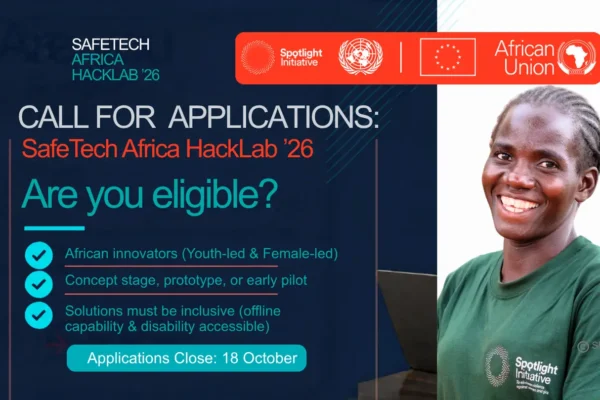
The SafeTech Africa HackLab 2026 also referred to as Spotlight Initiative SafeTech Africa HackLab ’26 is a targeted response. Led by UNFPA’s Eastern and Southern Africa and Western and Central Africa regional offices, in partnership with the Spotlight Initiative Africa Regional Programme (SIARP 2.0), the Global Programme to End Child Marriage (GPECM), the African Union Women, Gender and Youth Directorate (AU Innovation Lab), UNDP, UNICEF, and UN Women, the challenge seeks original, practical, youth-led innovations that make physical, informational, and digital spaces safer.
Officially launched at the African Union Innovation Festival ’26 (AU InnoFest ’26) in Addis Ababa under the theme “Vibrant Youth Ecosystems for AI & Digital Sovereignty,” the HackLab runs on a strategy of decentralised power and systemic shifting. It aims to equip local youth leadership to challenge power imbalances rather than simply treat symptoms.
Three Challenge Themes
Applicants must choose one theme:
Theme 1: Safe Physical & Community Spaces
Focuses on preventing and responding to child marriage, female genital mutilation (FGM), and community-based gender-based violence. Sub-Saharan Africa accounts for over 50 million child brides, and prevalence of intimate partner violence and other forms of GBV remains high in many countries. Examples of eligible innovations include mobile early-warning and referral systems (SMS/USSD/apps), school-retention tracking tools, interactive storytelling platforms that engage men, boys, traditional and religious leaders, and youth-led community safe-space networks.
Theme 2: Safe Informational Spaces
Addresses restricted access to accurate, age-appropriate comprehensive sexuality education (CSE) and sexual and reproductive health and rights (SRHR) information. High adolescent birth rates and disproportionate HIV acquisition among girls are linked to limited confidential information and services. Eligible ideas include youth-friendly chatbots or USSD engines, accessible digital learning hubs for out-of-school or rural youth and young people with disabilities, and encrypted peer-to-peer platforms for confidential service referrals.
Theme 3: Safe Digital Spaces
Tackles technology-facilitated violence, online harassment, anti-rights disinformation that normalises harmful practices, and digital censorship of legitimate SRHR and feminist content. Between 16% and 64% of young women experience some form of TF-VAWG. Solutions may include safety-by-design tools, browser extensions, encrypted reporting systems, algorithmic auditing and counter-narrative toolkits, privacy-preserving AI for detecting harassment or deepfakes, and decentralised publishing platforms for human-rights creators.
Who Can Apply
- Young African innovators, social entrepreneurs, and digital-rights advocates aged 18–35.
- Residents of Eastern, Southern, Western, and Central Africa.
- Individuals or teams of 2–5 members (teams strongly encouraged). A designated team lead serves as primary contact.
- Female-led ventures and teams with strong gender balance at least 50% female membership prioritised in some secondary guidance.
- Solutions at concept, early prototype, or early pilot stage are eligible.
- Strong preference for designs that work in low-bandwidth or intermittent-connectivity environments (USSD, SMS fallback, offline-capable progressive web apps, etc.) and that incorporate disability and digital-literacy accessibility.
Applicants retain full intellectual property. Solutions must comply with ethical AI, human-rights, data-privacy, and safeguarding standards (UNFPA provides relevant guidance documents).
What Winners Receive
Four winners will each receive seed capital grants ranging from USD 5,000 to USD 10,000. Beyond the funding, selected innovators enter a structured support pathway:
- Virtual mentorship using the UNFPA Social Innovation Toolkit.
- Pitch coaching.
- Live pitching opportunity at the YouthConnekt Africa Summit in Kigali, Rwanda 25–27 November 2026, one of the continent’s largest youth gatherings.
- Direct exposure to investors, venture funds, and continental development partners.
- Continental visibility through UNFPA, Spotlight Initiative, African Union, and other media channels.
Shortlisted finalists also participate in a virtual showcase ahead of the summit.
Evaluation Criteria (100 points total)
Applications are scored on:
- Problem–solution fit
- Innovation and originality
- Feasibility and viability (realistic 12-month roadmap)
- Inclusivity and disability accessibility
- Youth leadership (especially young women)
- Scalability and impact potential
- Safety, privacy, and ethics
How to Apply
Applications must be submitted online via the official Google Form linked on the Spotlight Initiative page with Link provided 👉 Here.
Required elements typically include:
1. Team details (ages, gender composition, nationalities, roles, contacts)
2. Selected theme
3. Problem statement (max ~200 words)
4. Innovation description (max ~700 words)
5. 12-month implementation roadmap with outputs and milestones
6. Digital safety and inclusion note covering safeguarding, data privacy, and accessibility
Official application link and focal contacts are available on the Spotlight Initiative event page. Contacts listed include representatives from UNFPA.
Deadline: 18 October 2026, 23:59 CAT.
Why This Matters
SafeTech Africa HackLab is more than a funding competition. It sits at the intersection of gender equality, digital rights, and youth-led innovation—three priorities that will shape Africa’s demographic and technological future. By prioritising low-connectivity solutions, disability inclusion, and community ownership, the programme aims to avoid the common trap of tech solutions that only work for urban, high-bandwidth users.
For young innovators already building tools that protect girls from harmful practices, deliver accurate health information, or make digital spaces safer, this is a rare opportunity to secure early capital, high-level visibility, and connections that can turn a promising prototype into a scalable intervention.
Applications close soon. If you or a team you know are working on relevant solutions, review the full call, prepare a clear problem–solution narrative, and submit before the 18 October deadline.
This is a time-sensitive opportunity. Prospective applicants should always cross-check the latest details on the official Spotlight Initiative page, as secondary aggregator sites occasionally contain slight variations in eligibility wording.