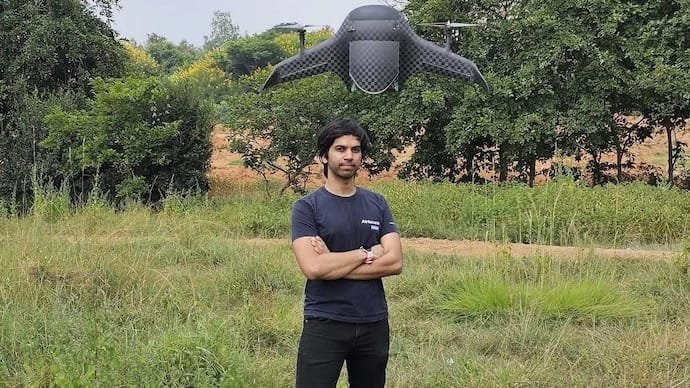
In 2020, as COVID-19 lockdowns closed schools across India, a 15-year-old named Naman Pushp sat at home looking for something to do. He had always liked building things like simple robots during his childhood years partly spent in Malaysia and turned to drones. What started as an open-ended experiment called Open Drone, entered into a hackathon for a $500 prize that he immediately reinvested, has grown into Airbound, a Bengaluru-based aerospace company that recently raised $37 million in Series A funding.
At 21, Pushp is founder and CEO of a startup that has raised nearly $50 million in total and is flying thousands of autonomous missions aimed at making aerial logistics competitive with trucking on cost.
From Boredom to First Prototype
Pushp was born in Mumbai and spent parts of his early years in Hyderabad and Malaysia before returning to India. He attended Dhirubhai Ambani International School in Mumbai. His interest in making things began early: in Classes 5 and 6 in Malaysia he built simple robots and later competed in robotics and engineering projects. By senior school he preferred learning by building over conventional classroom work.
During the pandemic lockdown he began experimenting with drones. There was no business plan at the start just curiosity and free time. He entered the Open Drone project in a hackathon, won $500, and used the money to build a more serious prototype. That early aircraft still hangs on the wall of Airbound’s office today.
He later received early support including a grant from the 1517 Fund, funding from GradCapital (while still a minor, so investors had to speak with his father), and other small checks. At 17 he received a term sheet from Lightspeed but waited until after his 18th birthday to sign. He completed Class 12, was admitted to Carnegie Mellon University, and chose not to attend, deciding instead to keep building.
Airbound itself was formally founded in 2023
The Technical Insight
Pushp’s core observation was straightforward: conventional aircraft (and many drones) spend a large share of their energy simply carrying their own weight. For small payloads this makes aerial delivery expensive compared with road transport. Airbound’s approach focuses on reversing that ratio—building aircraft that can weigh less than, or close to, the cargo they carry, while remaining efficient in cruise.
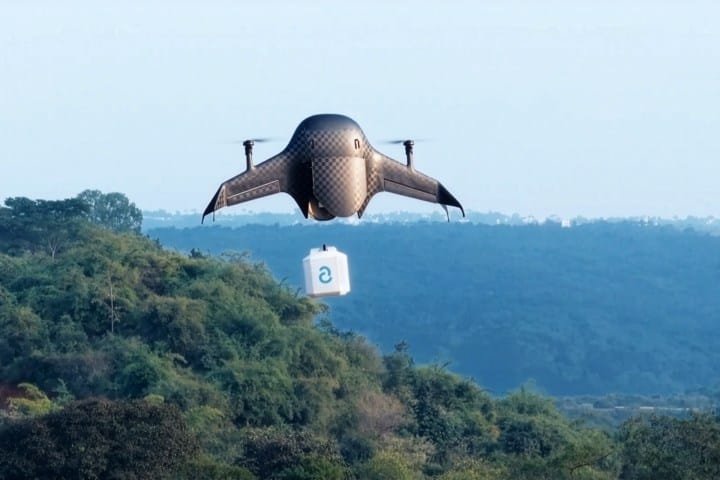
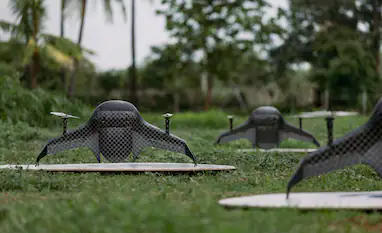
The company designs blended-wing-body tail-sitters. These take off and land vertically in an upright (rocket-like) orientation, then transition to efficient fixed-wing forward flight. The current TRT aircraft weighs about 1.5 kg and can carry roughly 1 kg of payload. A next version is targeted at higher payload capacity while remaining lightweight. The company uses carbon-fiber construction and keeps core airframe and systems work in-house at a facility in Bengaluru.
The longer-term goal is clear in Pushp’s public comments: achieve cost parity with trucking so that moving goods by air becomes the economical default for many use cases, not a premium option.
Real-World Progress and Funding
Airbound has completed more than 13,000 autonomous flights across Bengaluru and the Guntur region, including more than 1,000 for Narayana Health, one of India’s larger hospital networks. On one corridor the drones move diagnostic samples between a clinic and hospital in roughly seven minutes for a few kilometers which is far faster than the hours that can be required when samples wait to be batched for road transport. The partnership is expanding; a new Narayana facility was designed without an on-site diagnostic lab, relying instead on drone links to centralized facilities.
In August 2026 the company closed a $37 million Series A led by Greenoaks, with participation from DoorDash, Lachy Groom, Lightspeed, and Humba Ventures. This followed an $8.65 million seed round the previous year. The capital is earmarked for engineering, commercial-scale manufacturing, and go-to-market work.
Airbound has also signed an agreement with the Andhra Pradesh government to develop a three-city drone delivery network (connecting Amaravati, Vijayawada, and Guntur) with a long-term target of up to 10,000 daily flights supporting retail, e-commerce, and healthcare. The state is helping on regulatory and ground-observation frameworks; the commercial traffic is expected to come from private operators and customers.
The company still faces the usual constraints of the sector, particularly beyond-visual-line-of-sight approvals needed for true scale and remains focused on building capability rather than maximizing near-term revenue. Manufacturing capacity and regulatory progress are the key variables it is working through.
Naman Pushp’s path is unusual but instructive. A teenager with no formal aerospace degree, working from home during a pandemic, identified a physics and cost problem in logistics, iterated hardware, raised early capital while still in school, declined a prestigious university offer, and built a company that now employs a substantial team and flies real commercial-adjacent missions. The recent funding and the Andhra Pradesh network plans show investors and governments are taking the approach seriously.
India’s dense cities, traffic constraints, and growing healthcare and e-commerce volumes create a natural test bed for efficient aerial logistics. If Airbound and similar efforts can drive payload ratios, energy costs, and regulatory pathways far enough, the economics of short- and medium-haul goods movement could shift. The early drone that still hangs on the office wall is a reminder of how far a focused lockdown project can travel in six years.