On Saturday, 19 September 2026, a landmark procedure unfolded that few would have predicted just years earlier: a complex kidney cancer operation performed not with the surgeon standing at the patient’s bedside, but from hundreds of kilometres away.
A robot-assisted right radical nephrectomy the complete removal of a kidney affected by a cancerous tumour was carried out remotely. Professor Obi Ekwenna-Davis, a US-based professor of urology and transplantation and co-founder of RoboMed Global, sat at a Toumai robotic surgical console at Redeemer’s Health Village (RHV) in Mowe, Ogun State. The patient lay on an operating table at Nisa Premier Hospital in Abuja, roughly 500 kilometres distant. Real-time commands travelled across that distance via satellite and cellular networks, guiding robotic arms with the precision required for major cancer surgery.
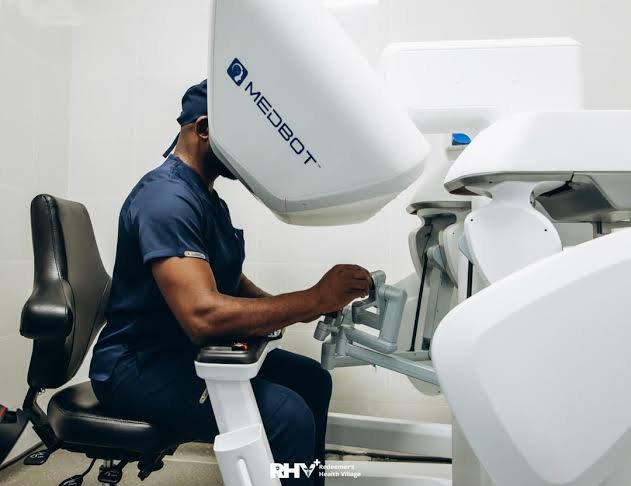
The operation lasted about three hours. Brief pauses allowed teams at both sites to verify that equipment and communication links remained stable. Afterward, the patient was reported to be in good condition and expected to leave hospital within 24 hours after given a recovery timeline consistent with the advantages of minimally invasive robotic techniques over traditional open surgery.
This was not autonomous robotic surgery. A highly experienced human surgeon controlled every movement. Medical teams remained present at both locations. The robot simply extended the surgeon’s hands and vision across geography that once made such collaboration impossible.
The platform used was the Toumai surgical robotic system, developed by Shanghai MicroPort MedBot. Toumai features multi-arm instrumentation, high-definition three-dimensional visualisation, tremor filtration, and the ability to operate over various network types, including 5G, fibre, broadband, and satellite. In this case, Starlink provided the primary connection, with MTN as backup. Redundancy mattered: any significant lag or drop in signal could compromise safety.
Telesurgery, also called tele-robotic or remote surgery, transmits the surgeon’s hand movements, instrument commands, and high-quality video of the surgical field in near real time. Latency must stay extremely low ideally under a few dozen milliseconds for the surgeon to feel in control. The Nigerian team demonstrated that, with careful preparation and dual connectivity, this threshold could be met across hundreds of kilometres of West African terrain.
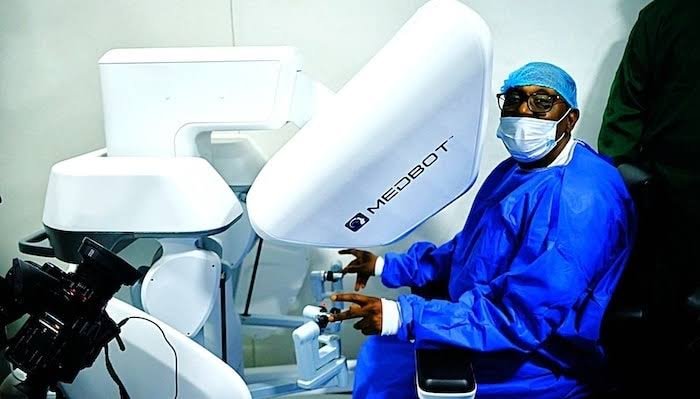
The procedure built on earlier local foundations. NAFDAC had previously approved the Toumai system for clinical use in Nigeria after procedures at Nisa Premier Hospital, making the country the first in West Africa to authorise such a platform. RHV itself had recently begun robotic-assisted cases at its Mowe facility, including prostate surgery, and had invested substantially around $4 million in systems, training, and capacity.
Professor Ekwenna-Davis framed the achievement clearly: “The procedure we did was a telesurgery procedure where we were able to operate on a patient in Abuja, 500 kilometres away.” He described it as a pilot and a demonstration of what becomes possible when technology, institutions, and diaspora expertise align. “Distance should never decide who receives safe surgery; this is what safe and trusted surgery looks like,” he said. He also noted the potential for Nigerian specialists abroad to contribute remotely without patients needing to travel for care.
Dr Adedamola Dada, chief executive of Redeemer’s Health Village, called it the first telesurgery in West Africa and emphasised the goal of reducing medical tourism while expanding access inside Nigeria. Ibrahim Wada, founder and CEO of Nisa Premier Hospital, highlighted the power of cross-institutional collaboration: two hospitals in different regions successfully delivering advanced surgical care together.
RHV is a 300-bed multispecialty hospital established by the Redeemed Christian Church of God. RoboMed Global, a US-based organisation with strong Nigerian diaspora leadership, has been introducing robotic surgery capacity in the country since late 2025, including training local teams.
Nigeria faces well-documented shortages of specialist surgeons. Many complex cases still prompt medical travel abroad, with the associated costs, delays, and logistical burdens. Tele-robotic surgery offers a different model: the patient stays closer to home and support networks, while expertise is delivered digitally. In principle, a specialist in Lagos, Abuja, or even overseas could assist or lead procedures in underserved areas, provided the necessary infrastructure exists at the patient site.
The Toumai system has already enabled long-distance telesurgeries elsewhere, including procedures spanning thousands of kilometres in other regions. Its presence in Nigeria, combined with successful local remote use, signals that the technology is no longer purely experimental on the continent. Earlier robotic work in places such as Angola had shown feasibility within Africa; the Ogun-to-Abuja case extends that proof to a full inter-city, multi-hospital collaboration in West Africa.
Beyond individual patient benefit, the event strengthens the case for building local ecosystems. Plans are already under way for a robotic surgery academy in partnership between RHV and RoboMed Global, with an ambition to train at least 150 surgeons within two years, alongside nurses, biomedical engineers, and support staff. Sustainable adoption depends as much on people who can operate, maintain, and troubleshoot the systems as on the machines themselves.
Although success on one day does not eliminate structural obstacles. Reliable high-bandwidth connectivity is essential. Weather can affect satellite performance, and terrestrial networks remain uneven. Consistent electricity supply, especially outside major urban centres, is a persistent Nigerian challenge.
Futhermore, Capital costs for robotic systems are high. Trained personnel are still scarce. Regulatory frameworks, liability questions, and data security for remote procedures will need ongoing attention.
Experts who spoke after the surgery stressed the need for government support in the form of scholarships, infrastructure investment, and policies that encourage private-sector innovation while protecting patients. Without parallel progress on power, broadband, and human capital, telesurgery risks remaining a capability limited to a handful of well-resourced facilities.
A Glimpse of What Comes Next
The September 2026 operation was deliberately described by its leaders as a test and a beginning rather than a finished programme. It proved that the technical links could hold, that teams in two cities could coordinate effectively, and that a major cancer operation could be completed safely under remote control. It also showed Nigerian institutions choosing to collaborate rather than compete in isolation.
If the planned training academy delivers on its targets, if connectivity continues to improve, and if more hospitals acquire compatible systems, the geography of specialist surgical care in Nigeria could shift meaningfully. Patients in secondary cities or regions short of urologists, oncologists, or other specialists might one day access expertise that currently requires travel to Lagos, Abuja, or overseas. Diaspora surgeons could participate more regularly without relocating.
None of this is automatic. Technology alone does not solve health-system problems. Yet the successful removal of a cancerous kidney across 500 kilometres stands as concrete evidence that the tools now exist. The question is how deliberately Nigeria and the wider region will invest in the infrastructure, skills, and partnerships required to turn a pioneering procedure into a routine option for those who need it.
For one patient in Abuja, the answer arrived in real time from Ogun State. For the country’s healthcare future, the implications are still unfolding.