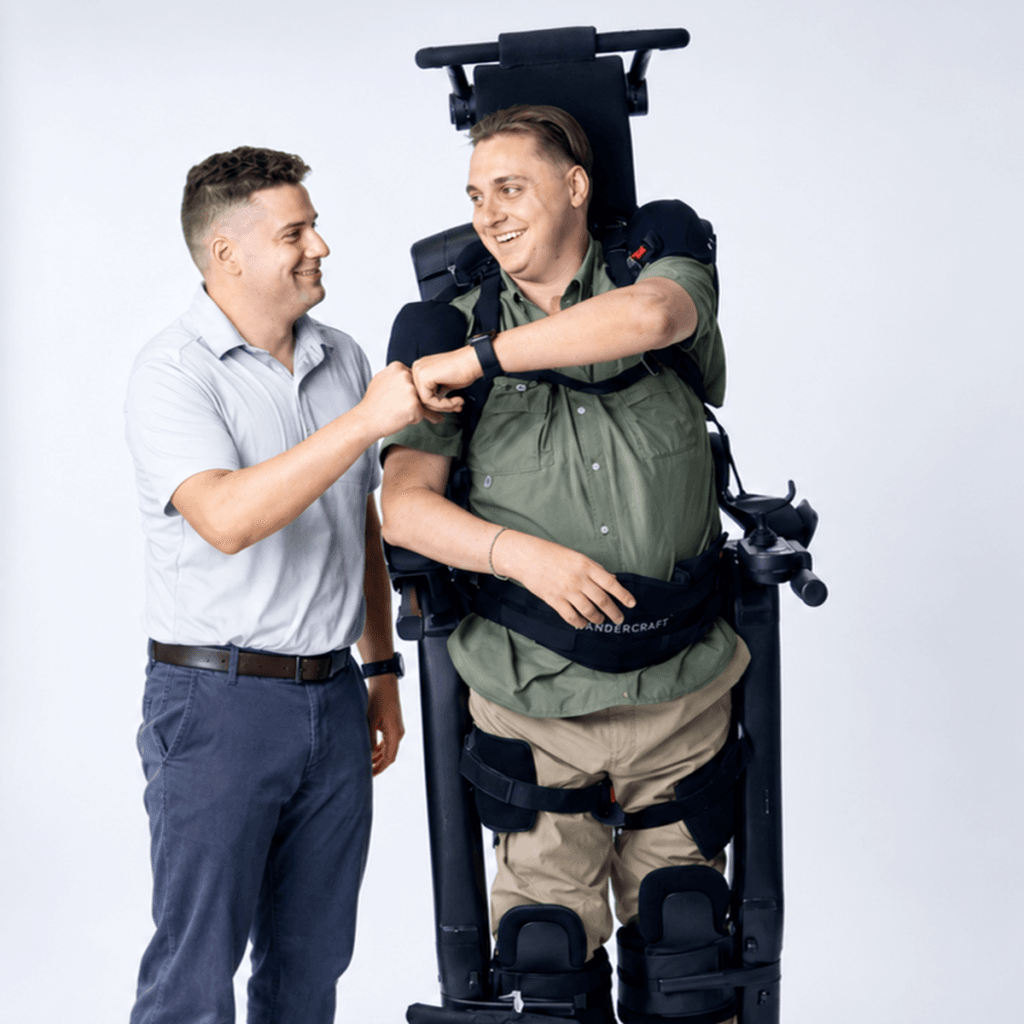
In a quiet but consequential moment for mobility technology, a Paris-based robotics company has brought something long promised into everyday American homes. On 17 September 2026, Wandercraft commercially launched Eve, the world’s first FDA-cleared self-balancing personal exoskeleton. Designed for eligible adults with spinal cord injury at any neurological level, Eve allows users to stand and walk upright without crutches or a walker, keeping their hands free for ordinary tasks—reaching for a cup, opening a door, preparing food, or simply holding a conversation at eye level.
For decades, powered lower-limb exoskeletons have offered glimpses of upright mobility. Most, however, required users to maintain balance with crutches or a walker. That requirement excluded many people with limited trunk control or upper-limb function and turned walking into a full-body effort rather than a practical daily option. Eve changes the equation. Its self-balancing system, driven by what the company calls physical AI, continuously stabilises the user so the hands remain available. The device is intended as a complement to a wheelchair, not a replacement but an additional choice for moments when upright posture matters.
From Clinic to Living Room
Wandercraft built Eve on years of experience with Atalante X, a self-balancing rehabilitation exoskeleton already used in more than 150 clinical and research centres worldwide. Atalante X demonstrated that dynamic balance control could enable hands-free standing and multi-directional stepping in supervised therapy settings. Eve takes that capability into the home and community.
FDA clearance (K260381) arrived in August 2026 after a three-site clinical study conducted at the Kessler Foundation, the James J. Peters VA Medical Center in the Bronx, and Wandercraft’s own Walk in New York centre. Participants with a range of spinal cord injury levels, together with trained companions, learned to operate the device and met functional and usability endpoints. Users reported improvements in health status, psychological well-being, endurance, lower-limb spasticity, and sitting balance. Some also noted better sleep quality and bladder and bowel function with secondary benefits often linked to regular upright activity and weight-bearing.
Critically, Eve carries no restriction based on the neurological level of injury. Eligibility centres on the ability to operate a handheld controller safely and the absence of contraindications listed in the user manual. Physical limits apply: users up to roughly 100 kg (220 lb) and 1.94 m (6 ft 4 in), within specific ranges for thigh length, leg length, pelvis width and joint mobility. A licensed clinician must prescribe the device after individual assessment.
How It Works in Practice
Once prescribed, Eve is custom-fitted and manufactured for the individual. The user and a companion complete a structured training programme. After certification, the device comes home. It is designed for level indoor surfaces and immediately adjacent outdoor areas such as patios or terraces, always under the supervision of the trained companion.
The self-balancing technology manages stability in real time. Users control direction and movement via a remote. Because the system handles balance, people without trunk control can still achieve upright posture and perform activities of daily living that previously required constant upper-body support. Tasks that once felt out of reach such as standing at a kitchen counter, brushing teeth at a sink, turning to speak face-to-face, become feasible.
Wandercraft has emphasised that the technology only matters when people can actually obtain and use it. The company has assembled an access pathway covering evaluation, fitting, training, reimbursement support, delivery and ongoing service. Medicare already classifies personal exoskeletons as custom-fitted orthoses under billing code K1007, providing a coverage route for eligible beneficiaries. Wandercraft is working to expand private-insurance reimbursement as well.
Why Hands-Free Matters
Upright mobility is not merely symbolic. Standing and walking, even for limited periods, can deliver physiological benefits: improved circulation, reduced pressure injuries, better bone density maintenance, and potential gains in bowel and bladder function. Psychologically, eye-level interaction and the ability to move through a room without a wheelchair can restore a sense of agency and social equality that many wheelchair users describe as profound.
Previous personal exoskeletons demanded that users sacrifice their hands to stay upright. Eve removes that trade-off. The difference is practical as much as emotional. A parent can stand and help a child with homework while holding a book. Someone can cook or clear a table without first transferring back to a chair. These are small actions that accumulate into larger changes in daily life.
Eve is not a cure, nor is it suitable for every person with spinal cord injury. It requires a companion, works best on level surfaces, and is currently limited to indoor and near-building outdoor environments. Cost, insurance coverage, and the logistics of training and maintenance will determine how widely it reaches those who could benefit. Access remains a central challenge for any advanced assistive technology.
Yet the regulatory milestone is genuine. By clearing a self-balancing device without injury-level restrictions and for personal rather than purely clinical use, the FDA has opened a new category. Other companies will likely follow, refining designs, expanding indications, and competing on usability and price. Wandercraft’s earlier work with Atalante X, including expanded clearances for higher-level injuries and multiple sclerosis in the rehabilitation setting, suggests a broader pipeline of self-balancing systems may emerge.
The launch of Eve marks a shift from clinic-bound demonstration to home-based possibility. For the first time, eligible wheelchair users can obtain an FDA-cleared device that lets them stand and walk while keeping their hands free for the ordinary business of living. That capability will not transform every aspect of disability, but it expands the range of choices available in daily life.
Technology of this kind succeeds only when it is reliable, accessible, and integrated into real environments. Wandercraft has invested in the supporting infrastructure including evaluation centres, training protocols, reimbursement navigation, and service networks because hardware alone is insufficient. Whether Eve becomes a widely adopted tool or remains a specialised option will depend on clinical outcomes in everyday use, payer decisions, and continued engineering refinement.
For now, a new option exists. Adults with spinal cord injury who meet the criteria can, after evaluation and training, bring a self-balancing exoskeleton into their homes. They can choose, for periods of the day, to be upright, mobile, and hands-free. In the long effort to expand independence and participation, that choice itself is meaningful.