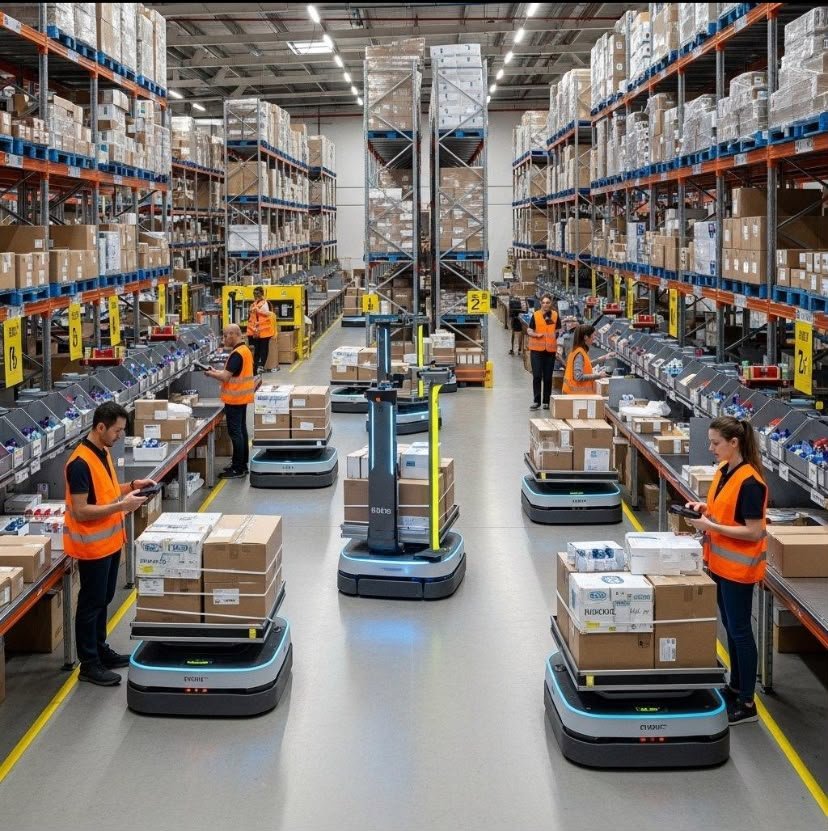
The next major shift in artificial intelligence may not happen on a computer screen. It may happen on a factory floor, inside a warehouse, in a hospital, or in a workplace where machines can physically carry out tasks that once required human hands.
The goal is ambitious: make it easier and faster for developers to build intelligent robots, train them in virtual environments and transfer those capabilities into physical machines operating in the real world.
This is important because the robotics industry has been working toward a difficult objective for years: creating robots that can do more than repeat a single programmed movement.
The longerterm ambition is to develop machines that can perceive their surroundings, learn different skills, adapt to unfamiliar situations and perform useful tasks across multiple environments.
NVIDIA’s latest announcement is a significant step in building the technology infrastructure needed to pursue that goal. However, it is important to distinguish between a promising development platform and a robot that is already ready for widespread commercial deployment.
1. What exactly did NVIDIA announce?
NVIDIA’s announcement is not simply about introducing another humanoid robot. It is about bringing more of the development process together in one connected system. Historically, a robotics team might need to assemble separate tools for creating simulated environments, generating training data, teaching a robot new movements, testing its behaviour and deploying its software onto physical hardware.
Integrating these components can take considerable time and engineering expertise. NVIDIA is expanding its Isaac ecosystem to help developers connect these stages more efficiently.
The announcement includes four particularly important areas:
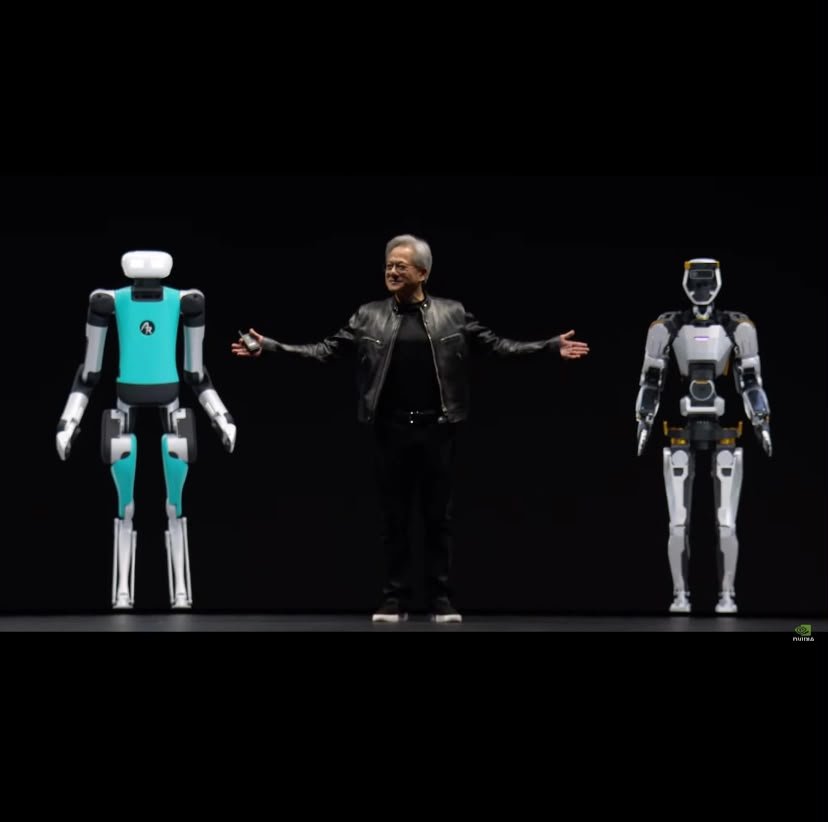
Agile ONE SN: A humanoid reference platform designed for robotics research and development.
Isaac Lab 3.0: An open-source framework for training and refining robot behaviours using simulation and reinforcement learning.
Isaac OS: A software runtime designed to connect AI systems, sensors, controls and robot hardware.
New datasets and simulation assets: Resources intended to help developers create training environments and teach robots a broader range of tasks.
NVIDIA also introduced reference workflows for generating synthetic data, training robot skills and evaluating AI models. Together, these additions are intended to shorten the journey from experimentation to physical deployment.
The business significance is straightforward: if robotics developers can spend less time connecting complicated tools and more time improving robot capabilities, they may be able to test ideas faster and reduce some of the engineering barriers to commercial adoption. That does not automatically make robots inexpensive or eliminate deployment challenges. It does, however, address one of the practical bottlenecks in robotics development.
2. Meet Agile ONE SN
The humanoid platform at the centre of the announcement One of the most notable developments is Agile ONE SN, introduced by Agile Robots as a fullstack reference humanoid built around NVIDIA’s robotics technologies. According to NVIDIA’s official announcement, the platform is designed to arrive preconfigured with Isaac GR00T and powered by NVIDIA Jetson Thor, bringing hardware and key software components together for developers and researchers. Its planned availability is early 2027. Here is what makes the machine interesting.
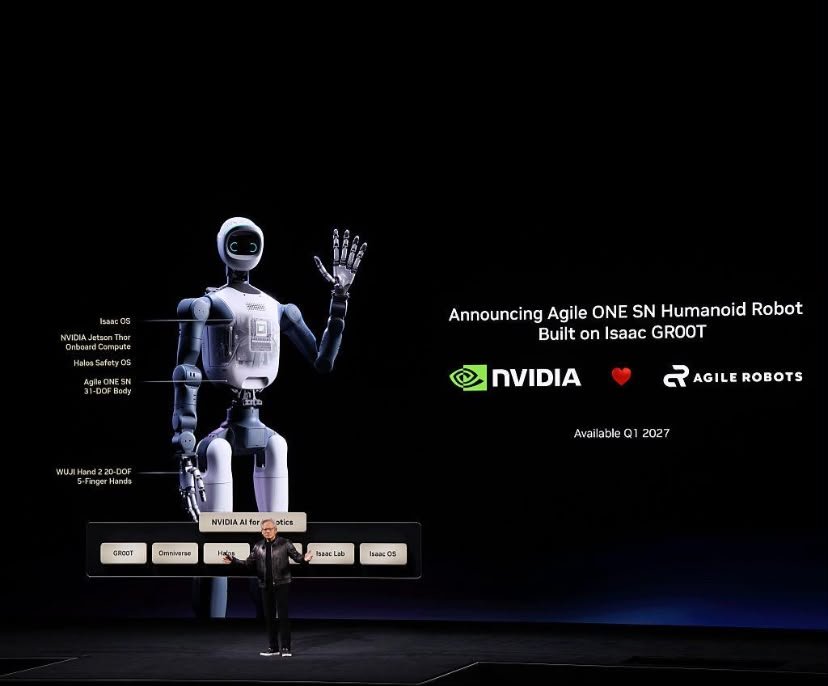
1.40 metres tall Approximately 4.59 feet The robot is designed with a human-like body structure for research into movement and manipulation.
40 kilograms Approximately 88 pounds Its relatively compact body is intended for humanoid robotics research and development.
31 degrees of freedom The robot’s body has multiple independently controllable movement axes, allowing researchers to develop coordinated movements.
Two five-finger hands Each WUJI Hand 2 has 20 degrees of freedom, tactile sensing and force control designed for delicate manipulation.
Jetson Thor computing NVIDIA specifies 128GB of unified memory and up to 2,070 FP4 teraflops of compute performance for the onboard platform.
Specifications from NVIDIA’s October 21, 2026 announcement. Computing performance figures refer to the stated FP4 format and should not be interpreted as equivalent performance across every AI workload.
The robot also uses cameras, lidar and inertial measurement sensors to gather information about its surroundings and physical movement.
Why do these features matter?
A robot needs more than a powerful AI model to function effectively. It needs to perceive objects, understand where its body is in space, control its movements and respond to what happens around it.
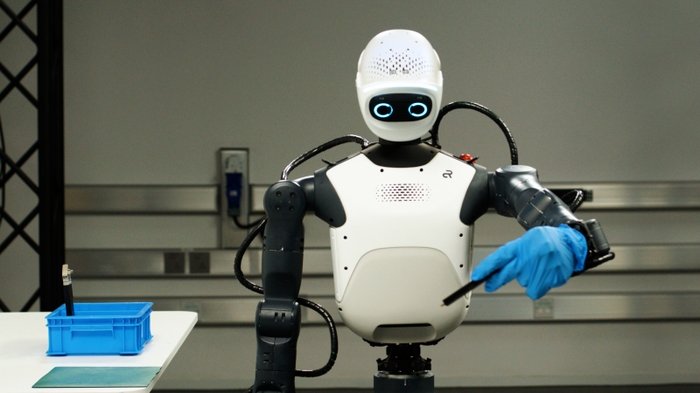
For example, picking up a fragile object requires a robot to locate it, estimate how to reach it, position its fingers, apply suitable force and adjust if the object begins to slip. These are connected perception, reasoning and control challenges.
The combination of a humanoid body, dexterous hands, sensors and onboard computing gives researchers a platform on which to develop and test those capabilities.
An important distinction: Agile ONE SN is a reference platform for research and development, not proof that a fully autonomous humanoid can already perform every ordinary workplace task reliably. Its announced availability is planned for early 2027, and actual performance will depend on the capabilities developers successfully build and validate.
3. The real breakthrough: Teaching robots through simulation
The humanoid itself is only part of the story. Some of the most consequential developments are happening in the software used to train robots. To understand why, imagine a company wants to teach a robot to sort packages in a warehouse.
The company could attempt to teach the robot directly in the physical warehouse. But every failed movement could consume time, interrupt operations, damage products or create safety risks. Testing thousands of variations in a real environment can become expensive. Simulation offers another route.

Developers can create a virtual environment in which a robot learns how to move, reach for objects, navigate obstacles and respond to different conditions. They can run experiments, evaluate failures and improve the robot’s behaviour before transferring the resulting skills to physical hardware.
This process is often described as sim-to-real: developing and testing capabilities in simulation, then adapting and validating them on a real robot. NVIDIA’s expanded Isaac platform is designed to make this workflow more accessible.
What Isaac Lab 3.0 brings to the table
Isaac Lab 3.0 is an open-source framework for robot learning. It supports workflows for training and refining robot policies using simulation, including reinforcement learning and multi-GPU computing.
In practical terms, developers can train a robot to perform a task, measure its performance, adjust its learning process and repeat the experiment at scale. NVIDIA also announced a SimReady Central Library containing more than 2,000 simulation-ready robotics and factory assets.
These assets can help developers build virtual environments without having to construct every component from scratch. Consider a manufacturing company that wants to automate the movement of components between workstations. It could use simulated factory layouts to test navigation, object handling and workflow coordination before committing to a physical installation.
Simulation does not eliminate the need for real-world testing. Physical robots still encounter unpredictable friction, lighting, object deformation, sensor noise and environmental conditions that may not be perfectly represented in a virtual environment. But better simulation can help teams identify more problems earlier, reduce unnecessary physical trials and accelerate development. That is where the commercial opportunity begins to emerge.
4. Human 1M: Why training data matters for robotics
Another important component of NVIDIA’s announcement is the Human 1M Dataset, which includes diverse human activities, synchronised video from three viewpoints and 3D handtracking information.
The dataset is intended to support research into how robots learn and reproduce physical skills. NVIDIA says the dataset is available through Hugging Face, with access to the full dataset provided to Cosmos Coalition partners.
Why Would Robots need Data Showing Humans Performing Activities?
Think about a person learning to prepare a meal, organise a shelf or handle a tool. Humans draw on years of observing other people, practising movements and adjusting their actions in response to feedback. Robots need their own methods for learning these skills.
Human demonstrations can provide useful information about how tasks are performed, while simulation, robot-specific training and physical testing help turn that information into executable behaviour. However, observing a human perform a task does not automatically teach a robot how to perform it.
Human anatomy, balance, hand structure and movement differ from those of a robot. The data must be processed and used within suitable learning systems. The larger point is that robotics progress depends on more than better hardware. It also depends on access to useful data, learning algorithms, computing infrastructure and effective methods for testing what a robot has learned. NVIDIA is working across these layers simultaneously.
5. Isaac OS: Connecting artificial intelligence to physical machines
Training an AI model is one challenge. Getting that model to operate a physical robot reliably is another. A robot must process information from its sensors, make decisions, coordinate its motors and respond to changing conditions.
Those activities need to work together within the timing and reliability constraints of the hardware. NVIDIA introduced Isaac OS, an open-source runtime framework built on NVIDIA Holoscan, to connect AI, sensors, controls and robot hardware for real-time operation. In simple terms, Isaac Lab helps developers train robot behaviours, while Isaac OS helps connect AI capabilities to the systems that operate the robot.
This distinction matters because a robot that performs well in a demonstration may struggle in a changing physical environment. Its software must handle timing, sensor inputs, communication and control while remaining responsive to events.
NVIDIA also highlighted its Halos safety platform, which is intended to support safer development and deployment of autonomous systems as Agile ONE SN is planned to integrate the Halos safety stack.
Safety remains a critical requirement. Industrial robots and humanoids operating near people must be assessed for foreseeable hazards, mechanical failures, unexpected movements and other risks. A safety platform can support that work, but it does not by itself certify a robot as safe for every environment.
For businesses, the message is that useful robotics requires a complete system, not merely an intelligent machine.
6. What Does This Mean for Businesses?
The biggest question for business leaders is not whether humanoid robots look impressive. It is whether they can perform useful work safely, consistently and at a cost that makes commercial sense. NVIDIA’s announcement points towards several areas worth watching.
Manufacturing Robots could eventually support repetitive material handling, component movement, inspection and selected assembly activities.
Humanoid designs are particularly interesting where workplaces were built around human-sized tools and workstations, although specialised industrial robots may remain better suited to many fixed tasks.
Warehousing and logistics Businesses could investigate robots for picking, sorting, transporting and replenishing goods. The practical challenge is handling different objects, unpredictable layouts and changing demands without compromising safety or throughput.
Hospitality and facilities Robots may eventually assist with transporting supplies, moving items between rooms and carrying out selected routine tasks. Adoption will depend on navigation, reliability, maintenance and how well the machines operate around guests and staff.
Inspection and hazardous environments Robotics can help reduce human exposure to certain dangerous or repetitive tasks. But high-risk applications demand rigorous validation, emergency procedures and appropriate human oversight.
These are potential application areas, not a claim that Agile ONE SN has already been deployed commercially across these sectors. The immediate opportunity for many companies is to assess where automation could solve a measurable operational problem.
A business should begin with questions such as: Which repetitive tasks consume the most employee time? Where do errors, delays or labour shortages affect productivity? Could existing specialised automation solve the problem more economically than a humanoid? What would a robot need to achieve to justify its purchase, integration and maintenance costs? How would staff training, safety and accountability be handled?
These questions turn the robotics conversation from technology excitement into business strategy.
7. Could Humanoid Robots change employment?
This is one of the most important questions surrounding the development of physical AI.
If robots become capable of carrying out more physical tasks, some businesses may need fewer hours of human labour for particular activities. Other roles may change as workers supervise robots, maintain equipment, manage exceptions or coordinate automated operations.
The outcome will not be uniform across industries, occupations or countries. Some tasks are repetitive and structured. Others require human judgement, trust, negotiation, creativity, empathy or the ability to handle complex and unpredictable situations. Even when a robot can technically perform a task, it may not be economically viable to use one.
There are also practical limitations: purchase costs, maintenance, power consumption, reliability, safety requirements and the difficulty of integrating machines into existing operations.
The more realistic expectation is that automation will reshape some jobs and workflows before it replaces entire occupations. For employees, the implication is not that everyone must become a robotics engineer. It is that understanding how AI and automation affect one’s industry is becoming a valuable career skill.
For business owners, preparing for this shift means investing in digital literacy, process improvement and employee development alongside any automation strategy.
The companies most likely to benefit will be those that understand both what machines can do and where human expertise remains essential.
8. The Opportunity for Africa and Nigeria
For African businesses and technology professionals, developments like this deserve attention for a reason beyond the excitement around humanoid machines. Robotics creates opportunities across an entire ecosystem.
Not every opportunity requires manufacturing a robot from scratch. Potential areas include:
Software and AI development: Building applications, developing robot behaviours and adapting models to specific tasks.
Simulation and digital twins: Creating virtual environments that help companies test factories, warehouses and automated processes.
Data and technical services: Supporting data preparation, evaluation, documentation and testing, subject to the relevant technical requirements.
Systems integration: Connecting robotic equipment with inventory platforms, enterprise software and existing business processes.
Maintenance and operations: Developing the technical capacity to install, monitor, troubleshoot and maintain automated equipment.
Training and consulting: Helping organisations assess automation readiness, redesign workflows and prepare employees for new technologies.
These are possible areas of opportunity, not guarantees of immediate demand or employment because each requires relevant skills, access to suitable tools and evidence that a service solves a real customer problem.
There are also challenges that businesses in emerging markets must consider, including the cost of importing hardware, access to reliable power and connectivity, technical support, financing and the availability of locally relevant training. This makes strategic positioning important.
A Nigerian entrepreneur does not necessarily need to start a humanoid robot company to participate in the robotics economy.
A software developer might build tools for industrial automation.
A consultant might help a manufacturer identify processes suitable for automation.
A training organisation might prepare technicians to work with emerging systems.
The opportunity is to understand the wider ecosystem and identify a practical entry point.
9. NVIDIA’s Bigger Strategy: Building the Infrastructure for Physical AI
NVIDIA is widely associated with the computing hardware used to train and run AI models. Its robotics announcements illustrate how the company is extending that technology into systems that interact with the physical world. The Isaac platform connects several parts of the robotics development process:
Technology & Primary purpose
1. Isaac GR00T Foundation models and workflows for humanoid robot learning.
2. Isaac Lab 3.0 Training and refining robot behaviours Isaac OS Connecting AI, sensors, controls and robot hardware.
3. SimReady Central Library Providing simulation-ready robotics and factory assets.
4. Human 1M Dataset Supporting research using human activity and hand-tracking data.
5. Jetson Thor Onboard computing for demanding robotics and physical AI workloads.
6. NVIDIA Halos Supporting safety development for autonomous systems.
This integrated approach could make NVIDIA’s ecosystem more attractive to developers and robotics companies that want to build on existing infrastructure rather than develop every component independently.
It also creates a broader strategic opportunity for NVIDIA: as more robotics companies adopt its computing systems, software tools and development workflows, the company’s technology can become part of the foundation on which other businesses build products.
However, the ecosystem still faces competition, and the success of individual robotics applications will depend on performance, cost, developer adoption and the ability to solve real operational problems.
NVIDIA’s ambition is clear. The commercial outcome remains something the industry must demonstrate.
10. What Happens Next?
The next major milestone for Agile ONE SN is its planned availability in early 2027. NVIDIA’s announcement also indicates that research institutions, including Stanford University and ETH Zurich, have expressed interest in the platform.
The developments worth monitoring over the coming months include: Actual hardware availability: Whether the reference platform becomes available on the announced timeline and on what commercial terms.
Demonstrated capabilities: Whether researchers can show reliable performance on useful manipulation and movement tasks.
Sim-to-real results: How well skills trained in simulation transfer to real-world environments.
Commercial pilots: Whether companies can demonstrate measurable improvements in productivity, safety or operating costs.
Safety and reliability: How developers address failures, unpredictable environments and operation around people.
Cost and scalability: Whether the total cost of deploying and maintaining humanoid systems makes sense for real businesses.
These are more useful indicators of progress than a launch video alone. The long-term question is not simply whether a robot can walk, wave or pick up an object. It is whether it can complete a valuable task repeatedly, safely and economically in an environment where real businesses depend on the result.
Final thoughts
The future of AI may be physical For years, much of the AI conversation has focused on what machines can do with information: write, analyse, generate images, answer questions and automate digital workflows. Robotics introduces another dimension. AI systems are increasingly being developed to interact with objects, navigate physical environments and perform actions in the real world.
NVIDIA’s October 21 announcement is significant because it addresses the infrastructure needed to make that transition possible.
The combination of robot-learning frameworks, simulation assets, datasets, runtime software and a reference humanoid offers developers a more connected starting point. But there is still a considerable distance between a promising research platform and widespread, dependable commercial use.
The real test will be what developers and businesses build with these tools, how reliably those systems perform and whether they create measurable value.
For entrepreneurs, professionals and organisations, the best response is neither to dismiss robotics as a distant possibility nor to assume that every workplace will soon be filled with humanoids. It is to pay attention, understand the technology and begin identifying where it could realistically change the way work gets done.
The next phase of AI is not only about making machines think. It is about teaching them to act, and proving that those actions are useful in the real world.
Editorial note: This article distinguishes between NVIDIA’s announced capabilities and future commercial possibilities. Agile ONE SN is planned for early 2027; widespread commercial deployment and the business outcomes discussed above are not guaranteed.