The Mozilla Foundation has opened applications for its 2027–2028 Fellowship cohort, offering up to 10 highly competitive fellowships to builders, founders, technologists, researchers, and creative advocates working on technology that is too early, too unexpected, or too ambitious for conventional funders.
Since 2011, the program has supported more than 200 mission-driven Fellows across 37 countries. Nearly 30% of alumni have founded an organization, and about 20% currently run one. The Fellowship provides time, funding, credibility, and a global network so that Fellows can ship real alternatives to extractive tech defaults and become the people the field turns to when better options are needed.
What the Fellowship Offers
Fellows receive up to $125,000 over 12 months beginning June 1, 2027, plus access to Mozilla Foundation support and a network of more than 200 previous Fellows. The opportunity is remote and designed for individuals. Key moments of travel are covered. Fellows are not expected to devote 100% of their time to the project, but they must complete the work and meet program expectations.
There are two tracks:
- Track I: Embedded Fellows — $100,000 total ($75,000 stipend + $25,000 project budget). These Fellows work in collaboration with a host civil-society organization that provides mentorship and community context. Hosts for this cycle include BASAibu (Indonesia), Fundación Kamanau (Chile), LAS Art Foundation (Germany), Quantum Village (United States), and the Slum & Rural Health Initiative (Nigeria).
- Track II: Independent Fellows — $125,000 total ($100,000 stipend + $25,000 project budget). These Fellows pursue their most ambitious idea independently, turning vision into working systems, platforms, tools, or other innovations.
One Independent Fellowship slot is reserved for Creative Advocacy — a culture jammer, artist-provocateur, or prankster who can turn a stunt into a movement that makes people rethink who technology is built for.
Focus Areas for 2027–2028
Mozilla is seeking work that reimagines emerging technology while its rules are still being written. Priority areas include:
- Neurotech, biotech, and physical AI (ensuring communities own, shape, and govern intimate technologies that touch brains, bodies, and land)
- Hard infrastructure: compute, energy, quantum, and the extremes (opening closed systems in orbit, data centers, quantum machines, and more)
- Raising p(bloom) (building AI that improves life for far more people and challenging gatekeeping that travels under the banner of “safety”)
- Business models for a post-agentic web (new deals so creators, communities, and the open web still get paid when agents and paywalls reshape the old attention bargain)
- Shared security and audit infrastructure for small organizations (making serious security and auditing affordable, like a public library rather than a pricey consultancy)
- Sovereign AI, public infrastructure, and maintenance (tools and systems communities can own, run, and keep running long after any single company disappears)
- Creative Advocacy (one dedicated Independent slot)
- Wildcards (strong ideas that do not fit the list above)
Across all areas, Mozilla evaluates proposals against three questions: Does the work put people in control (agency)? Does it cultivate open infrastructure (commons)? Can it change how markets work (economic conditions)?
Who Should Apply
Mozilla looks for builders at two career stages: people who have already shipped meaningful work but are not yet widely known beyond their field, and recognized leaders ready for field-defining projects. Ideal candidates are trailblazing, rigorous, and community-driven. The strongest applications point to something concrete that reviewers can open a repository, demo, dataset, deployment, paper, or performance and explain who uses it and how the applicant knows.
Projects must serve a charitable purpose and create meaningful public benefit. Applicants must be legally able to receive grant funds from the Mozilla Foundation. Applications are accepted in English (translation tools are welcome; ideas matter more than polished language). The program supports individuals; team structures are generally not the primary vehicle.
Anyone may apply directly. Nominations are also welcome; nominees who meet eligibility criteria will be invited to submit a Letter of Intent.
Application Process and Key Dates
Selection is multi-stage. The primary filter is the Letter of Intent; only a small number of applicants are invited to submit a full application.
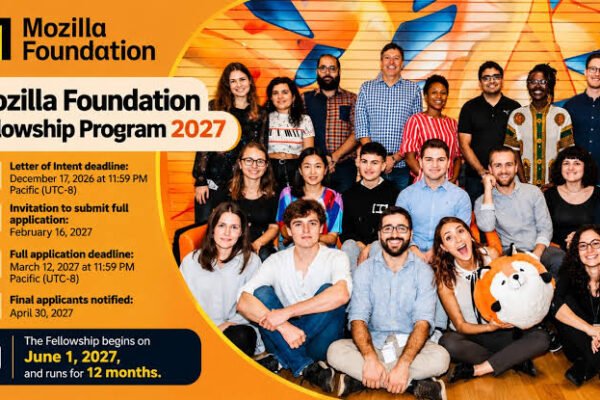
- Letter of Intent deadline: December 17, 2026, at 11:59 PM Pacific (UTC-8)
- Invitations to submit full applications: February 16, 2027
- Full application deadline: March 12, 2027, at 11:59 PM Pacific (UTC-8)
- Final applicants notified: April 30, 2027
- Fellowship begins: June 1, 2027 (12 months)
Before applying, review the full Request for Proposals (RFP) for detailed guidance on focus areas, host organizations, and expectations. Submit the Letter of Intent via the official portal.
Why This Matters
Mozilla’s Fellowship program has a track record of backing people who later shape policy conversations, found durable organizations, and create tools that communities actually use. Recent examples include privacy-first AI for courts that joined Y Combinator as a nonprofit, open-source quantum tooling influencing European Commission discussions, permissioned posts for community-governed online spaces, and systems that let Indigenous communities own and license movement data for embodied AI.
In a moment when many emerging technologies are being shaped behind closed doors, the Fellowship deliberately funds the builders who put control, openness, and public benefit first. If your work questions who gets to decide the shape of the next decade of technology and you are ready to ship something real, this is a rare window of support.
Applications are open now. The Letter of Intent deadline is December 17, 2026. Full details, the RFP, host organization briefs, FAQs, and the application portal are available on the Mozilla Foundation website.