

Dubai Civil Defence has unveiled and deployed an advanced robotic firefighting system to address high-risk fires and emergencies in environments too hazardous for human responders, such as those involving toxic gases, chemical spills, extreme heat, or unstable structures.
Key Takeaways:
• Dubai Ministry of Civil Defence create a Robot For Fighting Fire Emergencies
• Built with high quality sensors, it navigates complex spaces like high-rise buildings, warehouses, tunnels, factories, and industrial sites.
• The Fire Fighting Robot has already been deployed in Fire Emergencies proving to be a safer and effective option for Fire Emergencies
This remotely operated technology enhances firefighter safety while accelerating response times and improving overall effectiveness in crisis situations.
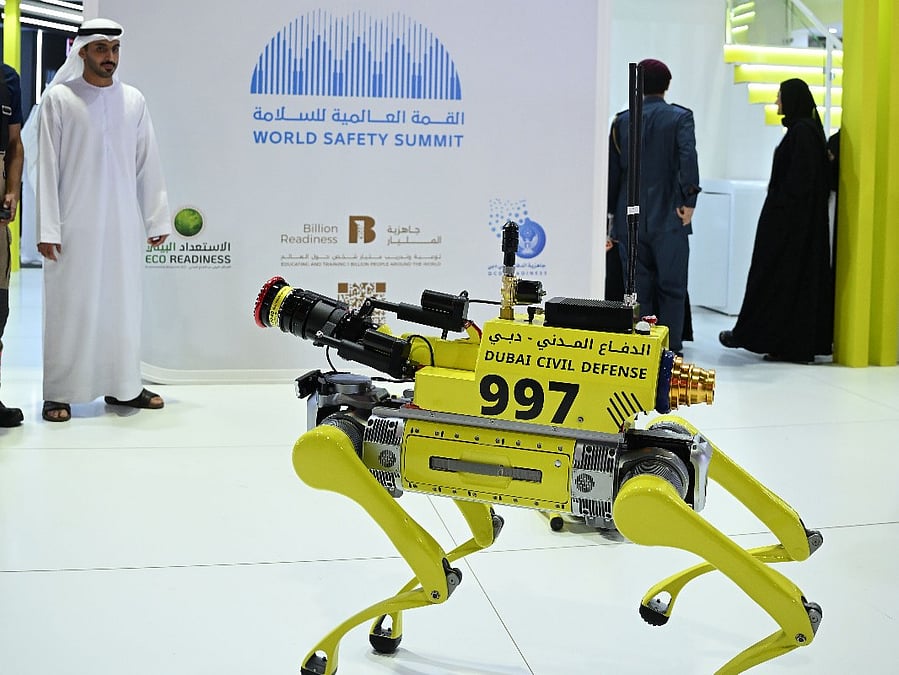
Photo Credit: Fire Fighting Robot – Gulfnews.com
The robot features state-of-the-art sensors that detect heat sources, gases, leaks, and other threats, combined with powerful water cannons capable of discharging up to 2,400 litres (about 634 gallons) of water per minute equivalent to 40 litres per second at distances reaching 60 metres (196 feet).
Built with fire and water-resistant batteries, self-cooling mechanisms, and rugged construction that withstands high hose pressures (up to 8 bar) and pulling forces of 200 kg, it navigates complex spaces like high-rise buildings, warehouses, tunnels, factories, and industrial sites. Variants include four-legged “robot dog” models (such as the B2W or D2W) that support water or foam payloads and can operate via remote control or AI-guided heat targeting for up to three hours on a single charge.
The system, which includes smaller reconnaissance units like the “First Explorer” for pre-entry assessments and live video transmission, was prominently showcased at Intersec 2026 alongside complementary innovations such as extended-endurance drones.
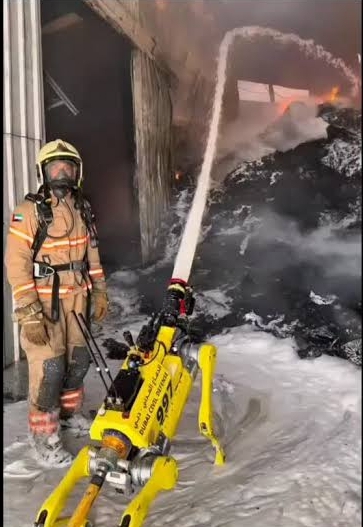
It has already seen real-world use, including during a warehouse fire in Dubai’s Ras Al Khor Industrial Area earlier this year, where it assisted in suppression and cooling while minimizing human exposure to smoke and hazards.
Dubai Fire Fighting Robot Deployed at a ware house fire incident Photo Credit: Arenar Intel
This rollout reflects Dubai’s broader strategy to integrate robotics, AI, and smart automation into emergency services and part of a citywide push that also includes self-driving police patrol robots prioritizing human protection and operational precision.
Officials emphasize that these tools reduce risks from toxic environments, cut potential casualties, and position the emirate as a global leader in futuristic public safety solutions.
Modern Robots Fighting Fires and Saving Lives:
The Rise of Robotic Heroes in Emergency Response When flames rage out of control or disaster strikes, the first responders on the scene often face extreme danger. Today, they’re getting powerful allies: modern firefighting and emergency robots.
These machines enter burning buildings, navigate toxic smoke, climb rubble, and suppress fires all while keeping human lives out of harm’s way. From tracked behemoths that blast thousands of gallons of water per minute to agile quadruped “robot dogs” that scout ahead, robotic technology is transforming emergency services.
The global firefighting robot market is booming as AI, thermal imaging, and autonomous navigation improve.
Why Robots Are Essential in Firefighting and Emergencies
Traditional firefighting exposes personnel to extreme heat (up to 1,000°C+), collapsing structures, toxic gases, and zero-visibility smoke. Robots solve this by:
- Entering hazardous zones first for reconnaissance.
- Providing real-time data via thermal cameras, gas sensors, and HD video.
- Suppressing fires with high-pressure water or foam cannons.
- Carrying equipment, transporting victims, or even performing basic rescue tasks.
Standout Modern Firefighting Robots
Here are some of the most advanced systems in use or deployment as of 2026:
- Colossus (Shark Robotics, France)
This rugged, tracked robot gained fame during the 2019 Notre-Dame Cathedral fire in Paris, where it helped tow heavy hoses and suppress flames in areas too dangerous for humans. Weighing around 500–1,100 pounds, Colossus is modular — it can switch attachments in under 30 seconds for tasks like hauling equipment, carrying stretchers for victims, or detecting hotspots with 360° thermal cameras. It blasts up to 660+ gallons of water per minute and is fireproof, waterproof, and radiation-resistant. It’s now trusted by elite brigades in France and deployed worldwide.
- Hyundai Unmanned Firefighting Robot
Unveiled in early 2026, this South Korean robot is engineered for extreme heat (up to 1,472°F / 800°C) and hazardous environments. It operates remotely or with high autonomy to perform fire suppression and human rescue before crews enter. Hyundai positions it as part of a “safer way home” for everyone, with deployments already planned for regional rescue units. - Thermite RS Series (Howe & Howe, USA)
These diesel-powered, tank-tread robots tackle industrial fires, oil refinery blazes, HAZMAT incidents, and boiling liquid expanding vapor explosions (BLEVEs). They climb steep slopes (up to 70°), deliver massive water/foam output (up to 2,500 gallons per minute), and navigate rough terrain where humans can’t go safely. - Quadruped Robots (“Robot Dogs”) — Unitree B2, DEEP Robotics X30/Lynx, and others
Four-legged designs excel in stairs, rubble, and confined spaces. AI-powered models use thermal imaging and sensors to detect victims, map environments, deliver supplies, or spray water/foam from a distance (some reach 60 meters). They’re ideal for search-and-rescue in collapsed buildings, wildfires, or toxic zones. Chinese and U.S. teams have demonstrated them scouting danger and streaming live data to commanders. - Emerging AI-Driven Systems
- Widemount Dynamics Smart Firefighting Robot (CES 2026 Innovation Award): Uses mm-wave radar SLAM for navigation in dense smoke without GPS, bringing higher autonomy.
- Hong Kong’s small tank robot: Leverages radar and AI to detect flames and operate in zero-visibility conditions.
- Dragon Firefighter (Japan): A flying hose-like robot that uses water jets and thermal cameras for inaccessible fires.
- Rosenbauer RTE: A compact, modular robot for tactical emergency response.
Drones also complement ground robots by providing aerial overviews, dropping retardants in wildfires, or delivering medical supplies.
Key Technologies Powering These Robots
- Thermal Imaging & Sensors: Spot heat signatures, victims, or gas leaks through smoke.
- AI and Autonomy: Enable independent navigation, hotspot detection, and even multi-robot coordination (e.g., teams splitting tasks).
- Rugged Mobility: Tracks, wheels, or legs for stairs, debris, and uneven terrain.
- Remote Operation with Safeguards: Joystick or tablet control, with fail-safes for loss of signal.
- Modularity: Quick-swap tools for firefighting, rescue, hazmat, or reconnaissance.
Real-World Impact and Future Outlook
Robots have already proven their worth in Notre-Dame, industrial incidents, tunnel fires, and disaster zones. Fire departments in France, the U.S., China, and beyond report fewer injuries and faster containment. In search-and-rescue, quadrupeds and drones cut critical response times in earthquakes, floods, or building collapses.
Challenges remain: high costs, operator training, battery life in extreme heat, and integration with human teams. However, as AI advances and prices drop, adoption is accelerating from urban fire stations to industrial sites and wildland firefighting.
The future? Swarms of collaborative robots, fully autonomous systems that predict fire spread, and humanoid variants for more dexterous tasks. Experts emphasize: robots won’t replace firefighters but will make their dangerous jobs significantly safer by reducing injuries and fatalities while speeding up response times.
Disclaimer
This post is only meant for Educational purposes. It is not by anyway intended for purchase or sale of any Product, Machine or Device.




Leave a Reply