

In the bustling city of Suzhou, a quiet revolution is unfolding inside ordinary apartments. Early in the morning, curtains part automatically as a compact, wheeled figure glides into the bedroom. It gently announces the time, prepares a fresh breakfast of eggs, toast, and a simple salad, then tidies the kitchen before the homeowner even finishes their coffee. Later, it wipes counters, organizes scattered items, and handles basic laundry all without complaint.
Key Takeaways:
• China Develop a Robot Capable of Cooking Dishes, Cleaning and Carrying out several house chores
• This Humanoid Robot called “Panther is equipped with sensors, LiDAR for mapping, and advanced AI allowing it to handle multi-step tasks simultaneously
• China has already commenced Mass Production and State wide sales
This development isn’t just another flashy tech demo. It signals a pivotal shift in how robotics and artificial intelligence are moving from factories and research labs into the fabric of daily human life. China, already a powerhouse in manufacturing and AI, is accelerating the timeline for practical home robots.
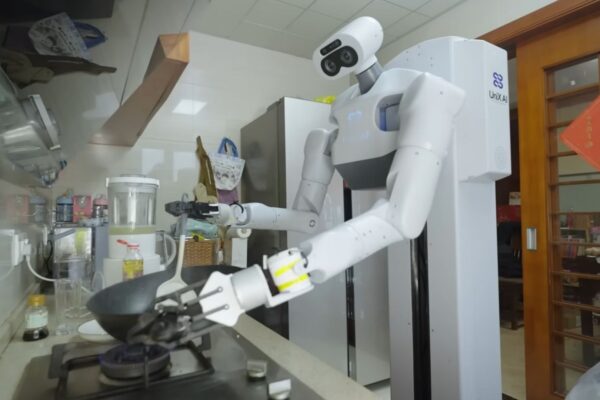
This isn’t a scene from a sci-fi movie or a carefully staged lab demo. As of early 2026, UniX AI’s Panther Robot has begun real-world duty in Chinese homes, marking what many are calling the world’s first genuine deployment of a humanoid-style service robot for everyday household tasks like cooking and cleaning.
While companies like Tesla with Optimus, Figure AI, and Boston Dynamics grab headlines in the West, Chinese firms are quietly shipping units, iterating rapidly, and testing in real environments. The Panther from UniX AI stands out for its focus on domestic workflows: waking users, meal preparation, room cleaning, item organization, and appliance operation.
Panther Design and Capabilities
The Panther is described as a service humanoid with a distinctive wheeled base rather than fully bipedal legs. Standing approximately 5 feet 3 inches (about 1.6 meters) tall and weighing around 176 pounds (80 kg), it prioritizes stability and efficiency for home navigation over acrobatic mobility. Its dual-arm design, equipped with sensors, LiDAR for mapping, and advanced AI, allows it to handle multi-step tasks in unstructured environments like a lived-in apartment.
In promotional videos and early deployment footage from Suzhou, the Panther demonstrates impressive versatility. It opens curtains to wake its “owner,” makes the bed, operates kitchen appliances like blenders, fries eggs with a spatula, prepares salads, cleans countertops and even toilets with a brush, organizes household items, and tidies rooms after the resident leaves for work. It can run for up to 12 hours on a single charge, making it suitable for a full day of light assistance. UniX AI emphasizes its ability to perform “multi-step household workflows” rather than isolated actions—sequencing tasks like breakfast prep followed by cleanup in a coherent routine.
Unlike purely legged humanoids that struggle with balance on carpets or uneven floors, the wheeled architecture gives Panther reliable mobility in typical homes. It uses computer vision and AI to recognize objects, adapt to slight changes in layout, and learn user preferences over time. Early reports suggest it’s being deployed not just in private homes but also in service environments like hotels, where repetitive tasks benefit from consistency.
This isn’t magic—it’s the convergence of several maturing technologies. Modern large language models (LLMs) integrated into the robot allow natural voice commands and task planning. Imitation learning, where robots are trained by observing human demonstrations (sometimes via workers filming chores with head-mounted cameras), accelerates skill acquisition. Force feedback in the arms helps with delicate gripping, whether holding a fragile egg or scrubbing a surface. China’s ecosystem of component suppliers—motors, sensors, batteries, and edge AI chips enables faster and cheaper iteration compared to many Western counterparts.
From Lab to Living Room: How It Began Duty
UniX AI announced the Panther’s transition to real-home deployment in March-April 2026, with units shipping to select residences in Suzhou and potentially other areas. Demonstrations showed the robot handling breakfast preparation in a real kitchen, including frying, blending, and plating, followed by post-meal cleanup. It doesn’t just mimic motions; it executes them with enough reliability for practical use, though early versions likely require some supervision or predefined environments for optimal performance.
This deployment comes amid a broader surge in China’s humanoid and service robot sector. Factories are ramping up production, with some lines claiming capacity for thousands of units annually. Government support for high-tech industries, combined with private investment, has created a fertile ground for rapid prototyping. While many Chinese humanoids like Unitree’s G1 or Fourier Intelligence’s GR-1 focus on industrial or research applications (with occasional home task demos), UniX AI targeted the domestic helper niche from the start.
Early users report the robot excels at structured, repetitive chores: wiping surfaces, picking up small debris, organizing shelves, and basic cooking of simple meals. More complex tasks, like handling varied ingredients or deep cleaning irregular spaces, may still need refinement or human oversight. Yet, the fact that it’s “beginning duty” in actual homes rather than just demo videos represents a milestone. Previous generations of home robots (think early Roomba or basic smart assistants) were limited to single functions. Panther aims for orchestration: a single platform managing a morning routine from wake-up to departure-ready home.
The Broader Chinese Robotics Boom
China’s push into humanoid robots isn’t isolated to one company. The country boasts over 140 manufacturers and hundreds of models as of recent years. Unitree Robotics, known for agile G1 models that can perform dynamic movements, has ambitions to ship tens of thousands of units. Fourier Intelligence’s GR-1 has been positioned for rehabilitation and general tasks. Astribot’s models have shown cooking and even sports skills in demos. Haier, a major home appliance brand, has entered the fray with its own household humanoid concepts.
Mass production is key. New facilities in regions like Guangdong claim to produce one humanoid every 30 minutes, targeting 10,000 units per year. This scale drives down costs and accelerates data collection for AI training. Chinese firms benefit from vertical integration: access to rare earth materials, electronics supply chains, and a huge domestic market hungry for labor-saving solutions amid aging populations and busy urban lifestyles.
Training methods are innovative too. Some companies recruit workers to film themselves performing chores with wearable cameras, generating vast datasets for imitation learning. This “human-in-the-loop” approach helps robots generalize beyond scripted actions. Combined with reinforcement learning and simulation, robots improve safety and dexterity—critical for operating in messy, unpredictable homes with kids, pets, or varying furniture.
Compared to Western efforts, China’s approach emphasizes speed and volume. While Tesla’s Optimus or 1X’s Neo focus on high-end general intelligence and may target higher price points (around $20,000–$30,000 for early consumer models), Chinese players often aim for more affordable entry points through wheeled hybrids or specialized service bots. Panther’s pricing rumors place it in a $10,000–$30,000 range depending on configuration, potentially making it accessible to middle-class households or shared services.
Technical Challenges and Realistic Limitations
No one should expect perfection on day one.
Cooking involves variable factors: ingredient freshness, stove heat consistency, utensil types, and safety around hot surfaces or sharp tools.
Early demos show basic successes like frying an egg or making a salad, but scaling to diverse cuisines or family-sized meals will require more training data and robust error-handling. Cleaning presents similar hurdles: navigating clutter, distinguishing trash from valuables, or handling delicate fabrics without damage.
Safety is paramount. Robots must avoid collisions with humans or pets, detect hazards like spills or fire risks, and incorporate fail-safes. Privacy concerns arise too: cameras and sensors collecting data in private homes demand strong encryption and user controls.
Battery life, maintenance, and repairability will determine long-term adoption. Wheeled designs like Panther sacrifice stair-climbing ability (common in fully legged humanoids) for reliability on flat floors, which suits many apartments but limits use in multi-story houses.
Current models likely perform best in semi-structured environments or with initial setup (mapping the home, defining zones). Over time, through over-the-air updates and user feedback, capabilities will expand. UniX AI and peers are collecting real-world data from these early deployments—the most valuable teacher for embodied AI.
Societal and Economic Impacts
If successful, home humanoids could transform daily life, especially in countries facing demographic shifts. China’s aging population and urban professionals with long work hours create demand for reliable help with chores. Robots won’t replace human connection or complex caregiving, but they can handle drudgery: repetitive cleaning, basic meal prep, organizing and freeing people for family, hobbies, or rest.
Economically, this could boost productivity. Households gain time; service industries (hotels, elder care) reduce labor costs.
On the flip side, it raises questions about job displacement for domestic workers, though many experts argue robots will augment rather than fully replace humans in the near term, especially for tasks requiring empathy or improvisation.
Globally, China’s lead in deployment could influence standards, supply chains, and even cultural acceptance of robots in homes. Will families bond with their “Panther” like a helpful roommate, or treat it as a tool? Early signs suggest the former, with marketing framing robots as “family members.”
Broader implications extend to AI ethics, energy consumption, and inequality. Affordable robots could democratize assistance, but high initial costs might widen gaps. Regulatory frameworks for safety certification, data privacy, and liability (who’s responsible if a robot causes damage?) will need to evolve quickly.
The Road Ahead
The Panther’s entry into real homes is an early chapter. Future iterations may gain better legs for stairs, finer dexterity for intricate cooking, or advanced emotional recognition for more natural interaction. Integration with smart home ecosystems such as controlling lights, thermostats, or security will make them seamless companions.
Competition will intensify. Western firms are catching up with superior software in some areas, while China excels in hardware scale. Collaborations or tech transfers could emerge, accelerating progress for everyone. By the late 2020s or early 2030s, home robots might become as commonplace as smartphones, evolving from basic helpers to personalized assistants that learn family routines, dietary needs, and preferences.
Challenges remain significant: achieving consistent 99%+ reliability in chaotic homes, reducing costs for mass adoption, and addressing ethical concerns around autonomy and surveillance. Yet, the momentum is undeniable. What was once Jetsons fantasy is materializing through persistent engineering, vast data, and bold deployment.
For now, in select Suzhou homes, a wheeled companion is already cooking breakfast and tidying up. It’s imperfect, evolving, and profoundly human in its ambition—to make life a little easier, one chore at a time. As more units roll out and capabilities improve, this “world’s first” home humanoid could redefine not just Chinese households, but the global vision of living with intelligent machines.
The era of the domestic robot helper has quietly begun. Whether it leads to utopian leisure or new societal adjustments, one thing is clear: the robots are here, and they’re starting with the dishes.





Leave a Reply