

Imagine riding a machine that blends the thrill of a motorcycle with the sure-footed agility of a living horse — one that climbs steep mountains, navigates rocky trails, and crosses rubble fields without missing a step, all while running on clean hydrogen energy. That’s exactly what Kawasaki Heavy Industries has brought to life with CORLEO a groundbreaking four-legged robotic vehicle unveiled at Expo 2025 Osaka-Kansai.
Key Takeaways:
•Japan’Mobility Giants Kawasaki has started the development of a Four Legged Robotic Vehicle
•This unique Mobility Machine is designed for Transportation in almost impossible Terrains and Moves like a Horse
•Market entry date is tied for 2030 at the earliest
Kawasaki Heavy Industries, Ltd. Announced it has launched development toward the commercialization of “CORLEO,” a new type of futuristic off-road personal mobility vehicle exhibited at the Japan World Expo 2025 (Expo 2025 Osaka, Kansai).
Kawasaki said it has started developing the hydrogen-powered quadruped robot horse named CORLEO to be Commercially available to the public by 2030. CORLEO is specifically designed for mountainous terrain where conventional motorcycles reach their limits. Functional prototypes are expected to be ready by the Expo 2030 in Riyadh.
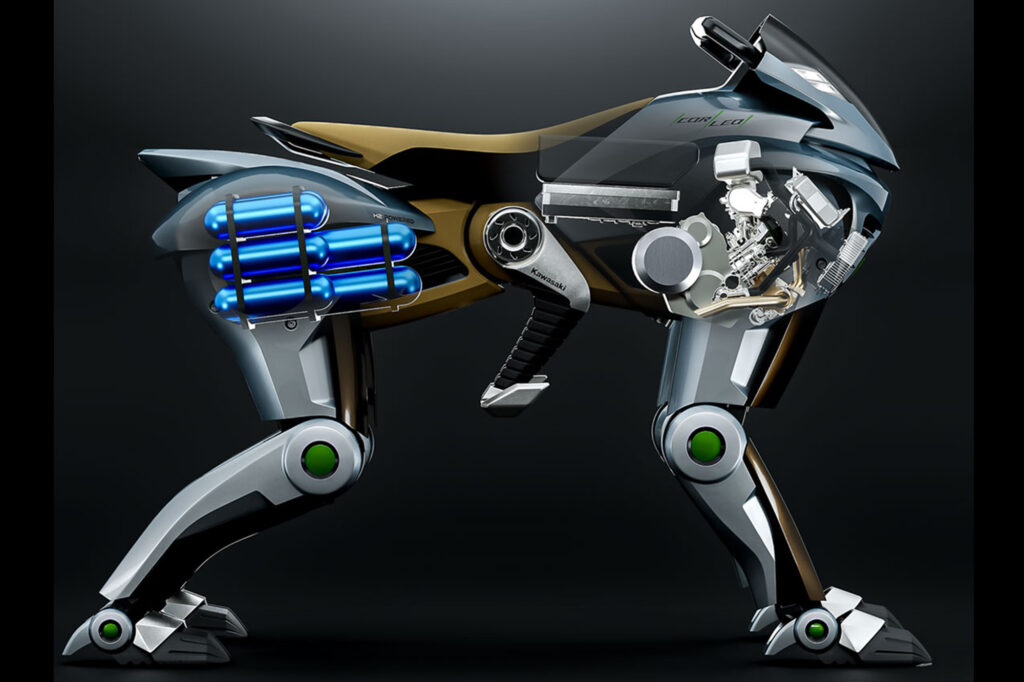
(Renders and model photos of the CORLEO concept show its sleek, powerful quadruped form with motorcycle-like fairing, green-accented joints, and prominent hooves.)
CORLEO according to Kawasaki Motors is powered by a 150-cc hydrogen engine and moves on four legs instead of wheels, designed to mimic the natural gait of animals while the fuel is likely to be stored in hydrogen cartridges at the rear. This unique design allows it to handle rough terrain and off‑road environments where traditional vehicles struggle.
Kawasaki unveiled the concept at Expo 2025 in Osaka and, according to its own statements, has established a business development team named ‘Safe Adventure’ to transform the robotic horse concept, which aims to eliminate mountain accidents and make mountainous regions safe and enjoyable for everyone. the Kawasaki will also develop a navigation system that detects weather, temperature, road surface conditions, and wildlife appearances, guiding users to safe routes via devices such as smartphone. This team reports directly to the company’s CEO, the organisation confirmed. With both robotics and motorcycle divisions, Kawasaki theoretically possesses the in-house expertise to develop a four-legged robot for locomotion.
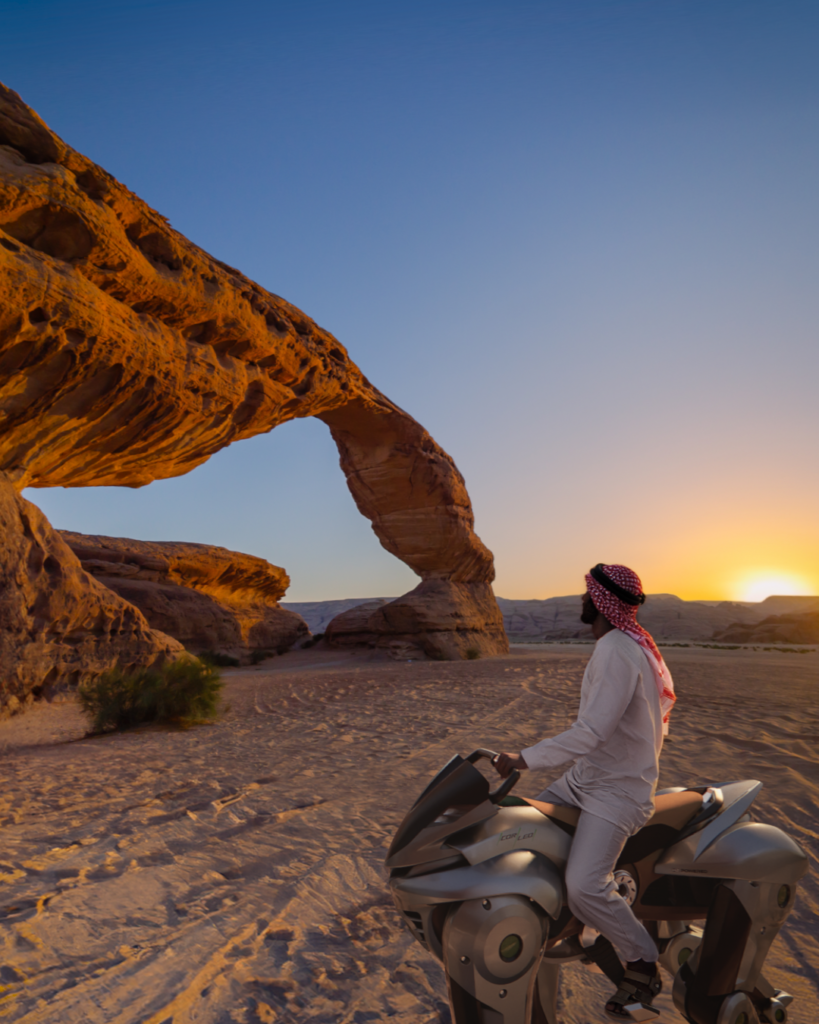
Corleo running in Saudi Arabia : Image Source Global. Kawasaki.com
According to Kawasaki Heavy Industries, CORLEO was presented as a 2050 concept model but is already being showcased at Expo 2025 Osaka as part of the Future Society Showcase project. The company emphasized that CORLEO is designed for exceptional terrain‑handling performance and stability, drawing on Kawasaki’s expertise in both robotics and motorcycles.
Far from a simple gadget or sci-fi prop, CORLEO represents a new category of personal mobility. It fuses Kawasaki’s legendary motorcycle engineering with advanced robotics to create an intuitive, all-terrain “ride” that feels alive. Whether you’re an adventurer seeking untouched panoramic views or someone who wants safer access to rugged outdoors, this mechanical quadruped promises to redefine exploration.
The design is inspired by animal Locomotion. According to Kawasaki’s concept details, the rear legs can swing independently from the front, absorbing shocks and keeping the rider stable even when climbing steps or crossing uneven ground. This makes CORLEO not only a technological showcase but also a practical vision for future mobility.
Part Motorcycle, Part Beast – At first glance, CORLEO looks like a futuristic hybrid sleek motorcycle-inspired bodywork meets powerful robotic legs ending in distinctive hooves. The chassis draws from Kawasaki’s “Fun to Ride” philosophy, offering responsive handling and stability, but replaces wheels with four independent robotic legs for unmatched terrain adaptability.
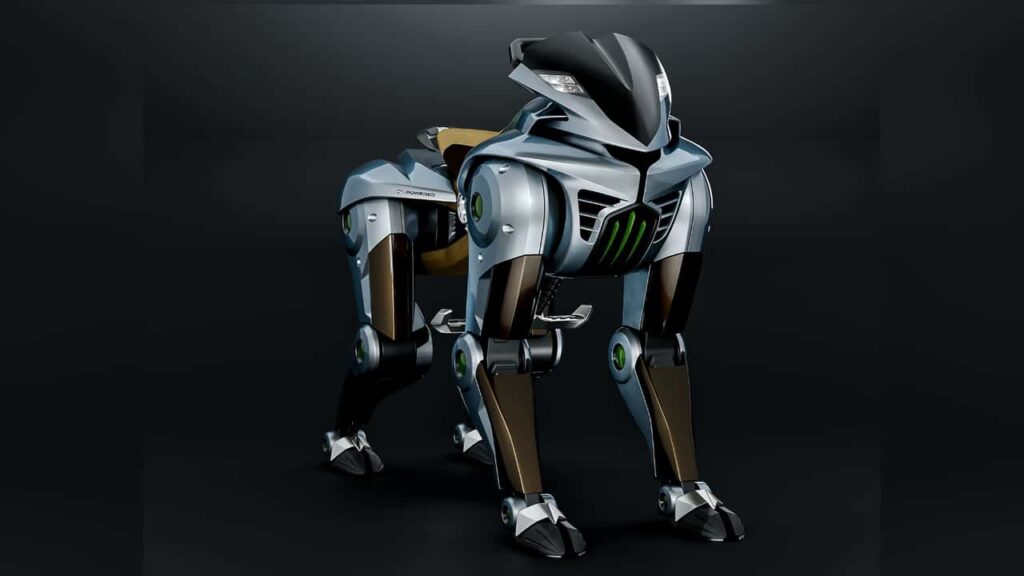
(Renders and model photos of the CORLEO – Kawasaki)
CORLEO Main Features Includes:
-Versatility
To add with off-road high performance provided by four-legged robotics, CORLEO combines the maneuverability and stability cultivated through motorcycle technology.
-High Performance
By applying the swing-arm mechanism developed for motorcycles, the rear legs move independently up and down to absorb shock. This allows the rider to maintain a posture that makes it easy to check the terrain ahead.
-Superior Terrain Adaptability
Operated by shifting body weight, like horseback riding. With support functions, anyone can easily and safely traverse challenging terrain such as mountains and water areas.
Powered by “hydrogen” fuel, using a “ 150-cc hydrogen engine” to generate electricity.
Key design highlights include:
- Robotic Legs and Swing Arm: Each leg operates independently. The rear leg unit can swing up and down separately from the front, absorbing shocks during walking, running, or climbing. This keeps the rider in a natural, forward-facing posture even on steep slopes or steps — no more craning your neck upward.
- Adaptive Hooves: The legs end in innovative rubber hooves with a left-right divided (cloven) structure. These are slip-resistant, shock-absorbing, and conform to irregular surfaces like grass, rocks, gravel, or rubble. They provide excellent grip where traditional wheels or tracks would fail.
- Rider Controls: Forget reins or complex joysticks. CORLEO responds to your body weight shifts, detected through sensors in the stirrups and handlebars — much like riding a real horse or shifting weight on a motorcycle. Adjustable stirrup lengths help maintain an optimal, comfortable posture.
- Instrument Panel and Night Riding: A dashboard displays critical info: hydrogen levels, route guidance, and your center of gravity. At night, it projects illuminated markers onto the ground ahead for safer navigation.
The overall form is aggressive yet elegant — often described as having the agility of a panther or deer, with hints of wolf-like power, rather than a purely equine silhouette. A windscreen and sporty seat echo Kawasaki bike aesthetics, while the body uses lightweight metal and carbon materials for durability.
Advanced AI and sensors enhance balance, terrain recognition, and stability. The machine continuously monitors the rider’s movements to create a seamless human-machine connection almost as if the robot anticipates your intentions.
From Concept to Reality: Production Underway
Unveiled as a visionary 2050 concept at Expo 2025, CORLEO has moved remarkably fast. Kawasaki has established a dedicated Safe Adventure Business Development Team focused on eliminating mountain accidents and making rugged areas accessible and enjoyable for everyone.
As of early 2026, production development is actively underway. Plans include:
- A riding simulator targeted for completion by 2027 (with potential applications in gaming and e-sports).
- Public demonstrations and visitor rides possibly at Expo 2030 in Riyadh, Saudi Arabia.
- Commercial availability for consumers targeted around 2035.
This accelerated timeline shows Kawasaki’s serious commitment to turning the “robot horse” into a practical tool for adventure tourism, rescue operations, or personal exploration.
Why CORLEO Matters
In an era of electric vehicles and autonomous tech, CORLEO stands out by going back to basics — legs instead of wheels while pushing forward with clean hydrogen power and intuitive controls. It could open up remote wilderness areas safely, reduce environmental impact compared to traditional off-road vehicles, and deliver an exhilarating riding experience that feels organic rather than mechanical.
Whether you dream of summiting peaks without trails or simply want a more engaging way to explore nature, the CORLEO hints at a thrilling future where humans and machines move together in harmony with the outdoors.
Technology is surely going to transform the future of Mobility and Translocation come 2030. What are thoughts about CORLEO ? Is this going to be hit or miss ? Please let us know in the comments section! 👇
Disclaimer!
This publication is made for Educational and awareness purposes. The information provided here are based on verified human aided research and studies.





Leave a Reply