

China’s Flying Backpack: Real-Life Superhero Tech that Lets You Soar at 100 km/h and 1,500 Meters High
Key Takeaways:
•Chinese Engineers Produce a Backpack that can fly up to 1500 Meters High in the air
•This innovative Flying Backpack allows a person to stay airborne for 3 to 5 minutes
•Experts say this invention can be used for Millitary Operations and Strategic rescue Missions in difficult terrains
Engineers at a Chinese university have created a jet-powered backpack that enables short-duration human flight. Developed entirely in China by the JetRob Team at Zhejiang University, the device relies on turbojet engines and lets the user steer and adjust height simply by moving their arms.
Imagine putting on a backpack, hitting a switch, and blasting off into the sky like Iron Man or any comic-book superhero. No plane, no parachute just you, the wind, and pure freedom. Sounds like pure Sci-fi? Not anymore. China has unveiled a jet-powered flying backpack that turns this dream into reality, letting a person glide through the skies at speeds up to 100 km/h and reach altitudes of 1,500 meters.
This isn’t some distant Prototype from a Silicon Valley Lab — it’s a homegrown innovation from Zhejiang University that’s already been flight-tested and demonstrated on campus. The future of personal flight is here, and it’s lighter than you think.
“The jetpack features fuel tanks mounted on both sides of the back, along with five turbojet engines: one positioned centrally on the back and two attached to each arm,” explained Jiao Bojing, the team’s mechanical systems and flight test engineer. “Its dry weight is 31 kg, increasing to 46 kg when fully fueled.”
This innovative flying backpack allows a person to stay airborne for 3 to 5 minutes at altitudes under 1,500 meters, with a top theoretical speed of around 100 km/h. The technology is now moving beyond lab testing toward real-world pilot programs, with promising uses in emergency response, disaster relief, and specialized operations.
Meet the JetRob Flying Backpack
The Device comes from the JetRob team at Zhejiang University’s Huzhou Institute, led by engineer Jiao Bojing and his collaborators. Unveiled in late 2025 (including a big campus demo in October and presentation at the IROS 2025 robotics conference), the backpack has quickly gone viral for good reason.
Weighing roughly 31–46 kg (depending on the configuration), it’s surprisingly portable for something that can carry a full-grown adult. The pilot simply straps it on, stomps to ignite the engines, and uses arm movements to steer with precision. No complicated cockpit or joystick required. Turbojet Engines mounted on the arms and back provide the Thrust, while side-mounted fuel tanks keep it humming for short bursts of flight (typically 3–5 minutes).
In demo videos, the pilot hovers steadily just above the ground, then rockets forward across open spaces, drawing cheers from crowds of stunned students. It’s stable, maneuverable, and looks every bit as futuristic as the headlines suggest.
How Does This Personal Flight Tech Actually Work?
-Propulsion: Multiple turbojet engines deliver raw power for rapid ascents, hovering, and smooth direction changes.
-Control: Intuitive arm-based maneuvering. tilt left or right, and the jets respond in real time.
-Performance: Top speed of 100 km/h and max altitude of 1,500 meters make it viable for more than just short hops.
-Safety Features: Designed for controlled, stable flight with an emphasis on ease of handling, even for trained users.
During a public demonstration at Zhejiang University’s open day in Hangzhou, spectators watched in amazement as a pilot wearing the large jetpack spread his arms, roared into the air with the engines firing, and hovered steadily about 2 meters off the ground. He then maneuvered smoothly, flew forward, performed a turn, and landed gracefully in one continuous motion.
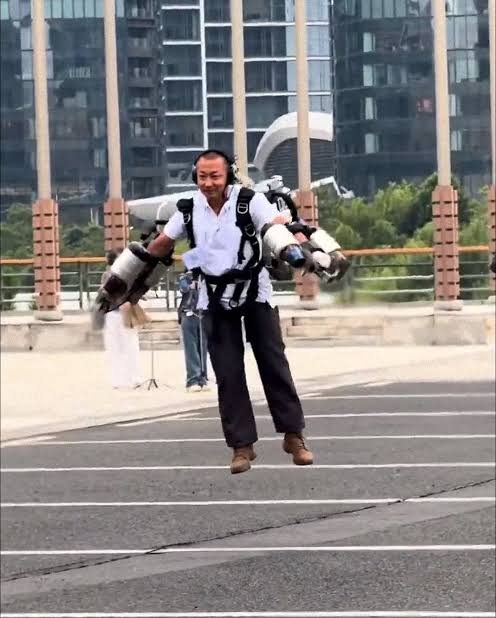
Flying Backpack on Display at Zhejiang University’s Huzhou Institute
The project took three to four years to develop, including two years of intensive flight testing. “This is the most advanced and reliable version we’ve achieved so far,” Jiao said with pride. “We’re now at a stage where we can take it out and fly it almost anywhere, anytime.”
“Operating the device currently requires good upper-body strength, as the pilot controls flight through arm and body movements,” Jiao noted. “In future versions, we plan to introduce autonomous flight capabilities, where the system or even humanoid robots could handle control independently.”
It’s not endless flight (yet), but for rescue ops, quick inspections, or adrenaline-fueled adventures, those few minutes of airtime are game-changing.
Real-World Uses
This isn’t just a toy for daredevils. Developers see huge potential in:
- Emergency Rescue: Flying first responders straight into disaster zones, mountains, or flooded areas where helicopters can’t reach.
- Military & Border Patrol: Rapid deployment in tough terrain for surveillance or tactical operations.
- Industrial Inspections: Checking power lines, bridges, or remote infrastructure from the air.
- Extreme Sports & Tourism: Guided “superhero flights” for adventure seekers (once regulations catch up).
China’s broader tech push from flying cars to AI drones and humanoid robots makes this feel like part of a bigger mobility revolution.
Mastering the jetpack is similar to learning to ride a bike — it demands training for safe and controlled operation. Jiao also addressed online concerns about safety, confirming that the engine exhaust is directed safely away from the pilot, eliminating any risk of heat or flames affecting the user.
Jiao Bojing’s journey adds an inspiring layer to the story. A passionate aviation enthusiast since childhood, he began with a technical secondary school background and worked as an equipment maintenance technician at a television station. Through years of practical experience and creative problem-solving, he advanced to become a key mechanical systems and flight test engineer, realizing his lifelong dream of human flight.
Challenges on the Horizon for the Flying Backpack
Of course, no breakthrough is perfect. The current flight time is short, noise levels are high (jet engines aren’t exactly whisper-quiet), and safety training will be essential. Regulatory hurdles around personal airspace, air traffic control, and environmental impact still need sorting. Cost and scalability will determine whether this stays a university prototype or becomes an everyday gadget.
The Sky’s No Longer the Limit
China’s flying backpack isn’t just cool tech — it’s a glimpse at how personal flight could reshape how we move, work, and play. In a world chasing sustainability and speed, devices like this prove human ingenuity can literally launch us forward.
Looking ahead, Jiao imagines a near-future where entire families could fly together — a vision that echoes science fiction but feels increasingly achievable thanks to ongoing advancements.
Would you strap one on and take off? Or are you waiting for the commercial version with cupholders and Wi-Fi? Drop your thoughts in the comments section below 👇 and keep an eye on the skies 🌫️
Disclaimer!
This publication is made for Educational and awareness purposes. It is not made for the sale of any product or service. The information provided here are based on verified human aided research and studies




Leave a Reply