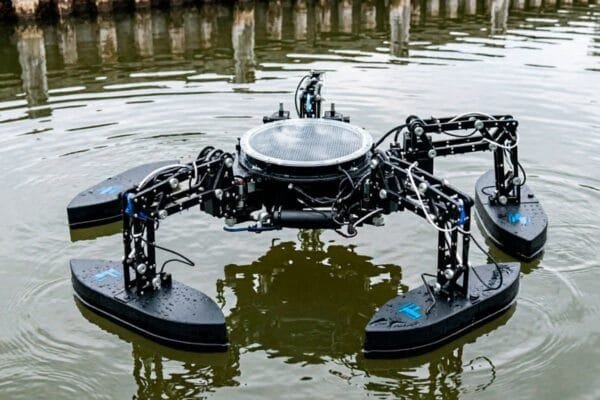
Researchers from the Shenzhen Institute of Artificial Intelligence and Robotics have developed a floating robot, QuadBoat, capable of not only detecting people in the water but also tracking their movements and retrieving them from the surface. The robot has a design with four controlled “legs”, inspired by fishing spiders, capable of moving on the surface of water.
Rescue teams in coastal cities and towns often need to rescue people who are at risk of drowning. These operations often require emergency teams to locate and reach people in distress as quickly as possible, as even a short delay could have serious or even fatal consequences.
QuadBoat is a spider-inspired robot built to locate, retrieve, and transport drowning victims to safety when every second counts.
When someone falls into the water and cannot swim to safety, every second matters. Search-and-rescue teams already use drones, boats, and other robotic systems to help locate people in distress, but most of these autonomous vehicles stop short of performing the actual rescue, wasting critical time. A new spider-inspired robot called QuadBoat aims to change that by not only finding victims, but also retrieving them from the water and transporting them to safety.
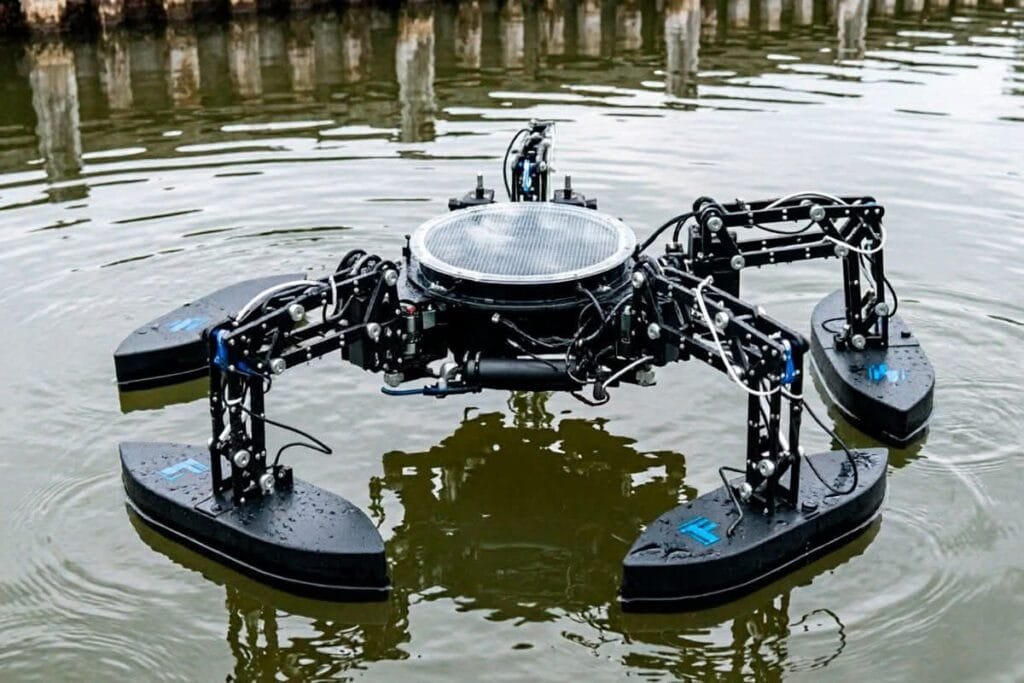
QuadBoat takes its inspiration from fishing spiders. These arachnids are able to move quickly across calm water thanks to long, water-repellent legs that distribute their weight over the surface. Rather than attempting to leverage surface tension alone, the researchers adapted the concept into a buoyancy-based unmanned surface vehicle with four articulated legs that provide both stability and maneuverability.
Unlike many existing rescue boats that primarily deliver flotation devices or guide responders to a victim’s location, QuadBoat was designed around the entire extraction process. The researchers focused specifically on the ability to pull victims from the water and transport them afterward — an area that has received comparatively little attention in previous rescue robot research.
The robot has a central body connected to four independently controlled outrigger hulls, each mounted on an articulated leg with multiple degrees of freedom. By extending, lifting, rotating, and repositioning its legs, QuadBoat can actively adjust its posture while remaining stable on the water. The design also supports two operating modes: a fully actuated mode for omnidirectional movement and an underactuated mode for higher-speed travel. Together, the four buoyant hulls provide approximately 55 kilograms of buoyancy, while integrated thrusters generate propulsion.
The control system is handled by a Raspberry Pi 4 Model B running the robot’s navigation software, while multiple Arduino boards manage the individual motors and joint controllers. Cameras identify rescue targets, and inverse kinematics algorithms coordinate the motion of the four legs. Overall movement is managed using a cascaded model predictive control (MPC)-PID controller, allowing the robot to accurately follow trajectories while maintaining stability during retrieval operations.
To validate the design, the team carried out a series of pool-based experiments evaluating everything from basic maneuverability to autonomous tracking and object retrieval. The robot successfully followed planned paths, tracked floating targets using computer vision, and demonstrated its ability to collect and transport objects in both indoor and outdoor environments. These tests confirmed QuadBoat’s agility, motion accuracy, and effectiveness during simulated rescue scenarios.
While still a research prototype, QuadBoat could become a valuable addition to future search-and-rescue operations, particularly in situations where conditions are too dangerous for human rescuers to respond immediately. The next step will be evaluating the system under more demanding real-world water conditions beyond the controlled environment of a swimming pool.