Oluwatobi Oyinlola was born on May 10, 1992, in Ibadan — Nigeria’s Second-Largest city, a sprawling, layered metropolis in Oyo State known for its intellectuals, its markets, and its deep cultural pride.
STAR ⭐ Innovator OluwaTobi was not born into a Tech Ecosystem. He was not handed a laptop. In the early years of his education at Bishop Philips Academy, computers were not even part of the curriculum, and access to technology was a distant aspiration for most families in his community.
The turning point came when OluwaTobi was around 13 years old. His secondary school received a donation of fully equipped computers from an Alumnus: Seyi Makinde, then an Engineer and today the Executive Governor of Oyo State. For most students, it was a curiosity. For Tobi, it was a portal for achieving greatness.
STAR ⭐ Innovator OluwaTobi says: “From the moment I booted it up, I was absolutely captivated. I remember spending hours after class tinkering with basic programs and exploring every part of the system just to understand how it all worked. That early exposure ignited an endless curiosity in me and set me on the path that led to where I am today.”
The Architecture of a Breakthrough and entering into the Guinness Book of Records
The spark for his historic invention came from a stark, undeniable reality: the global security and logistics landscape was changing, and traditional tools were failing. Standard GPS trackers were bulky, easily spotted by criminals, and notorious for draining batteries within hours.
STAR ⭐ Innovator OluwaTobi asked himself a question that world-class hardware labs were actively struggling with: How do you shrink a GPS module, a cellular antenna, and a reliable power source into a form factor so microscopic that it becomes virtually invisible?
Achieving this was a masterclass in obsessive engineering. In the world of hardware, every millimeter matters. If you shrink the device, you shrink the antenna, which destroys the signal. If you shrink the battery, the device dies in minutes.
The young Tech STAR ⭐ Oluwatobi, spent tireless months solving this intricate puzzle. Through custom IoT architecture, clever power-management protocols, and proprietary micro-antenna designs, he achieved the impossible.
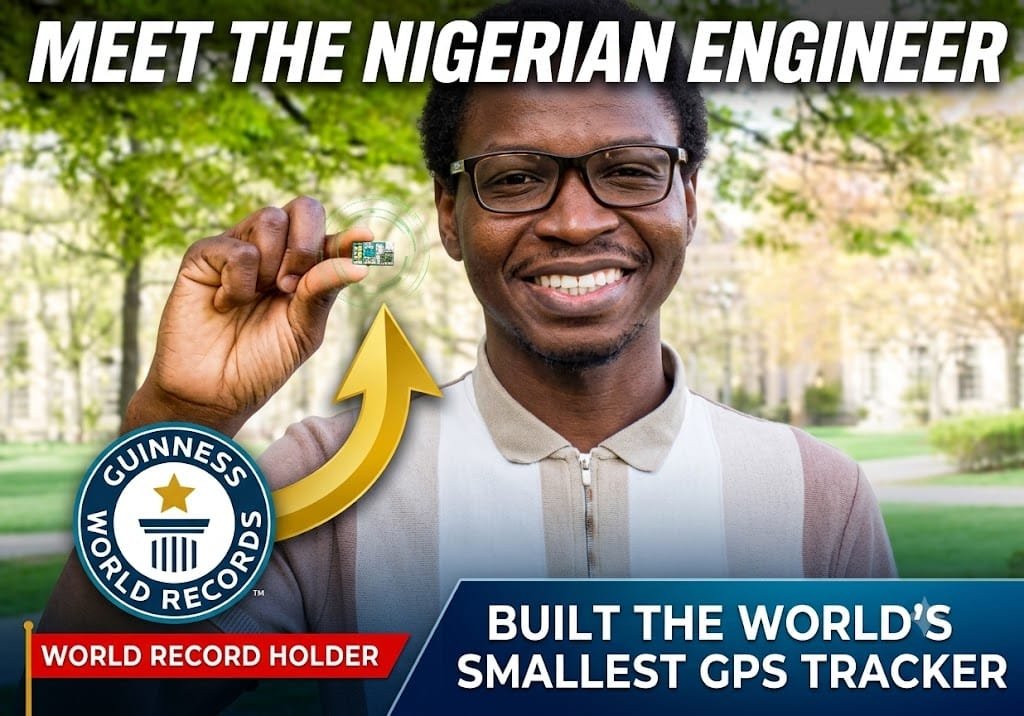
He engineered a fully functional, real-time GPS tracking device roughly the size of a small coin measuring exactly 22.93 mm × 11.92 mm. It could be stitched into the lining of a jacket, slipped into a watch strap, or hidden inside a wallet without ever creating a bulge.
“I realised that if we wanted to embed GPS functionality into cutting-edge wearables, medical devices, or tiny sensors, we needed to dramatically shrink the technology. My goal was to develop a tracker so compact that it could be embedded in almost any object or device from consumer electronics to critical safety gear without compromising functionality.”
The device was designed, developed, and produced in Cambridge, Massachusetts. To qualify for the Guinness World Record, it underwent independent review by two engineers and an architect, who confirmed both its functionality and its dimensions. On April 27, 2025, Guinness World Records made it official: Oyinlola’s prototype was the smallest GPS tracking device in the world.
The record was not something OluwaTobi had planned from the start. He describes it as a personal engineering challenge that kept pushing further:
“At first, it was just a personal challenge. But once I realised how small and functional the device actually was, I thought — why not take it a step further and attempt a world record? ”
The Real-World Applications of a SIM-Sized GPS Tracking Device
It is smaller than your thumbnail. It is smaller than the SIM card in your phone. In fact, if you placed it on a Nigerian ₦50 coin, you’d still see coin around its edges. And yet this tiny rectangle — measuring exactly 22.93 mm × 11.92 mm — can receive GPS signals from satellites orbiting hundreds of kilometres above the Earth, log precise location data, and stream it wirelessly over Bluetooth. All on its own. No external antenna needed.
The practical significance of this invention stretches far beyond the record itself. The ability to embed a fully functional GPS tracker into an object the size of a SIM card opens doors that were previously closed across medicine, conservation, logistics, safety, and the future of smart cities.
Other Areas of Real-World Applications of this SIM-Sized GPS Applications include:
1. Medical Microchips & Implants
Enabling precise patient tracking within hospitals, or GPS functionality in medical implants without the bulk that made this previously impractical.
2. Wildlife Monitoring
“Imagine tracking wildlife with a tag practically invisible to the animal,” OluwaTobi says. Near-invisible tags reduce stress on animals and expand the scope of conservation research.
3. Next-Generation Wearables
GPS-enabled jewellery, ultra-thin smart watches, children’s safety bands and product categories previously constrained by GPS component size.
4. Personal Safety Devices
Covert personal trackers for vulnerable individuals embedded in everyday objects with no visible hardware signature.
5. Logistics & Supply Chain
Tracking individual items not just pallets or containers — This Micro tracking device opens granular supply chain visibility at a scale previously cost-prohibitive.
6. Smart City Infrastructure
Urban sensing at micro-scale embedded in city infrastructure to provide real-time data on movement, environment, and asset location.
Guinness World Records itself described the invention as a major advancement in the trend toward more compact and powerful electronics, commending Oyinlola for “pushing the boundaries of what’s possible” in compact, high-performance technology.
From Local Genius to Global Impact
What this young STAR ⭐ Innovator Oluwatobi Oyinlola built in his lab isn’t just a brilliant DIY project; it is a profound technological milestone that instantly captured the attention of the global Tech community. He proved that world-class hardware innovation isn’t reserved for Silicon Valley or Shenzhen, it is actively being forged in Africa by Nigerian minds.
Beyond the sheer Brilliance of the Engineering, the real-world implications of his micro-tracker are monumental. In an era where personal security, asset protection, and anti-kidnapping measures are paramount, an invisible, un-trackable tracker changes the entire equation. It gives power back to the vulnerable.
The young STAR ⭐ Innovator went on to complete his undergraduate studies at Tai Solarin University of Education and later earned a Master’s degree in Internet of Things and Embedded Computing Systems at the African Centre of Excellence in IoT (ACEIoT) at the University of Rwanda — as a World Bank scholar. Before he ever set foot at MIT, he was already changing Africa.
Before MIT, The Inventions That Put Tobi on the Map
Oyinlola’s professional journey before MIT is not a footnote — it is its own chapter of remarkable, impact-first engineering. He has been popularly known in tech circles as “Internet of Tobi”, a nickname that captures his singular dedication to making IoT work for Africa, not just in theory, but in the hands of real people in real communities.
Inventing Nigeria’s First Pay-As-You-Go Solar Energy System
One of his most impactful early inventions was pioneering Nigeria’s first pay-as-you-go solar energy system. Working with a Lagos-based solar energy firm, STAR ⭐ Inventor OluwaTobi built an IoT solution that allowed consumers to pay for electricity incrementally — and allowed operators to remotely manage access for customers across Abeokuta, Ibadan, and beyond. In a country where grid electricity has remained unreliable for decades, this was not just an engineering achievement. It was infrastructure for everyday survival.
Tobi on the Record, the Mission, and What Comes Next
What is striking about Oyinlola’s public statements around the record is their consistency not with the language of personal ambition, but with the language of mission. He is remarkably clear about why he invents:
“I love that with science and technology you can have an idea in your mind and then actually bring it to life — it’s like turning imagination into reality through innovation. It’s not just about theory; it’s about building solutions with your own hands and constantly learning new things along the way.”
On the record itself, he described the feeling as “incredible and a bit surreal”, but was careful not to treat it as a destination:
“Breaking a record isn’t a finish line for me, it’s a starting point. It proves that with dedication and creativity, we can achieve what once seemed impossible. I plan to carry this momentum forward, continuing to research, learn, and invent new solutions to challenging problems.” he concluded.
STAR ⭐ Nigerian Technology Innovator Oluwatobi’s Timeline of Achievements
- 2005 First Contact with a Computer — Ibadan, Nigeria at the age of 13, OluwaTobi used a computer for the first time at his secondary school, after a donation from alumnus Seyi Makinde. He begins teaching himself C programming from textbooks, writing code by hand.
-2015 Joins rLoop — Elon Musk’s Hyperloop Project Becomes part of the engineering team at rLoop Incorporated for the SpaceX Hyperloop Pod Competition, representing Africa in a globally crowdsourced engineering effort.
-2016 SpaceX Hyperloop Competition — Top 30 Finalist rLoop achieves top-30 placement and wins the Pod Innovation Award.
-2017 Intel Software Innovator Award Recognised by Intel for pioneering IoT work, representing Africa in international innovation spotlights. Also represents Africa at Hackaday Super conference in San Francisco.
-2018 100 Most Influential Young Nigerians (Avance Media)Named to this prestigious list for his pay-as-you-go solar energy systems and IoT innovations. Repeated in 2019.
-2019 SolarPocha — World’s First Solar IoT Outdoor Work station Installs the first unit at Tai Solarin University of Education, providing students with solar-powered electricity and internet access outdoors.
-2021 Joins MIT Senseable City Lab Begins research as a Fellow at MIT Senseables City Lab, working on IoT and urban sensing. Contributes to the City Scanner project — a mobile platform for urban environmental data collection.
-Apr ’25 Guinness World Record — World’s Smallest GPS Tracking Device On April 27, 2025, Guinness World Records officially certifies Oyinlola’s prototype (22.93 × 11.92 mm) as the world’s smallest GPS tracking device, following independent verification by two engineers and an architect.
-May ’25 Presidential Congratulations — National Pride by President Bola Ahmed Tinubu and Minister Bosun Tijani publicly celebrate the achievement. Oyinlola is featured on TVC News Nigeria and covered across pan-African and global media.
STAR ⭐ Tech Innovator OluwaTobi Oyinlola represents the wealth of highly Innovative and Skilled Tech Talents that Nigeria Boasts of Today.
His impressive timeline and track of achievements rising from the slums of Ibadan Nigeria to the global world stage and entering into the Guinness Book of Records is enough evidence that Several Other Thousands of Nigeria and Africa’s Brilliant & Innovative Tech Brains can also achieve this feat if given the right resources, support and mentorship.
Seedufy Technological Africa Resources STAR ⭐ remains committed in our quest to Search, Identify and Showcase these young Innovative Tech Brains who are building impressive Tech products in their Backyards to the outer World where they can gain much needed Visibility, Access investors and Talent Employers.