
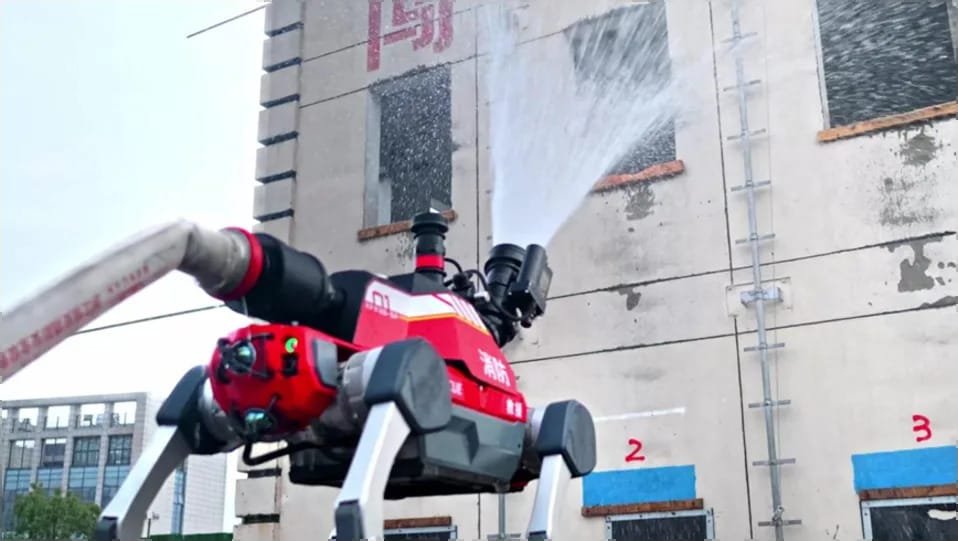
DEEP Robotics is expanding the use of industrial quadruped and wheeled-legged platforms to address dangerous life-threatening environmental fire hazards by sending robots in first so human responders can make better decisions with better information.
This comes as DEEP Robotics as launched it’s Quadruped and Wheeled-Legged Robots for Firefighting and Emergency Response for teams in environments that are nearly impossible to assess from the outside.
The company’s emergency and firefighting solution centers on two complementary platforms: the X30 industrial quadruped robot and the Lynx M20 wheeled-legged robot. Deployed together in a reconnaissance-first workflow, the robots enter hazardous zones ahead of personnel, map the scene, detect dangers, relay communications, and support logistics and suppression tasks. The goal is not to replace firefighters but to reduce the number of times people must step into the unknown.
How the System Operates on Scene
In a typical response, reconnaissance units move first. The X30 carries dual-spectrum cameras and 3D LiDAR that allow operators to build real-time interior maps, locate fire sources, and track how flames are spreading. Multi-gas sensors detect dangerous levels of carbon monoxide, hydrogen cyanide, hydrogen sulfide, and hydrogen chloride data that traditionally required a fully suited firefighter to gather in person.
When cellular or radio signals drop inside buildings, tunnels, or basements, communications-configured robots establish self-organizing mesh networks so command posts stay connected. Suppression units can then advance with water-cannon payloads capable of delivering water or foam up to 60 meters at flow rates of around 40 liters per second. Logistics robots follow personnel at walking speeds, carrying hoses, air tanks, and breaching tools so firefighters no longer have to haul heavy equipment on repeated trips into the danger zone.
The Lynx M20 wheeled-legged platform adds flexibility. It can roll quickly across relatively clear ground and switch to legged mode when it encounters debris, stairs, or rough terrain—useful for rapid approaches or supporting operations on mixed surfaces.
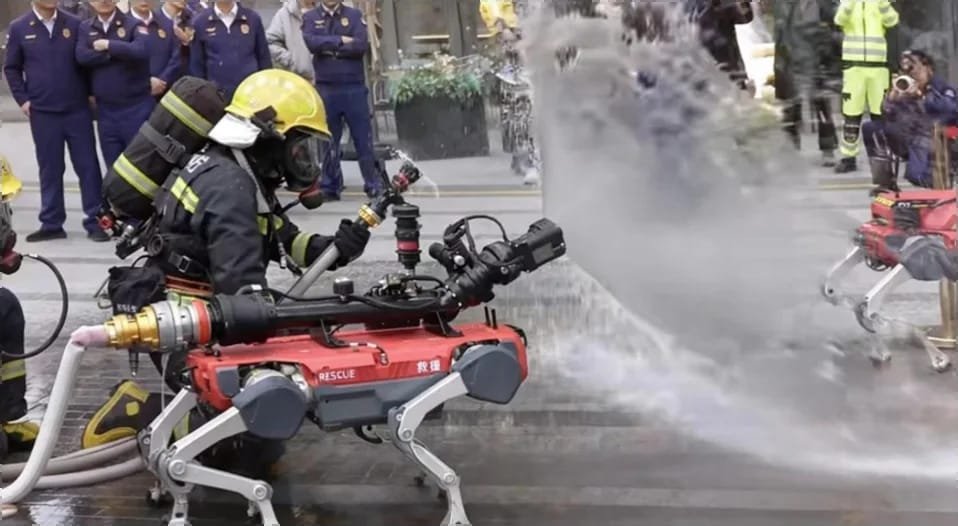
These capabilities have been tested beyond controlled labs. In the 2025 High-Rise Firefighting Drill, multi-robot teams combining reconnaissance, suppression, and logistics units performed smoke-penetrating reconnaissance, victim search, hazardous-gas detection, and precision suppression inside a simulated super high-rise fire—the kind of scenario where limited visibility and structural uncertainty normally force high firefighter exposure.
At the 2025 Emergency Response Competition, the DEEP ROBOTIC combinations earned first and second places in tunnel and confined-fire tracks, successfully operating through signal blind spots using reconnaissance-plus-relay configurations. The robots have also been evaluated in broader disaster scenarios involving chemical leaks, tanker fires, and simulated structural collapses.
Earlier deployments reinforce the pattern. X30 units have supported high-rise building drills, tunnel emergencies, and hazardous-material exercises. In Changsha, an X30 became the first domestically developed quadruped robot put into operational use by a local fire and rescue team, capable of functioning across extreme temperatures from roughly –20°C to 55°C. The platform has also participated in flood-control and typhoon-related drills in Zhejiang, demonstrating mobility across muddy, flooded, and debris-strewn terrain.
The X30 is designed as an industrial workhorse. It measures about one meter long, weighs approximately 56 kg including battery, and offers IP67 protection. It can climb slopes and stairs up to 45 degrees, clear obstacles around 20 cm high, and operate across a wide temperature range. Endurance typically spans 2.5–4 hours with a range exceeding 10 km, supported by quick battery swaps. These specifications make it suitable for the chaotic, unstructured environments of real emergencies.
The Lynx M20 and related wheeled-legged models complement it with hybrid mobility, higher speeds on open ground, and strong obstacle-crossing ability, including the capacity to handle significant single steps or platforms in some variants.
As these systems continue to mature through live drills, competitions, and operational deployments, the combination of quadruped agility and wheeled-legged speed of DEEP ROBOTICS firefighters and emergency responding Robots is proving particularly well suited to the messy, multi-terrain reality of disaster scenes.
For firefighters and emergency responders, the expanding presence of these platforms means fewer blind entries into the most dangerous environments, and a stronger chance of bringing everyone home safely.