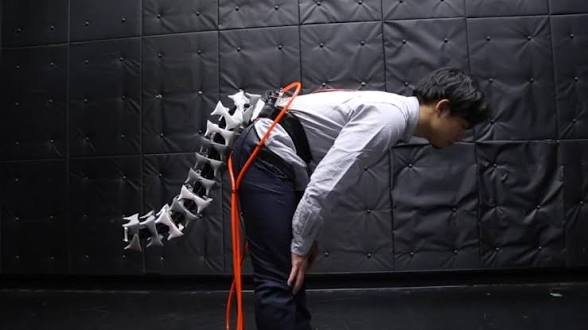
Millions of years after our ancestors traded their tails for an upright stance and free hands, researchers in Japan have decided humans might benefit from getting one back. At Keio University’s Graduate School of Media Design, a team from the Embodied Media Project has developed Arque an artificial, biomimicry-inspired wearable robotic tail designed to expand innate body functions, particularly balance and stability.
Arque uses four pneumatic artificial muscles powered by compressed air to move in eight directions. Like a pendulum, it shifts opposite to the wearer’s movement, helping counter changes in the body’s center of gravity. The one-meter device moves in response to the wearer’s body motion to help maintain stability.
The experimental technology could eventually assist older adults, industrial workers, and people undergoing rehabilitation. Researchers also see potential applications in virtual reality and other systems requiring physical motion or balance support.
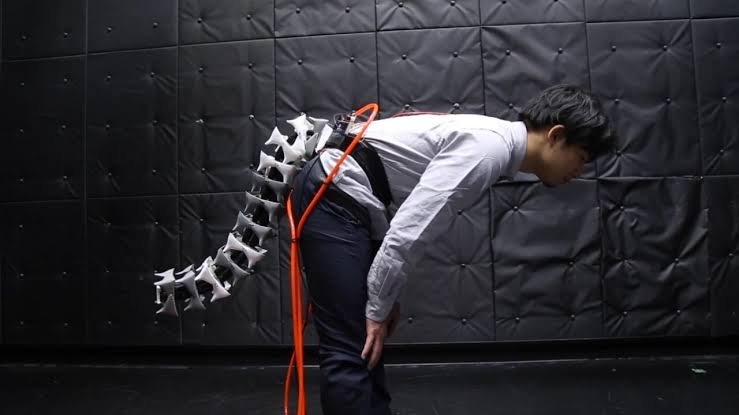
Picture showing a Japanese Citizen testing the robotic tail. Photo Credit:CNN
The device, roughly one meter long in its primary form (with prototype versions reported around 71 cm), attaches to the lower back or waist via a harness. It responds dynamically to the wearer’s movements, acting much like a living pendulum.
When the body tilts or shifts weight in one direction, Arque moves in the opposite direction, helping to counteract changes in the center of gravity and restore equilibrium. This simple yet elegant principle draws directly from how many vertebrate animals use their tails—whether a cheetah flicking its tail while cornering at high speed or a monkey using its tail as a counterweight while navigating the canopy.
Engineering Inspired by Nature
Arque’s design is not a superficial imitation. Researchers, including Junichi Nabeshima, MHD Yamen Saraiji, and Kouta Minamizawa, studied animal tails extensively. Early prototypes modeled after cat or tiger tails proved too light to meaningfully affect human momentum. The breakthrough came from examining the seahorse’s tail: square rather than cylindrical in cross-section, modular, strong, and flexible enough for gripping yet capable of handling significant forces.
The resulting structure consists of adjacent interlocking joints resembling vertebrae. Each segment features a central plate surrounded by protective plates, linked by a spring-based system that manages shearing and tangential forces while maintaining structural integrity. This modular architecture allows the length and therefore the weight to be adjusted. For the tail to be effective, it should represent approximately 5% of the wearer’s body weight, a ratio that can be fine-tuned by adding or removing segments or adjusting counterbalancing elements.
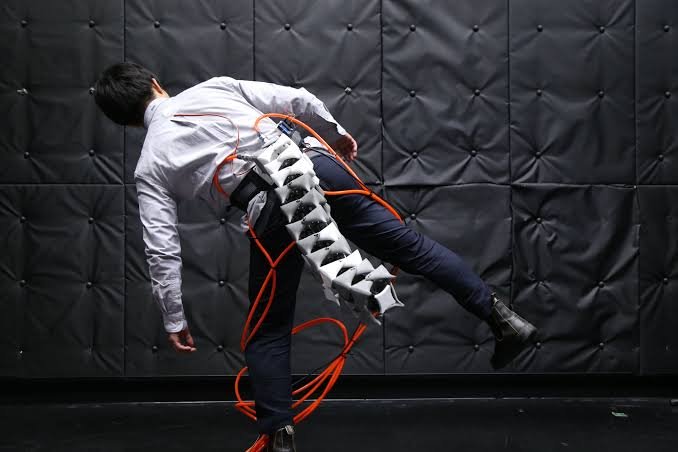
Picture showing a Japanese Citizen testing the robotic tail. Photo Credit:CNN
Inside the tail run four pneumatic artificial muscles powered by compressed air. These actuators enable movement in eight directions. Sensors or a wearable body tracker monitor the user’s posture, weight shifts, and center of gravity in real time. The system then activates the appropriate muscles so the tail responds almost instantly such that leaning left triggers a rightward swing, bending forward prompts an upward or rearward counter-movement. Wearers report that the static weight feels negligible until the tail begins to move and apply force.
Practical Potential Across Domains
Although still experimental and largely confined to the laboratory, Arque points toward several promising applications. Japan faces one of the world’s most rapidly aging populations, with a high proportion of residents over 65 and falls remaining a leading cause of injury among older adults. Traditional aids such as canes and walkers have limitations. A wearable device that actively assists balance could offer a more intuitive form of support, potentially helping elderly users move more confidently in everyday environments.
Industrial settings present another clear use case. Warehouse or factory workers who routinely lift and carry heavy loads often face challenges maintaining stability. Arque could function as a dynamic counterweight, reducing the physical strain of shifting loads and lowering the risk of toppling or injury—functioning in a complementary way to exoskeletons but with a simpler, more appendage-like form factor that is relatively easy to don and doff.
Rehabilitation is a natural extension. Patients recovering from injuries or neurological conditions that impair balance might use the device under supervised conditions to retrain postural control and rebuild confidence in movement. Beyond clinical and occupational contexts, the researchers highlight opportunities in virtual reality and immersive systems. By actively altering the body’s momentum, Arque could deliver full-body haptic feedback simulating the push of wind, the pull of virtual forces, or the sensation of walking on unstable surfaces making VR experiences more physically convincing and embodied.
The project sits within a broader exploration of how wearable technologies can extend or restore human capabilities rather than merely monitor them. By returning a lost anatomical feature in robotic form, Arque raises interesting questions about the boundaries between body and machine, evolution and engineering, and assistance versus augmentation.