
Canadian publishing house Les Editions du Boreal said on Wednesday it had ended its professional relationship with Haitian-Canadian author Thelyson Orelien after it found that he had used Artificial Intelligence (AI) to write his award-winning book.
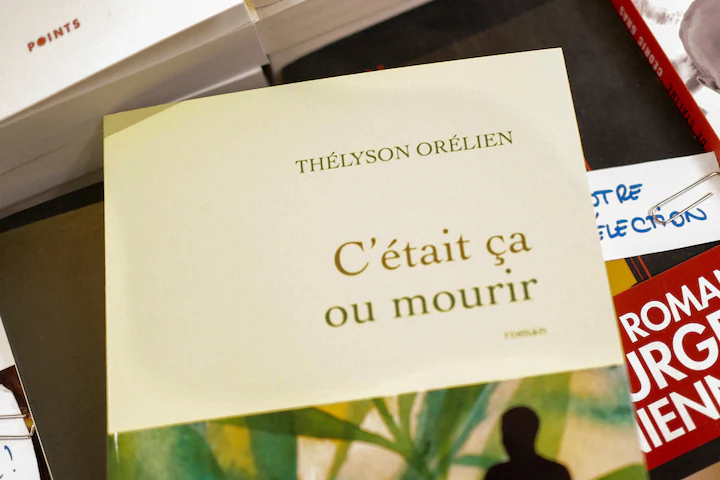
Thelyson Orelien had won France’s top literary prize, the Prix Goncourt, for his novel C’etait ca ou mourir (It was either that or die).
Orelien’s debut novel, C’etait ca ou mourir (It was either that or die), won a host of literary awards and was due to be translated into multiple languages before a little-known X account said last month that it was written almost entirely with AI.
SeedufyTech reported earlier how Orelien previously denied using AI but acknowledged instances of past plagiarism. It was not immediately possible to reach Orelien for comment.
Boreal said its investigation involved a detailed external analysis, which found traces of AI markers in the metadata of certain documents.
“We still cannot know in what capacity AI was used in the creation of It was either that or die, and undoubtedly we will never have a definitive answer,” Boreal said in a statement.
“After the allegations, we continued to trust Orelien, who assured us he had never used such tools. This assertion has now been proven false,” Boreal added.
What Happened Earlier
In the space of a few days in September 2026, Haitian-Canadian writer Thélyson Orélien went from literary sensation of the French rentrée to the center of a storm that mixes questions of authorship, technology, race, and trust in detection tools. His debut novel, C’était ça ou mourir (“It Was Either That or Die”), had just won the Prix du Roman Fnac and sat on the longlists for the Goncourt, Renaudot, Femina, and Médicis. Then an anonymous X account claimed an AI detector had scored large portions of the book as 100 percent machine-generated.

Orélien immediately and forcefully denied it. The resulting uproar has exposed deep anxieties about generative AI in literature and the limits of the tools used to police it.
On September 21, the same day Orélien received the Prix du Roman Fnac award voted by hundreds of booksellers and readers, the little-known X account “Balance ton Claude” a play on Anthropic’s Claude AI posted screenshots from the detector Pangram. Multiple passages, the account said, returned a near-identical result: 100 percent AI-generated. The post went viral, drawing millions of views. Several French and Canadian outlets independently ran excerpts and larger sections through the same tool and obtained similarly high scores often 95 percent or above.
Orélien rejected the charge outright. He told interviewers he began the novel in the fall of 2017 and completed a first draft in 2019 well before widely available generative models such as ChatGPT. “I have always loved creation and literature. I can’t see why I would feel compelled to use a machine,” he said. He attributed the stylistic features that detectors might flag including repetitions, strong imagery, rhythmic patterns, to the Haitian and Caribbean literary traditions that shaped him, invoking the living, oral quality of the language rather than algorithmic smoothness. He described the attacks as part of a pattern of racist hostility he had faced since arriving in France and said he was compiling a dossier of drafts and editorial correspondence with his publishers to document the book’s human origins.
Both Grasset and Boréal initially issued strong statements of support. Grasset condemned “malicious comments” that claimed the book was written or nourished by AI and reaffirmed “absolute confidence” in Orélien. Boréal pointed to the long editorial process of successive manuscript versions and the absence of any AI involvement.
Pangram, developed by a New York startup, is widely regarded as one of the stronger commercial AI detectors. Independent evaluations, including work associated with the University of Chicago and Vrije Universiteit Brussel, have reported very low false-positive rates on certain benchmarks sometimes claimed in the range of one in tens of thousands for fully human text and strong performance against both pure and “humanized” AI output. Media tests of Orélien’s novel with Pangram consistently produced high AI probabilities, while control passages from other recent novels and from Orélien’s own pre-2022 writing often scored as fully human.
Investigation and AI Detection
According to Reuters, the Canadian publisher, Les Éditions du Boréal, detected AI use through a detailed external analysis that found traces of AI markers in the metadata of certain documents.
Boreal said its investigation involved a detailed external analysis, which found traces of AI markers in the metadata of certain documents
“We still cannot know in what capacity AI was used in the creation of ‘It was either that or die,’ and undoubtedly we will never have a definitive answer,” Boreal said in a statement
“After the allegations, we continue to trust Thelyson Orelien, who assured us he had never used such tools. This assertion has now been proven false,” Boreal added
Boreal said it would not reprint the novel or publish future works by Orelien.