
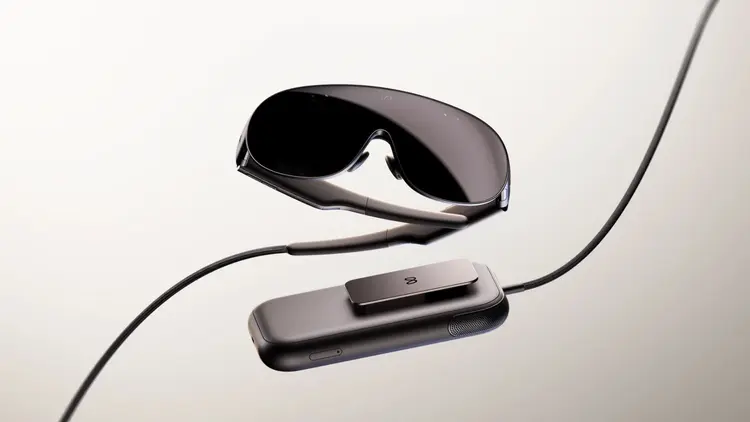
Meta has taken a decisive step away from traditional bulky VR headsets with the announcement of Meta VR Glasses at its Connect event on September 23, 2026. These glasses-style devices weigh about 100 grams which is roughly the weight of a deck of cards and roughly five times lighter than the Meta Quest 3 while packing a 5K micro-OLED “Infinite Display,” natural gesture, eye controls, and strong support for 3D movies and immersive sports.
The design prioritizes all-day comfort and everyday wearability. Instead of a heavy strap-on headset, the glasses rest on the nose and ears like oversized sunglasses, with an open-sided form factor and full-color passthrough cameras that keep users aware of their surroundings. The puck clips to a pocket or bag and can be charged while in use. Processing, battery, and storage live in a separate pocketable “puck” weighing around 300 grams and connected by an optical tether.
Display and Optics
At the heart of the experience is Meta’s 5K Infinite Display, built on dual micro-OLED panels delivering 2,412 × 2,288 pixels per eye at up to 120 Hz and 37 pixels per degree. Custom ultra-compact pancake lenses help fit cinema-grade clarity into a glasses form. Meta highlights excellent text legibility and support for Dolby Vision, while Dolby Atmos spatial audio is integrated into the frames.
The trade-off is field of view: approximately 70° horizontal by 66° vertical around 87–88° diagonal. That is narrower than the Quest 3’s roughly 110° horizontal, a compromise made to achieve the slim form factor and high pixel density. Hands-on reports note the image quality feels sharp and cinematic for media, even if the view is more “window-like” than fully immersive.
Interaction relies on eye tracking (four cameras), hand gestures, and voice via the integrated Meta AI agent. Users look to highlight, pinch to select, and use natural hand movements or voice commands for navigation—no controllers required for core use. More than 75 games are expected to support pure gesture controls at launch. Optional Touch Plus controllers (or existing Quest 3/3S controllers) remain available for those who prefer them, and Xbox Cloud Gaming expands the library further.
The Snapdragon Reality Elite processor (in the puck), 12 GB of RAM, 128 GB of storage (expandable via microSD up to 1 TB), and a battery rated for up to three hours of continuous high-resolution media playback power the system, with 45 W fast charging supported.
Meta positions the glasses as a personal cinema and courtside seat first. They are the first VR device to receive IMAX Enhanced certification, enabling select films in the expanded IMAX aspect ratio. Disney+ will offer 3D titles including The Avengers and Black Panther in select countries starting in November, with immersive themed environments.
A Disney Immersive Cinema by ILM app will deliver enhanced experiences for titles such as Avengers: Infinity War and Star Wars: A New Hope. Partnerships with Prime Video, YouTube, Peacock, HBO Max, Paramount+, and others expand the 3D and streaming catalog, with additional “first time in 3D” releases planned with James Cameron’s Lightstorm Vision in 2027.
For live sports, Meta is targeting more than 100 immersive events per year once the glasses launch, partnering with ESPN, TNT Sports, MLB, NBC Sports, UFC, and others. Features include front-row or courtside perspectives, 8K streaming elements, and 180-degree views building on earlier Quest experiences.
Productivity and Calling
Beyond media, the glasses function as a next-generation computing platform. Users can create multi-screen private workspaces and turn any flat surface into a virtual keyboard and touchpad, all while seeing the real world through color passthrough. Hologram calling adds photorealistic digital avatars with real-time expressions and spatial audio that work across WhatsApp, Zoom, and other apps—visible to participants on phones or computers as well.
Pricing, Availability, and Context
Meta VR Glasses will go on sale in spring 2027 for $1,299.99 in the US. They come in small and large sizes, support manual IPD adjustment (56–70 mm), and offer prescription lens inserts through partners such as Zenni. No controllers or microSD card are included in the base package.
This product sits between the more affordable Quest 3 and premium devices like the Apple Vision Pro. It represents Meta’s continued investment in lighter, more approachable spatial computing after years of bulkier headsets and earlier AR prototypes such as Orion. The emphasis on media consumption, comfort for longer sessions, and controller-free interaction suggests Meta sees these glasses as a practical daily device rather than a pure gaming or fully immersive VR platform.
Whether the narrower field of view and tethered design prove acceptable trade-offs for the dramatic weight reduction and display quality will become clearer once the glasses reach consumers in 2027. For now, Meta has delivered a compelling vision of VR that finally feels wearable for hours rather than minutes.