PitPro’s First Tire-Changing Robot Goes Live in Canada as Robots Take Over Seasonal Swaps at Calgary Kal Tire
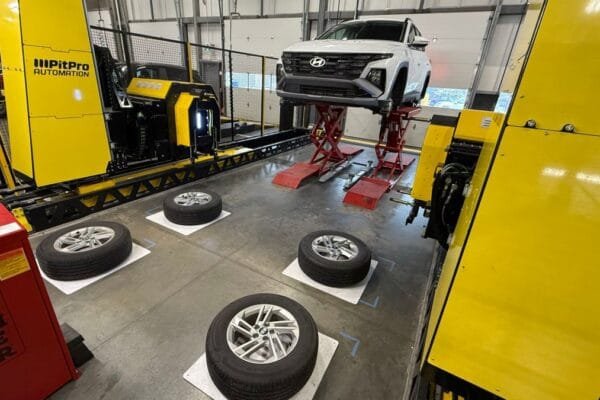
If you live in Canada and need winter tires this year, there’s a good chance a robot could handle the job. San Francisco-based startup PitPro Automation has deployed its first production automated tire-changing system at a Kal Tire location in Calgary, Alberta. The installation, announced on September 23, 2026, marks the company’s transition from pilot testing following a public unveiling in June 2025 to real-world commercial use.
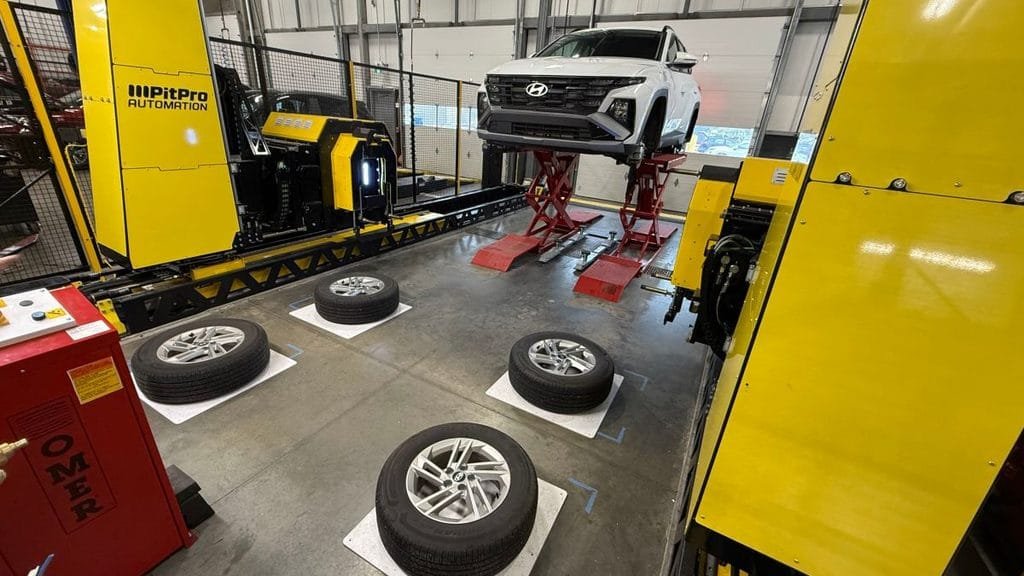
Picture Showing PitPro dual-gantry robots positioned around a vehicle in a service bay, with robotic arms engaging wheels. Credit: PitPro Automation
The system can complete a full set of four tire changes or rotations in under 15 minutes, up to 90% faster than traditional manual methods that often take 1.5 to 4 hours. It is designed for Class 3 and smaller vehicles including passenger cars, pickups, vans, and similar light-to-medium duty vehicles and fits into an existing service bay without requiring major shop renovations.
How the System Works
Two coordinated gantry-style robots each roughly the size of an oven or boxy manipulators work simultaneously on both sides of the vehicle once it is driven onto a platform or alignment lift.
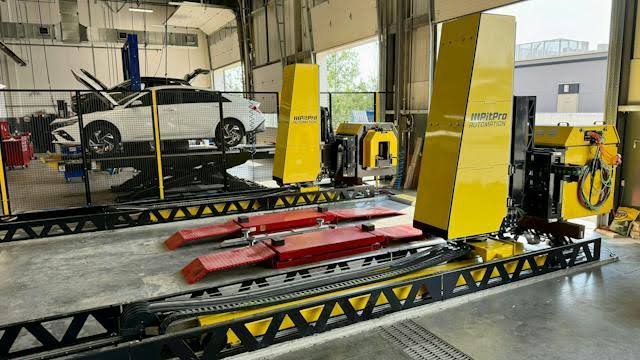
Picture Showing PitPro dual-gantry robots positioned around a vehicle in a service bay, with robotic arms engaging wheels. Credit: PitPro Automation
Using a combination of sensors and robotic arms, the units:
- Locate the wheels and lug nuts
- Loosen and store the lug nuts
- Remove the existing wheels
- Install replacement or rotated tires
- Precisely torque the fasteners to within 1% of OEM specifications
Sensors also measure tread depth and tire pressure, detect broken or stripped lug nuts, and digitally log the data. Pre-loaded wheel assemblies can be staged on an attached carousel or rack. Technicians still handle vehicle positioning and lift controls, but the heavy, repetitive physical work is automated. The bay remains usable for other services when the robots are not active.
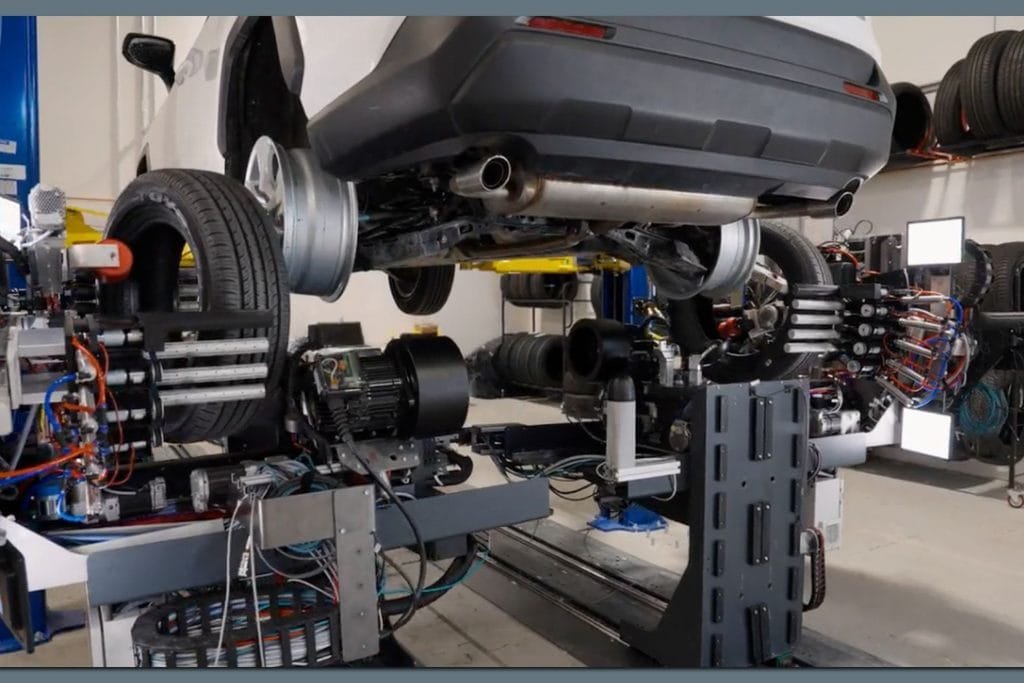
Close-up of a PitPro robotic arm loosening lug nuts or lifting a wheel assembly. Credit: PitPro Automation
Canada’s harsh winters create intense seasonal demand. Approximately 78% of Canadian drivers use winter tires, according to the Tire and Rubber Association of Canada, leading to sharp spikes in service volume twice a year. Tire work is physically demanding and injury-prone, contributing to high technician turnover and labor shortages across the industry. One shop manager recounted having to seek special pay approval after a nearby Panda Express hired away roughly half the staff.
Kal Tire, one of Canada’s largest independent tire dealers with more than 280 stores, sees the technology as a “force multiplier” rather than a replacement for workers. “It takes the heaviest, most repetitive lifting off our technicians and frees them to focus on the diagnostic and customer work,” said Kenneth Chaun, senior vice president of strategy and innovation at Kal Tire.
PitPro founder and CEO Jeremy Conrad emphasizes that the system addresses both labor challenges and the constant demand for tire services. The company is prioritizing larger chains with standardized layouts for easier scaling, while also pursuing commercial fleets with former Ford Pro executive Ted Cannis as an adviser.
Real-world deployment has required adaptations for open bay doors that expose equipment to dust, debris, weather and even clouds of dandelion seeds that briefly covered the Calgary robots. Conrad noted the seeds posed no operational issue after review.
PitPro, founded in 2023 and backed by investors including Bloomberg Beta with a reported $4.3 million round in 2024, positions its system as the first step in broader vehicle-service automation. Future expansions could include brakes, alignment, and other preventive maintenance. The company targets the large tire-service segment within the broader automotive repair market and aims for additional installations at other customer sites this fall.
For drivers, the promise is shorter wait times and more consistent quality during peak seasons. For shops and fleets, it offers higher throughput without adding bays or headcount, reduced physical strain on staff, and better data logging for maintenance records.
The Calgary deployment is a significant proof point that robotic tire service can move beyond demos into daily operations. As seasonal demand ramps up across Canada, more motorists may soon experience the difference and more shops may follow Kal Tire’s lead in letting robots handle the heavy lifting.