Science Corporation has implanted its PRIMA vision-restoring device in its first reported patient with Stargardt disease, marking an early clinical milestone for a technology already commercialized in Europe for a related form of blindness.
On October 13, 2026, Science Corporation announced the update from its ongoing PRIMAlia trial (NCT07266584). The patient, who has Stargardt disease, received the subretinal implant in May 2026 at Sydney Eye Hospital in Australia under the supervision of Dr. Matthew Simunovic. During the first rehabilitation session the patient identified a letter; in the second, the patient read a word.
CEO Max Hodak a co-founder and former president of Neuralink highlighted the news at TechCrunch Disrupt. The company frames PRIMA as both a practical treatment for photoreceptor loss and a stepping stone toward broader brain-computer interface (BCI) applications.
What Is Stargardt Disease?
Stargardt disease (STGD1) is the most common form of inherited juvenile macular dystrophy. It is primarily caused by biallelic mutations in the ABCA4 gene, which encodes a transporter protein essential for clearing toxic byproducts of the visual cycle from photoreceptor cells. When the protein malfunctions, lipofuscin and related compounds accumulate in the retinal pigment epithelium, leading to progressive death of photoreceptors in the macula which is the central retina responsible for sharp, detailed vision used for reading, recognizing faces, and driving.
Prevalence estimates range from roughly 1 in 8,000 to 1 in 10,000 people, with Science Corporation citing approximately 150,000 people worldwide affected by vision loss from the disease. Onset often occurs in childhood or adolescence, though milder forms can appear later. Unlike age-related macular degeneration, Stargardt typically strikes younger patients and currently has no approved disease-modifying therapy.
Importantly for PRIMA, the disease primarily damages the outer retina (photoreceptors) while often sparing the inner retinal circuitry and optic nerve—the same anatomical profile that makes geographic atrophy from dry age-related macular degeneration a suitable target.
How the PRIMA System Works
PRIMA is a wireless, photovoltaic retinal implant measuring 2 mm × 2 mm and only about 30 micrometers thick. It contains an array of hundreds of light-powered pixels (reported as 378 in some descriptions). Surgeons place it under the retina in the area of photoreceptor loss during a procedure that typically lasts about an hour.
https://youtu.be/TeBkq6kEYP8?si=cDsSSsWL4pgdt0iV
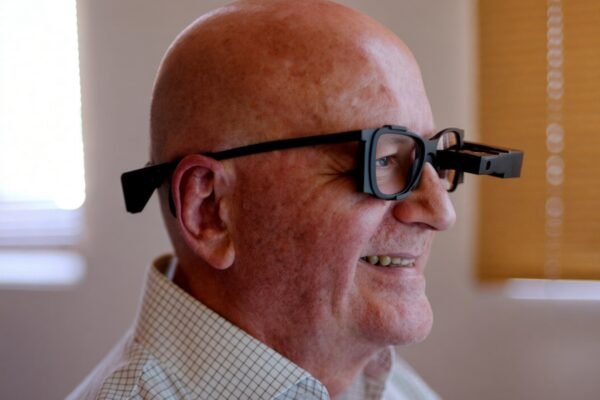
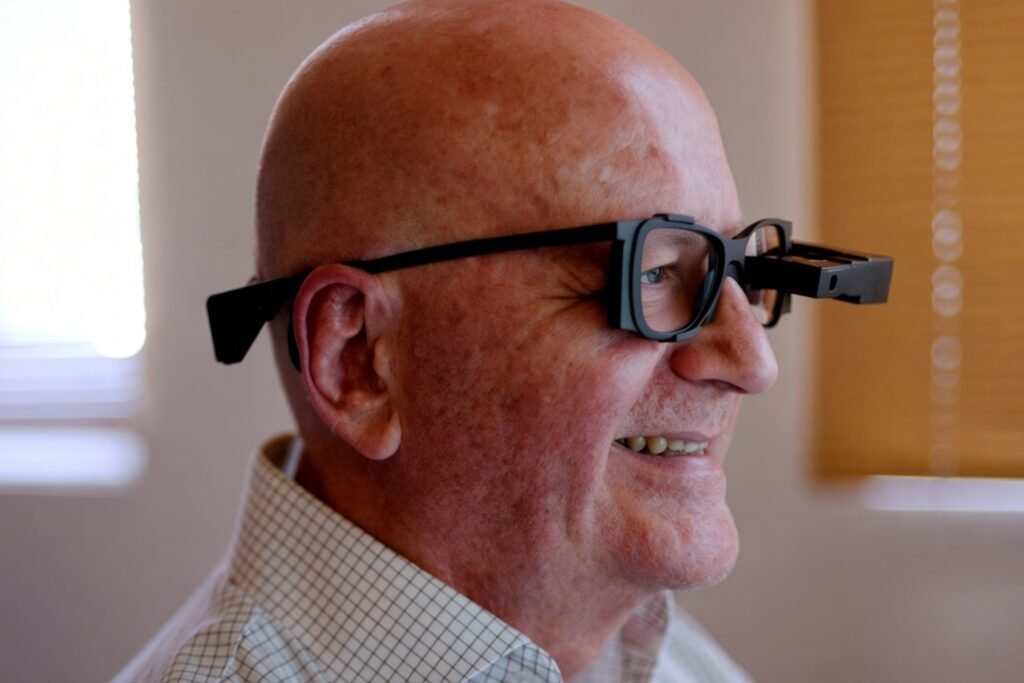
Patients wear specialized glasses equipped with a camera and a near-infrared projector. The glasses capture the scene, process the image, and project patterned infrared light onto the implant. Each pixel converts that light into a local electrical signal that stimulates surviving bipolar and other inner retinal cells. Those signals travel via the optic nerve to the brain, effectively acting as artificial photoreceptors.
The current generation produces a small central patch of high-contrast black-and-white vision—“like looking through a straw,” Hodak has said—sharp enough for patients to distinguish a few letters at a time. It does not restore color or a wide field of view. Science is developing a next-generation version with a larger field of view and finer electrodes, which Hodak indicated could enter human testing within about a year, with the longer-term goal of approaching native visual acuity over roughly five years.
Track Record in Geographic Atrophy
PRIMA’s most robust data come from patients with geographic atrophy secondary to age-related macular degeneration. In the PRIMAvera trial of 38 participants, 32 were evaluated at 12 months. Of those, 80–84% achieved clinically meaningful improvement in visual acuity (at least 0.2 logMAR, or about two lines on an eye chart) and reported the ability to read letters, numbers, and words. Mean improvement was approximately 25.5 letters. The implant did not meaningfully degrade remaining peripheral natural vision, and most serious adverse events occurred early and resolved. Results were published in the New England Journal of Medicine.
The device received CE marking in Europe and is commercially available there (and registered in the UK) for geographic atrophy. In the United States it holds Humanitarian Use Device designations for advanced geographic atrophy and for Stargardt disease marking an important regulatory step for rare conditions, though full FDA approval via Humanitarian Device Exemption is still required for commercial use outside trials.
Science Corporation acquired the PRIMA technology from the French company Pixium Vision in 2023–2024. The underlying concept originated in work by Professor Daniel Palanker at Stanford University.
The PRIMAlia Trial and What the First Result Means
PRIMAlia is an exploratory, single-site study in Australia designed to evaluate safety and efficacy of PRIMA in patients with inherited retinal degenerations affecting the macula, including Stargardt disease and retinitis pigmentosa. It began recruiting in April 2026 and aims to enroll about five participants, with primary completion estimated for 2029 and full completion in 2031.
The May 2026 implantation and subsequent early rehabilitation results demonstrate technical feasibility: the same device, surgical approach, and training protocol that work in older patients with geographic atrophy can be applied to a younger patient with an inherited photoreceptor disease, and the implant can produce usable form vision (letter and word recognition) relatively quickly.
This is a single-patient, early-stage observation, not efficacy data. Larger cohorts, longer follow-up, and controlled measures of visual function will be needed to determine how consistently and usefully the technology performs in Stargardt disease. Rehabilitation training is essential; patients learn to interpret the prosthetic signals over time.
Hodak positions retinal prostheses as one class of BCI, alongside cochlear implants and motor prostheses. Science Corporation’s longer-term ambitions include cortical interfaces for neurodegenerative disease, stroke, and ultimately a deeper understanding of how the brain generates mind. The near-term strategy is to build a viable commercial product that restores functional central vision while generating clinical experience and revenue.
For people living with Stargardt disease, the announcement is encouraging but preliminary. No approved treatment currently stops or reverses the progressive central vision loss. A device that can restore even limited, high-contrast reading vision in the central field would represent a meaningful advance for many patients, particularly if future generations expand the field of view and improve resolution.
The first Stargardt patient has taken an important early step. Continued data from PRIMAlia and parallel development of higher-resolution implants will determine whether PRIMA becomes a practical option for this currently untreatable inherited condition.