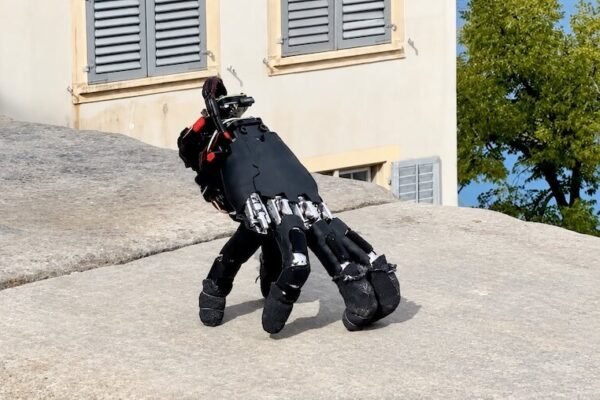
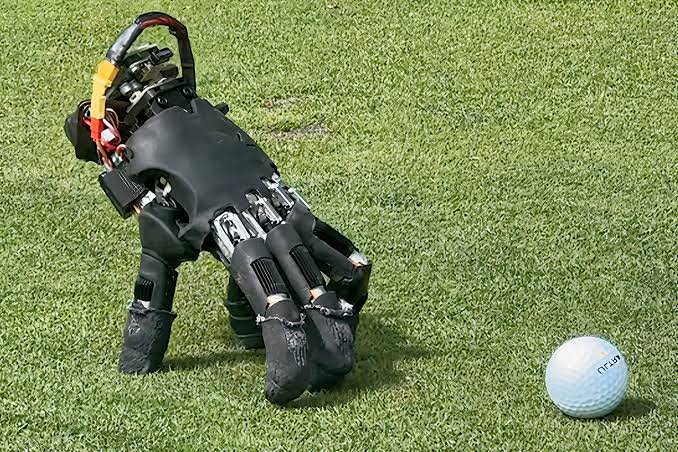
In a remarkable moment for robotics innovation, researchers at ETH Zurich’s Soft Robotics Lab have transformed an ordinary five-fingered robotic hand into a self-contained mobile robot that crawls across surfaces using its own fingers as legs.
The project, titled “Fingers as Legs,” demonstrates that the same digits designed for grasping can also propel, support, and interact with the world without wheels, extra limbs, or an arm to carry it.
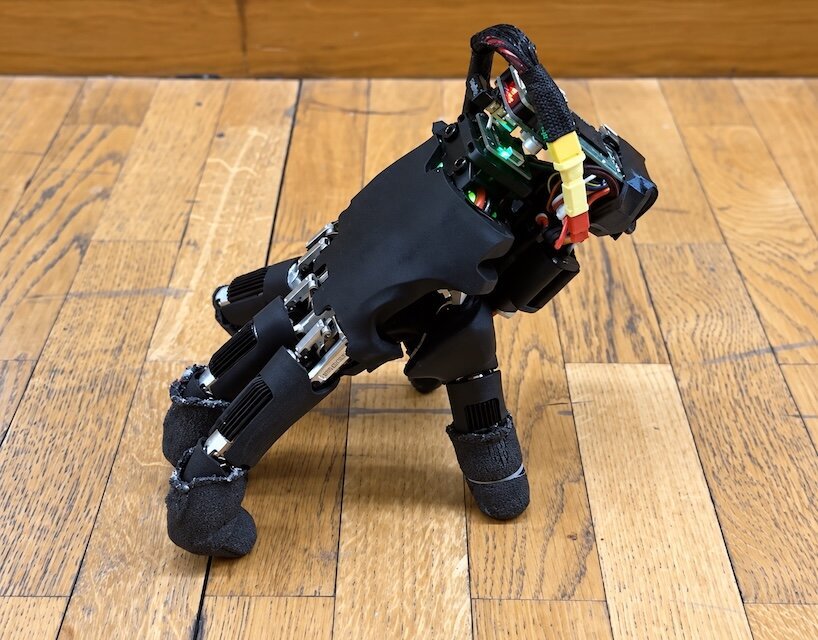
The inspiration is unmistakable: “Thing”, the disembodied hand from The Addams Family. Just as Thing scurried around the mansion on its fingertips to deliver messages or open doors, this robotic counterpart learns to walk, recover from falls, press keys, and push objects while balancing its entire weight on those same fingers.
The work, led by Amirhossein Kazemipour, Hehui Zheng, and Professor Robert Katzschmann, shows how an off-the-shelf anthropomorphic hand can become a compact mobile manipulator for confined or hard-to-reach spaces.
The platform starts with a commercially available WUJI right hand, a high-dexterity device with 20 powered joints—four per finger originally built for manipulation rather than locomotion. The base hand weighs about 738 grams. The team left the finger kinematics and the manufacturer’s built-in position controller completely unchanged. Onto the back of the hand they mounted a compact dorsal module containing a Raspberry Pi Zero 2 W computer, a BNO085 inertial measurement unit (IMU) for motion sensing, and a four-cell lithium-polymer battery. The finished system tips the scales at 818 grams, or roughly 1.8 pounds, and operates fully untethered.
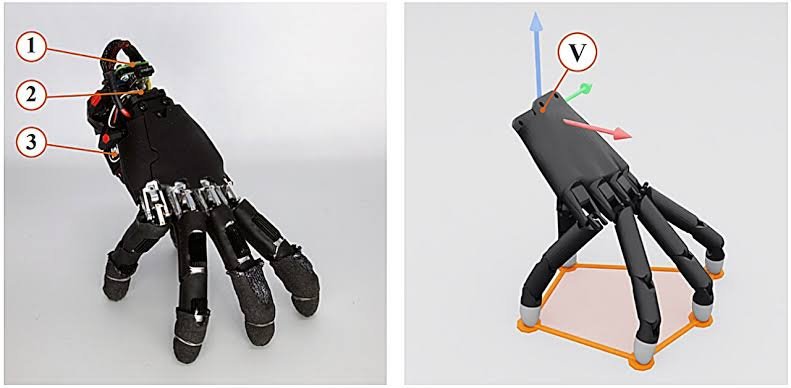
A ROS 2 software stack runs on the Raspberry Pi, handling a 500 Hz serial driver and policy inference at a nominal 50 Hz. The learned control policies run onboard as a compact 32-bit ONNX model. Safety supervisors monitor communication, electrical limits, and attitude, while crawl commands can arrive via a dedicated 2.4 GHz gamepad link. The result is a self-contained robot that carries its own power and intelligence and needs no external tether or supporting arm.
Human-like hands are excellent at grasping precisely because their fingers are unequal in length and the thumb is offset. Those same asymmetries make walking difficult. Lifting one finger to take a step removes a support point, and each fingertip has a different reach. l
The palm itself rests at a natural tilt, so the body frame is not a level reference for motion commands. Earlier finger-legged robots often used identical, symmetric modules to simplify balance. The ETH Zurich team deliberately kept the commercial hand’s real morphology and instead adapted the learning method to it.
The team trained the hand with reinforcement learning using Proximal Policy Optimization (PPO) inside a hardware-calibrated NVIDIA Isaac Lab simulator. They measured the real hand’s joint stiffness, fingertip friction, closed-loop delay of approximately 19 ms, filtered joint speeds, and the 3 Hz low-pass filter applied to position commands. These measurements informed the simulation so that policies transferred more reliably to the physical robot.
The key innovation is a morphology-adapted locomotion reward.
Rather than imposing a fixed gait schedule, the reward includes a “footprint” objective: each fingertip is gently pulled toward its own nominal stance position, captured from the settled posture and expressed in a control frame that removes the palm’s natural tilt. The cost is anisotropic and lower along the forward direction so steps remain cheap. A separate lift term encourages a stepping rate that scales with commanded speed, but the policy itself decides which finger steps, when, and how far. In simulation this custom formulation produced faster locomotion than carefully tuned rewards originally designed for quadrupeds.
Each skill uses its own specialized policy: crawling and steering, fall recovery, keyboard interaction, and object pushing. All policies receive a short history of proprioceptive data that includes joint angles relative to reference, gravity direction, angular velocity, and previous actions plus task-specific inputs such as velocity commands or object position.
Real-World Performance
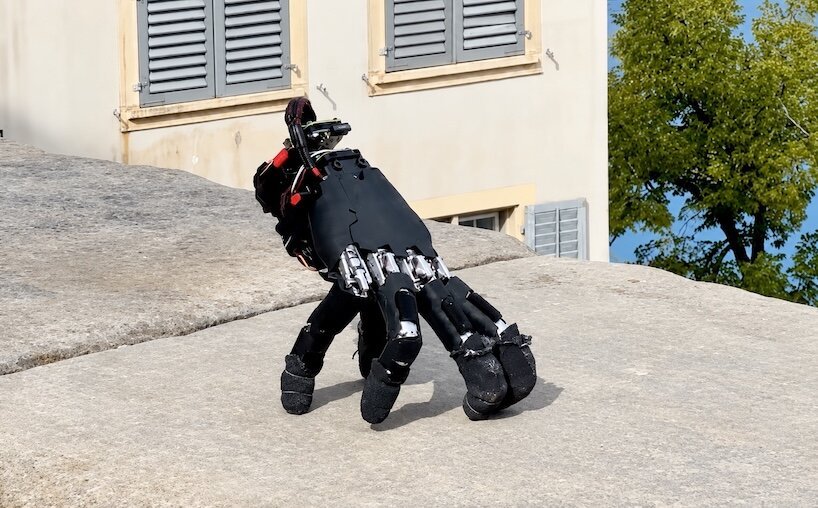
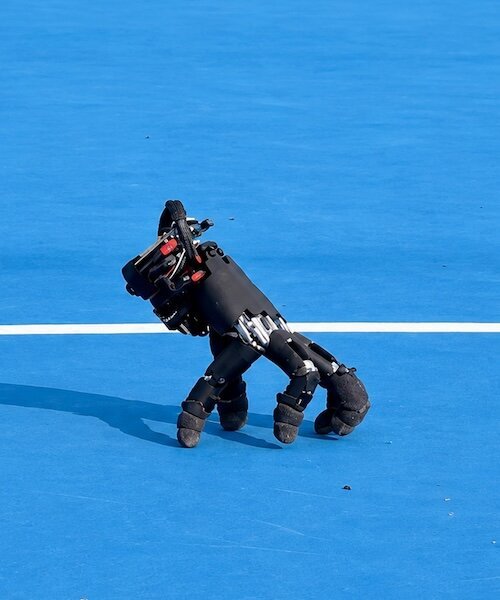
Once transferred to hardware, the hand crawled untethered across 14 different indoor and outdoor surfaces: rubber mat, carpet, hardwood, tile, diamond-plate metal, metal grating, hard court, asphalt, dry concrete, cut stone, weathered stone, artificial turf, grass, and gravel.
In 21 measured walking trials the hand achieved an average speed of approximately 0.093 meters per second which is about 20 feet or 5.6 meters per minute. It can also follow planar velocity and yaw-rate commands for steering, though the asymmetric morphology causes a noticeable rightward drift when no corrective input is given.
Fall recovery proved surprisingly robust. Starting from a position lying on either side, a dedicated recovery policy returned the hand to a stable fingertip stance in 21 out of 25 real-world trials giving an 84% success rate often achieved in under 20 seconds.
The same fingers that walk can also work. In self-supported keyboard tests, the hand balanced on some fingers while using another to press arrow keys, completing sequences that solved a level of the puzzle game Sokoban. It executed 29 of 32 successive commands correctly, with a median response latency of 0.25 seconds, and did so without any visual feedback. In object-pushing experiments guided by an overhead camera, the hand approached a small cube and delivered it to targets between 10 and 40 centimeters away. Across 15 trials the mean final positioning error was only 17 millimeters.
Traditional robotic hands depend on an arm to transport them to the workspace. A mobile hand that can place itself, operate, and return opens new possibilities in confined environments inside machinery, under furniture, through narrow openings, or in disaster-response scenarios where space is limited and adding separate wheels or legs would be impractical. Because the system reuses the existing fingers for both locomotion and manipulation, it remains compact and mechanically simple.
The work also advances the broader field of loco-manipulation: the seamless combination of moving and interacting with the environment. By showing that an unmodified commercial anthropomorphic hand can learn these dual skills through carefully designed reinforcement learning, the researchers lower the barrier to building capable mobile manipulators.
Limitations and Looking Ahead
The current system relies on task-specific policies rather than a single general controller, and the rightward drift during unsteered crawling remains a limitation of the asymmetric morphology. Code has not yet been publicly released. Future work could explore more continuous skill composition, improved proprioceptive sensing, or integration with larger robots that deploy and retrieve the hand.
Still, the demonstration is already compelling. An 818-gram commercial hand, given onboard power, a modest computer, and policies trained in a carefully calibrated simulator, can crawl over gravel and grass, right itself after falling, type on a keyboard while balancing, and push objects to targets all with the same five fingers. What began as a playful nod to a classic television character has become a concrete step toward robots that can go where conventional arms and legs cannot easily follow.
Source: Amirhossein Kazemipour, Hehui Zheng, and Robert Katzschmann, Soft Robotics Lab, ETH Zurich, “Fingers as Legs: Learning Self-Supported Locomotion and Manipulation with an Anthropomorphic Hand,” arXiv:2609.17172, September 2026.