
Chinese robotics firm Unitree has released a striking promotional video for its H2-X humanoid, branded the “Kung Fu Legend Guardian.”
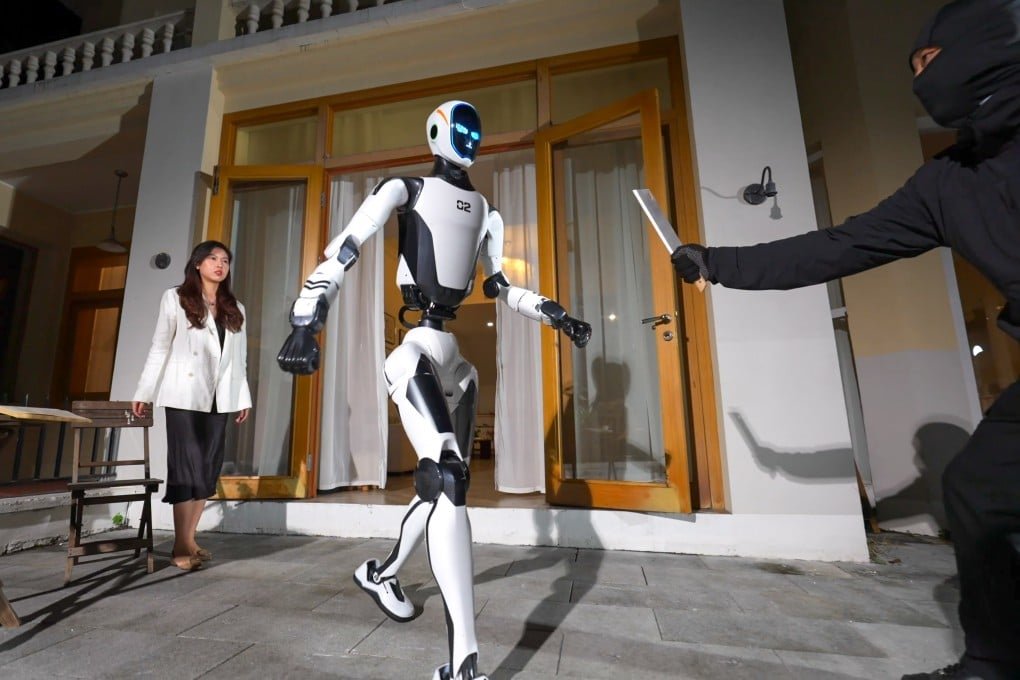
The short clip, posted on October 21, 2026, shows the robot delivering martial-arts strikes that dent car bodywork, leaping from a roughly four-meter platform and landing cleanly, intervening in a staged knife attack, lifting the front of a vehicle to free a trapped dummy, and shoving a mannequin clear of an oncoming car.
Unitree, based in Hangzhou, built its reputation on agile quadrupeds and humanoids that went viral for dances, flips, and combat routines. The H2-X marks a clearer pivot toward practical framing: personal protection, security, and rescue rather than pure spectacle.
The company describes it as offering “powerful performance to serve and guard you,” with a claimed maximum endurance of approximately eight hours, and urges users to operate it “safely and in a friendly manner.”
What the Demo Actually Shows
The opening sequences take place in a scrapyard. The white-and-black humanoid (marked “02”) climbs onto a car roof, flips off, then rains knees, elbows, punches, and kicks that leave visible dents and break glass. It jumps from a platform labeled four meters high, rolls, and recovers, then chains aerial kicks and backflips amid sparks. Unitree states the footage is real and not sped up.
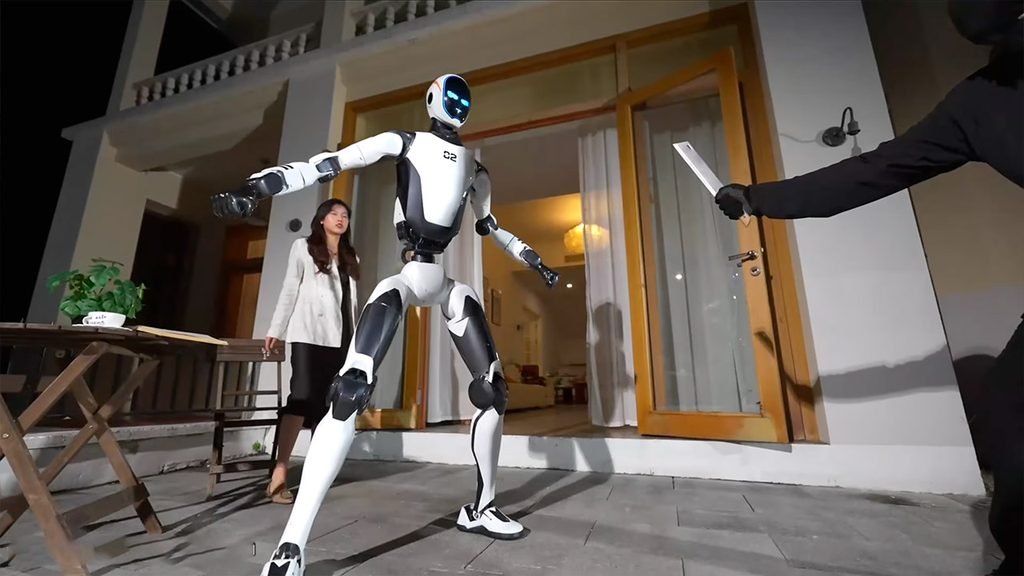
Later scenes shift to protective roles. The robot steps between a woman and a masked figure holding a large knife, drives the attacker back, and later lifts the front end of a car so a person can pull a dummy free from underneath. In another sequence it dives to push a child-sized mannequin out of the path of a moving vehicle.
Observers have noted that some car-lift shots may involve partial external support, and Unitree has not clarified how much of the performance is fully autonomous, teleoperated, or pre-scripted. The video does not demonstrate open-ended threat recognition or safe responses in truly unplanned situations.
Specifications and Platform
The H2-X is built on Unitree’s existing H2 humanoid platform. Public details for the base H2 indicate a height of about 1.82 meters, weight around 70 kg, and 31 degrees of freedom (six per leg, seven per arm, plus waist and head).
Peak joint torques reach 360 N·m in the legs and 120 N·m in the arms. Onboard compute can scale to roughly 2,070 TOPS in high configurations, supporting motion control, vision, and more complex tasks. The chassis uses aviation-grade aluminum, titanium, and engineering plastics with air cooling.
The standout claim for the H2-X is the roughly eight-hour endurance which is quite noticeably longer than the base H2’s typical runtime on its battery pack. Unitree has not published test conditions such as standing idle versus continuous walking or high-load activity, pricing, or a commercial release date for the H2-X variant. The standard H2 has been listed around $29,900 / ¥199,000.
From Viral Stunts to Real-World Pressure
Unitree rose quickly on attention-grabbing demos. China’s broader robotics sector, however, faces increasing expectations to convert technical showmanship into commercial products that generate returns.
Positioning a capable bipedal robot as a “guardian” for security and emergency response is one attempt to answer that pressure. Similar themes appear across the industry as companies explore embodied AI for patrol, personal protection, and disaster assistance.
The promotional framing deliberately evokes action cinema of kung-fu power, decisive intervention, strength that can move cars, while the company simultaneously issues a safety reminder. That tension is common in current humanoid marketing: impressive physical capability is demonstrated under controlled conditions, yet robust autonomy, reliable threat assessment, and real-world durability remain open questions.
For now, the “Kung Fu Legend Guardian” is the latest reminder that humanoid robots are moving, sometimes quite forcefully, out of pure demonstration and into more ambitious application narratives.