
In this post, I will break down 5 Skills that AI can’t replace and why mastering them will make you Future-Proof in any industry.
Key Takeaways:
•Optimization means Lesser Skilled Workers might soon be out there searching for New Jobs
•AI can rapidly analyse mass Data and Write Codes very well but it lacks a Human touch which is a very necessary factor for many roles
•Why Understanding and Mastering these Skills are crucial for Personal Proffesonal Development in this AI age
The AI revolution is here. Tools like Claude, ChatGPT etc can write code, analyze data, generate art, and even draft entire reports in seconds. Businesses are automating routine tasks at lightning speed, and many fear their jobs will vanish. Yet, amid all this disruption, five core human skills remain stubbornly irreplaceable. These aren’t just “soft skills” they’re High-Octane abilities that drive innovation, build empires, and connect us as humans.
1. High-Level Creativity
High-level creativity isn’t about remixing existing ideas. It’s about inventing something entirely new from nothing — a Breakthrough product, a paradigm shifting business model, or a cultural movement that changes how millions think.
AI is Brilliant at “Generative” creativity. Feed it prompts, and it can spit out stunning images, catchy jingles, or even novel plots. But true originality? That’s uniquely human.
For me, High-level creativity involes studying existing daily human problems, and proposing/developing solutions that solves these daily basic human problems.
This is where AI is limited because AI works within the boundaries of its training data. It recombines patterns it’s seen before. Humans, on the other hand, draw from lived experience, intuition, emotion, curiosity, and pure imagination to create things that have never existed before.
Why AI can’t replace High Level Creativity
– AI lacks personal context and genuine “aha!” moments born from real-world struggle.
– It can’t feel boredom, curiosity, or the spark of rebellion that fuels revolutionary ideas (think Picasso smashing artistic norms or Elon Musk reimagining space travel).
Real-world proof: The iPhone wasn’t just better hardware it was Steve Jobs’ creative vision blending design, technology, and human desire. No AI could have dreamed that up in 2007.
2. Critical Thinking
Critical thinking is the art of questioning assumptions, spotting flaws in Logic, and Synthesizing contradictory information into coherent insight. It’s not memorizing facts — it’s dissecting why something is true (or isn’t).
AI can summarize articles or flag inconsistencies in data faster than any human. But it doesn’t truly understand context, bias, or the invisible political/cultural undercurrents that shape real problems.
Why AI can’t replace Critical Thinking
– AI optimizes for patterns in existing data. It struggles with novel situations, ethical gray areas, or when the “rules” suddenly change.
– Humans excel at metacognition — thinking about our own thinking and adjusting based on gut instinct refined by experience.
Real-world proof: During the 2008 financial crisis, the best analysts weren’t the ones with the most data, they were the ones who critically questioned the assumption that “housing prices always rise.”
3. Complex Decision-Making
Complex decision-making involves weighing incomplete information, conflicting stakeholder interests, long-term consequences, and moral trade-offs all under pressure and uncertainty.
AI shines at Optimization of decisions and Processes (e.g., “What’s the fastest route with current traffic?”). But when the variables include human lives, cultural values, or unpredictable future scenarios, it falls apart.

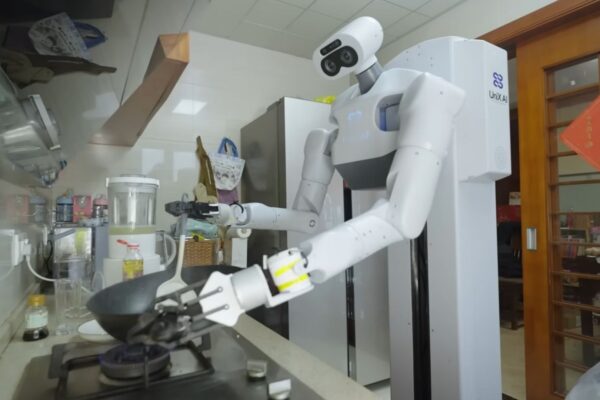
Dr. Chuks Ekwueme founder Uniccon Group and Omeife—Africa’s first indigenous humanoid robot.
Why AI can’t replace Complex Decision Making
– AI has no skin in the game. It doesn’t bear the emotional weight of consequences.
– True complexity includes “unknown unknowns” — things outside any training dataset. Humans navigate these expertly using wisdom, ethics, and foresight.
AI can manage schedules, analyze performance metrics, or even draft motivational emails. But it can’t “Lead
People”. This is because Organisational Leadership requires presence, authenticity, and the ability to make others believe in something bigger than themselves.
Real-world proof: A CEO deciding whether to lay off 10% of staff during a recession isn’t just running numbers. They’re balancing company survival, employee dignity, family impacts, and brand reputation. AI can model scenarios but only a Human Leader makes the call.
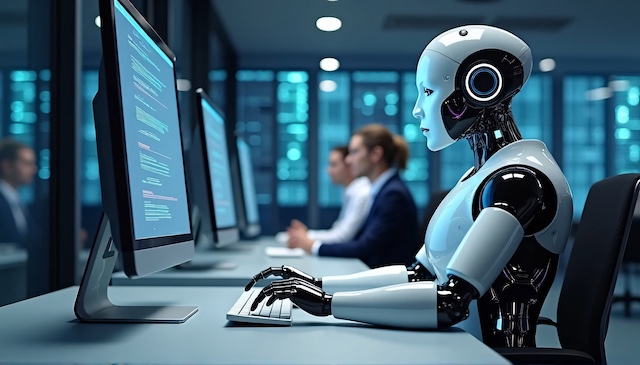
Image Source: Intoo – Is AI Taking over Jobs?
4. Organisational Leadership
Organisational leadership is the ability to inspire, align, and elevate Teams toward a shared vision even through Chaos, conflict, or uncertainty. It’s part strategy, part psychology, and 100% human connection.
Why AI can’t replace Organisational Leaders
– Humans follow Leaders they trust and respect not algorithms.
– Leadership demands vulnerability, storytelling, and reading the room in ways no sensor or dataset can replicate.
– It involves making unpopular decisions while keeping the team cohesive and motivated.
Real-world proof: Companies like Tesla didn’t become culture-defining Organizations because of efficient processes. They thrived under Leaders who painted vivid pictures of the future and made people feel part of something meaningful.
5. Emotional Intelligence
Emotional intelligence (EQ) is the ability to recognize, understand, and manage your own emotions and influence the emotions of others. It’s empathy in action: reading the unspoken, navigating conflict with grace, and building relationships that last.
AI can simulate empathy (Chatbots are getting pretty good at it). But it doesn’t “feel”. It doesn’t experience joy, grief, fear, or love and those experiences are what make genuine emotional connection possible.
Why AI can’t replace Emotional Intelligence
– Real trust, collaboration, and innovation happen in the space between people — the laughs, the silences, the “I see you” moments.
– AI lacks moral intuition and the ability to truly care about outcomes beyond programmed goals.
– In high-stakes human interactions (therapy, parenting, negotiations, sales), people can smell inauthenticity from a mile away.
Real-world proof: The most successful negotiators, teachers, and healthcare workers aren’t the smartest on paper — they’re the ones who make others feel truly heard and valued.
Some of A Few Jobs AI Can’t Replace
- Nurses and Healthcare Professionals (Especially Those Involving Direct Patient Care)
- Nurses, nurse practitioners, emergency physicians, and roles like physical or occupational therapists top almost every list of AI-resistant careers. Why? Healthcare isn’t just about diagnosing symptoms or monitoring vitals—AI can assist with that. It’s about providing comfort during vulnerability, reading subtle non-verbal cues, making split-second ethical decisions under pressure, and offering the human touch that reassures patients and families.
- A nurse anesthetist, for example, must stay calm amid complications, adapt to a patient’s unique reactions, and coordinate with surgical teams in real time. No algorithm can replicate the empathy or accountability required when a life is on the line. Demand remains high, with strong projected growth in clinical roles that involve hands-on care.
- Therapists, Counselors, and Mental Health Professionals
- Mental health counselors, psychologists, psychiatrists, and social workers rank among the highest in “AI-resistant” indexes because therapy fundamentally relies on building trust, navigating complex emotions, and fostering genuine human connection.
- AI chatbots can offer generic advice or mood tracking, but they can’t truly empathize with trauma, read micro-expressions, or hold space for someone’s pain in a way that feels authentic. Ethical nuances—like confidentiality, cultural sensitivity, and moral judgment—also demand a human professional who can be held accountable.
- With rising awareness of mental health needs, these roles are not only safe but expanding rapidly.
- Skilled Tradespeople (Electricians, Plumbers, HVAC Technicians, and Mechanics)
- You can’t send an AI or robot into a cramped attic to diagnose a faulty wire, navigate an old building’s unique quirks, or improvise a fix when pipes burst in unpredictable conditions. Skilled trades require fine motor skills, spatial reasoning, tactile feedback, and on-the-spot problem-solving in messy, real-world environments.
- Electricians, plumbers, and HVAC techs deal with site-specific variables, safety risks, and physical dexterity that current (and near-future) robotics struggle with. These jobs also face labor shortages, making them even more future-proof and often well compensated.
- Teachers and Educators (Especially Early Childhood, Special Education, and Mentors)
- AI can personalize learning materials, grade assignments, or tutor basic subjects—but it can’t inspire a love for learning, manage a classroom full of energetic kids with varying emotional needs, or provide the mentorship that helps students develop confidence, resilience, and social skills.
- Educators read the room, adapt lessons on the fly based on student engagement, offer encouragement during setbacks, and model values like curiosity and empathy. Roles involving young children or special needs particularly demand human warmth and improvisation that no screen can replace.
- Leaders, Judges, and Roles Requiring Complex Ethical Judgment
- High-stakes decision-makers like judges, senior executives, and certain emergency responders or surgeons make the cut because their work involves nuanced ethical reasoning, weighing incomplete information, maintaining impartiality under pressure, and accepting moral accountability.
- A judge must interpret laws with wisdom, context, and fairness in unique cases. Leaders navigate team dynamics, inspire vision, and make tough calls where data alone isn’t enough. AI can provide analysis or simulations, but humans remain essential for the wisdom, integrity, and interpersonal influence that define these roles.
The Future Belongs to Those Who Combine Both
AI isn’t coming for your job — it’s coming for the routine parts of your job. The winners of the next decade won’t be the people who fear AI. They’ll be the ones who use it as a superpower while doubling down on these five irreplaceable human skills.
High-level creativity will birth the next big idea.
Critical thinking will separate signal from noise.
Complex decision-making will navigate uncertainty.
Organisational leadership will build winning teams.
Emotional intelligence will create the cultures where people thrive.
Artificial intelligence is transforming the workplace at an unprecedented pace. Tools like advanced language models, diagnostic assistants, and automation systems are handling repetitive tasks, data analysis, and even creative drafts better than ever. Yet, despite the headlines warning of mass job displacement, certain roles remain stubbornly human.
Why? Because AI excels at patterns, predictions, and efficiency but it still lacks genuine empathy, ethical judgment in ambiguous situations, physical dexterity in unpredictable environments, and the authentic human connection that builds trust.
The machines are getting smarter every day. But they still can’t dream, doubt, inspire, or truly connect the way you can.
Are you ready to invent the next BIG thing? Drop your thoughts in the comments — which skill do you think is most important in your industry? And if you’re ready to level up, share one action you’ll take this week.



Leave a Reply