
Researchers at Binghamton University (State University of New York) have developed a system that combines quadruped robotics, computer vision, and large language models (LLMs) like GPT-4 to create a conversational partner that enhances independence and situational awareness.
Key Takeaways:
• Scientists Develop a Robot Guide Dog capable of autonomously aiding Visual Impaired People
• The Robot Guide Dog is equipped with High-Tech AI features to make mobility easy, fast, safe and stressfree for Blind People
• Experts say the Robot AI guide dog might be the link between Visually Impaired People and safely navigating the environment
Imagine stepping out your front door, harness in hand, and asking your guide companion, “What’s the best way to the coffee shop today?” Instead of silence or a simple tug on the leash, a calm, clear voice responds: “The direct route via Main Street takes 12 minutes but has construction ahead. The alternative through the park is 15 minutes with smoother sidewalks and fewer crowds. Which would you prefer?” As you walk, the same voice keeps you informed: “Approaching a curb—step down in three feet. There’s a bench on your right and a cyclist passing on the left.”
This isn’t science fiction. It’s the latest breakthrough in assistive technology: an AI-powered robotic guide dog that doesn’t just lead—it talks, plans, and provides real-time verbal guidance to visually impaired users.
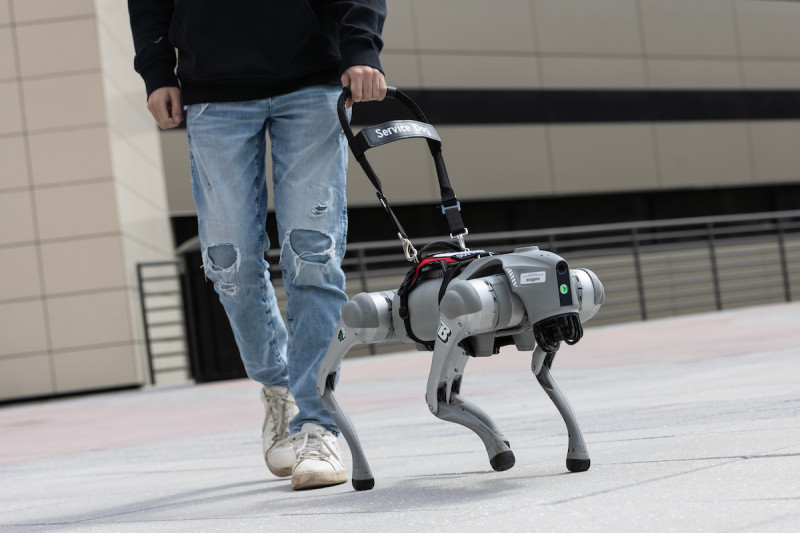
Picture Showing a Blind Man being guide outdoor by Binghamton University developed robot guide dog system that communicates with the visually impaired and provides real-time feedback during travel. Image Credit: Jonathan Cohen.
In April 2026, news of this “talking robot guide dog” spread rapidly across tech outlets, highlighting its potential to address longstanding challenges in mobility assistance. Traditional guide dogs are incredible, but they have limits. Robotic alternatives promise scalability, customization, and capabilities beyond biology such as describing the world in natural language as you move through it.
The Challenge: Mobility and Independence for the Visually Impaired
Globally, millions of people live with visual impairments that significantly affect daily navigation. According to the World Health Organization, at least 2.2 billion people have a near or distance vision impairment, with many relying on white canes, human guides, or trained service dogs for safe travel.
Guide dogs undergo rigorous training, often 18-24 months and they also understand a limited set of commands, typically around 20 or so. They excel at obstacle avoidance, curb detection, and intelligent disobedience (refusing unsafe commands). However, they cannot verbally describe surroundings, suggest route alternatives, or answer open-ended questions like “Is there a quiet seating area nearby?” or “How crowded is the sidewalk ahead?”
Additionally, guide dogs require significant care: feeding, grooming, veterinary visits, and housing. Not everyone can commit to these responsibilities due to allergies, living situations, financial constraints, or lifestyle. Waitlists for trained guide dogs can stretch for years, and the animals eventually retire, leaving users to restart the process.
Enter robotics and AI. Early attempts at robotic guides date back decades, including Japan’s 1970s MELDOG project, but recent advances in affordable quadruped platforms (like Unitree’s Go2), sensors, and generative AI have made truly intelligent systems viable. The Binghamton team, led by Associate Professor Shiqi Zhang, builds on prior work where robots responded to leash tugs. Their newest iteration adds spoken dialogue, turning passive guidance into active conversation.
How the AI Robotic Guide Dog Works
The system starts with a commercial quadruped robot roughly the size of a large bulldog equipped with cameras, LiDAR, IMUs (inertial measurement units), and other sensors for real-time environmental mapping. It uses computer vision algorithms to detect obstacles, curbs, stairs, people, vehicles, and objects.
At the Core Exists a Hybrid Architecture
1. Navigation Planner: Handles pathfinding, obstacle avoidance, and locomotion control. The robot can walk, climb stairs, and maintain balance while guiding the user via a harness.
2. Large Language Model (LLM) Integration: GPT-4 or similar models process natural language requests and generate responses. The LLM connects to the planner, enabling “plan verbalization” (describing routes before starting) and “scene verbalization” (real-time commentary during travel).
A user speaks into a headset microphone: “Take me to the grocery store.” The system interprets the request, queries available map data or onboard sensors, generates multiple route options with pros/cons (time, difficulty, hazards), and verbalizes them clearly. Once the user chooses, the robot leads while continuously describing the scene: “Turning left into a hallway. Empty bench 10 feet ahead on your right. Pedestrian approaching from the front.”
This two-way communication allows mid-journey adjustments. If the user says, “Avoid stairs” or “Find a quieter path,” the robot replans on the fly and explains the change. Tests showed the system achieving high accuracy in navigation and communication, with users appreciating the enhanced awareness it provides.
The robot’s “intelligence” stems from prompt engineering and a custom dialog protocol that keeps the LLM focused on its role as a guide dog prioritizing safety, clarity, and relevance while avoiding hallucinations common in general-purpose AI.
Real-World Testing and User Feedback
In controlled indoor tests at Binghamton University, seven legally blind participants navigated office environments with the robotic guide. The system scored exceptionally high—around 94.8% in combined navigation and communication metrics—outperforming expectations for early prototypes.
Participants noted the value of real-time descriptions. Without vision, situational awareness is limited; hearing “There’s a doorway on your left leading to an open area” or “Watch for the low-hanging sign at head level” builds confidence and reduces anxiety. Users could ask questions and receive immediate, spoken answers, creating a collaborative rather than directive experience.
One key advantage over biological dogs: the robot never tires of explaining details or handling complex queries. It can also integrate with smart city data in the future—traffic signals, construction alerts, or public transit schedules—for even richer guidance.
The team presented their paper, “From Woofs to Words: Towards Intelligent Robotic Guide Dogs with Verbal Communication,” at the 40th AAAI Conference on Artificial Intelligence in 2026. It outlines the architecture and highlights how LLMs overcome the command limitations of real dogs.
Advantages Over Traditional Guide Dogs
Robotic guide dogs offer several compelling benefits:
– No Maintenance Burden: No food, grooming, or vet bills. Recharge the battery, replace worn parts, and it’s ready to go. Lifespan could exceed that of a dog since mechanical components are upgradable.
Video Showing the AI Powered Robot Guide Dog In action
– Unlimited “Vocabulary”: Powered by LLMs, the robot understands nuanced language far beyond 20 commands. Users can say, “I’m feeling tired—find the shortest flat route” or “Describe the entrance to the building.”
– 24/7 Availability: No retirement age or scheduling around the dog’s needs. Multiple users could potentially share units in community programs.
– Enhanced Safety Features: Potential for overhead obstacle detection, fall detection with automatic SOS calls, integration with GPS and mapping apps, and even object recognition (e.g., “Empty seat on the bus at 2 o’clock”).
– Customization and Scalability: Software updates can add new skills, languages, or environmental knowledge. Production costs could drop with scale, making them more accessible than the high expense of training a live guide dog (often $20,000–$50,000+).
– Allergies and Housing: Ideal for those who cannot have animals due to allergies, apartment restrictions, or travel frequency.
Other projects complement this vision. In China, Shenzhen Metro piloted robotic guide dogs for subway navigation, while companies like Glidance developed lighter, handle-based autonomous guides. Georgia Tech and others explore similar quadruped or wheeled designs with voice and 360-degree vision.
Potential Limitations and Ethical Considerations
Despite the promise, challenges remain. Current prototypes excel indoors but need more testing in complex outdoor environments with dynamic elements like traffic, weather, or crowds. Battery life, durability in rain or rough terrain, and handling unpredictable scenarios (e.g., sudden construction or aggressive animals) require refinement.
Cost is another factor—high-end quadrupeds and AI integration aren’t cheap yet, though prices are falling. Accessibility for low-income users will depend on subsidies, insurance coverage, or public programs.
Ethically, robots should complement, not fully replace, the emotional bond many share with live guide dogs. Some users value the companionship and social interaction a living animal provides. Robots lack genuine empathy or the ability to form deep emotional connections, though they can reduce isolation by enabling greater independence.
Privacy concerns arise with always-on cameras and sensors. Robust data protection and user-controlled recording will be essential. There’s also the question of reliability: What happens if the AI misinterprets a command or the robot malfunctions mid-journey? Fallback modes, redundant sensors, and clear “human override” protocols are critical.
Regulatory approval for public use, liability in accidents, and training users on the new technology will take time. Acceptance may vary culturally—some communities strongly prefer traditional guide dogs for their proven track record and emotional benefits.
The Road Ahead: From Lab to Everyday Life
The Binghamton team plans expanded user studies, longer routes, outdoor testing, and increased autonomy. Future iterations could incorporate multimodal inputs (gesture, haptic feedback), better natural language understanding for accents or dialects, and integration with smart environments.

Picture Showing Associate professor Shiqi Zhang who developed the robot guide dog system with his students at Binghamton University’s School of Computing. Photo Credit: Jonathan Cohen
Broader ecosystem developments—5G/6G for real-time cloud AI, improved battery tech, cheaper sensors, and open-source navigation frameworks will accelerate progress. Companies may commercialize versions tailored for airports, malls, campuses, or public transit.
In places like Shenzhen, robotic guides are already assisting in metro systems, showing early real-world deployment. As AI and robotics mature, we could see hybrid solutions: robotic dogs for routine navigation paired with occasional live dog companionship.
This technology aligns with larger trends in inclusive design. AI isn’t just about efficiency; it’s about expanding human potential. For visually impaired individuals, greater mobility means better access to education, employment, social activities, and spontaneous adventures.
A Future of Empowered Mobility
The AI-powered robotic guide dog represents more than a gadget—it’s a step toward a world where disability doesn’t dictate dependence. By combining physical guidance with verbal intelligence, it restores agency and enriches the sensory experience of navigation.
Users won’t just arrive at destinations; they’ll understand the journey. They’ll make informed choices, stay aware of their surroundings, and travel with confidence that comes from clear, ongoing communication.
Of course, no technology is perfect, and live guide dogs will retain their special place for many. But for those who need or prefer an alternative due to practicality, allergies, or lifestyle—the talking robotic guide dog opens exciting possibilities.
As Professor Zhang’s team and others continue refining these systems, the line between “woofs” and words blurs. What emerges is a powerful partnership: human intention guided by machine perception and voice.
In the coming years, more people may hear that reassuring voice say, “We’re almost there. Sidewalk clear ahead. Ready to cross?” And with each step, independence grows—not through replacement of human or animal connection, but through smart augmentation of it.
The future of guidance is conversational, adaptive, and accessible. For visually impaired users worldwide, that future is closer than ever—guided not just by instinct or training, but by AI that listens, speaks, and walks alongside them in real time.
This breakthrough reminds us that technology, at its best, doesn’t isolate us—it connects us more fully to the world around us. As robotic guides evolve, they have the potential to transform lives, one informed step at a time.






Leave a Reply