
In the heart of Sydney, two innovative Australian companies have unveiled a groundbreaking machine that looks like it stepped out of a science fiction novel. Meet Charlotte, a six-legged, spider-inspired robot designed to 3D print entire homes in just 24 hours.
Key Takeaways:
• Australia Invents A 3D-Printing Spider Robot “Charlotte” Capable of Self Building a House Complete in just 24-hours
• The Robot’s lightweight construction and efficient operation reduces its environmental impact making it ideal for Lean Construction
• Experts say Charlotte could be used to build houses and bases on the Moon
Developed by Crest Robotics and Earthbuilt Technology, Charlotte doesn’t just promise faster construction; it aims to revolutionize how we build on our planet while laying the groundwork for habitats beyond Earth.
Named after the clever spider in E.B. White’s classic children’s book Charlotte’s Web, this semi-autonomous robot combines advanced robotics with additive manufacturing (3D printing) to create durable structures using locally sourced materials. Unveiled at the 76th International Astronautical Congress in Sydney in 2025, Charlotte addresses two of humanity’s biggest challenges: the global housing crisis and the need for sustainable infrastructure in space exploration.
The Birth of a Construction Revolution
Crest Robotics specializes in bio-inspired locomotion and automation to make blue-collar work safer and more productive. Earthbuilt Technology brings expertise in extrusion and compaction systems that turn raw earth into strong building components. Together, they created Charlotte as a lightweight, foldable platform that can operate autonomously or with minimal human oversight.
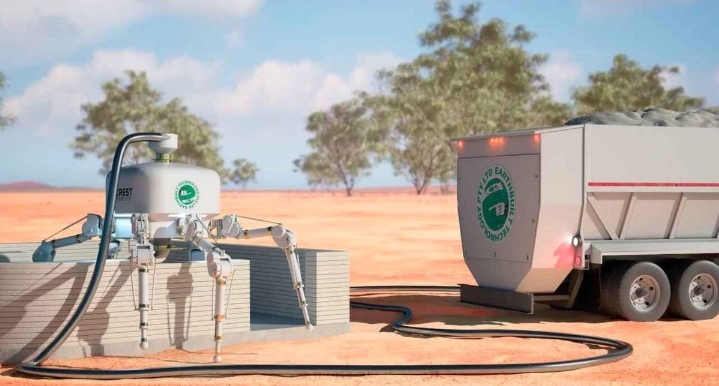
Picture Showing Australian construction robot Charlotte which can 3D print 2,150-sq-ft home in one day using sustainable materials. Photo Credit Fox News
The robot’s body houses a central fabrication module, while its six articulated legs—capable of extending over 18 feet provide stability and mobility on uneven terrain. Constructed from aluminum, carbon fiber, and 3D-printed plastics, Charlotte is designed to be transportable, whether by truck on Earth or potentially inside a rocket for lunar missions. A scaled-down prototype has already been demonstrated, showcasing its ability to navigate and position itself precisely over a build site.
Charlotte’s development received support from Australia’s SmartSat CRC and the NSW Government’s Space+ program, reflecting a national push to blend terrestrial innovation with space ambitions. As Jan Golembiewski, founder and CEO of Earthbuilt Technology, explained, traditional construction involves dozens of complex, carbon-intensive steps.
Charlotte simplifies this dramatically: “Making a simple brick requires around 50 different processes and inputs. By contrast, Earthbuilt’s technology uses only three: earth, fibre and energy.” When paired with advanced robotics, the system minimizes energy use and human intervention.
How Charlotte Builds a House in 24 Hours
Traditional home construction can take months, involving teams of workers, heavy machinery, and long supply chains for materials like concrete, steel, and bricks. Charlotte flips this model on its head through a process called “bound earth” or automated earthbagging.
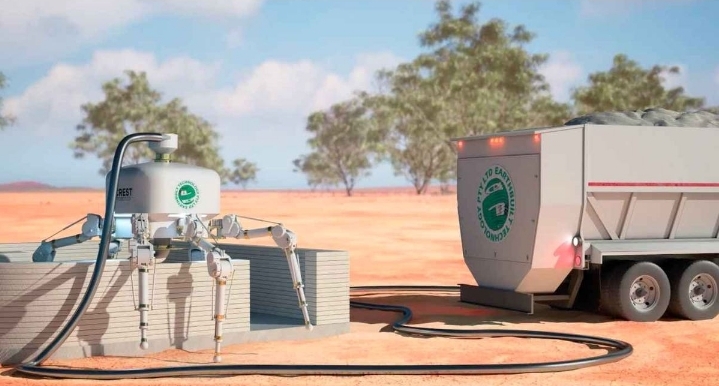
Picture Showing Australian spider robot Charlotte in action 3D Printing and entire home in just one day | Photo Credit: Fox News
Here’s how it works on Earth:
- Material Collection: The robot gathers local raw materials—sand, soil, crushed brick, recycled glass, or other waste—directly from the site or nearby sources.
- Fabric Forming: Materials are packed into fabric sleeves (like giant, durable bags).
- Compaction and Extrusion: The undercarriage fabrication system compresses the filled sleeves and extrudes them layer by layer to form thick, structural walls.
- Layer-by-Layer Building: Charlotte’s spider-like legs allow it to raise itself as walls grow taller, maintaining optimal positioning. It straddles the emerging structure, printing continuously in a single, seamless process.
The result? A 200 square meter (approximately 2,150 square foot) home shell can be completed in about 24 hours—equivalent to the output of more than 100 bricklayers working simultaneously. The walls are fireproof, flood-resistant, and have a significantly lower carbon footprint because they avoid energy-intensive manufactured materials and long-distance transportation.
This speed isn’t just impressive; it’s transformative. In regions facing labor shortages or rapid urbanization, Charlotte could help deliver affordable housing at scale. The structures’ thermal mass from compacted earth also provides natural insulation, reducing long-term energy costs for heating and cooling.
Unlike gantry-based 3D printers that require fixed setups and struggle with height or irregular sites, Charlotte’s mobile, legged design offers flexibility. It can handle slopes, rough ground, and even climb as it builds, making it suitable for diverse environments—from suburban lots to remote or disaster-prone areas.
Sustainability at the Core
One of Charlotte’s biggest advantages is its eco-friendliness. By using on-site or recycled materials, it slashes waste and emissions. Traditional concrete production alone accounts for a massive portion of global CO2 output; Charlotte bypasses much of that by relying on abundant earth and minimal binders.
Video Showing Charlotte 3D-Printing Robot on Display at an Exhibition in Switzerland – Video Credit: Crest Robotics
The robot’s lightweight construction and efficient operation further reduce its environmental impact. Developers claim the overall process can be 1,500 to 5,000 times faster than conventional methods while being far less resource-intensive. For a world grappling with climate change and resource scarcity, this represents a leap toward circular, low-carbon construction.
Charlotte on the Moon: Building Humanity’s Lunar Future
While Charlotte’s Earth applications are exciting, its true potential shines in space. NASA’s Artemis program and other international efforts aim to establish permanent human presence on the Moon, but transporting building materials from Earth is prohibitively expensive and logistically nightmarish. The solution? In-situ resource utilization (ISRU)—using what’s already there.
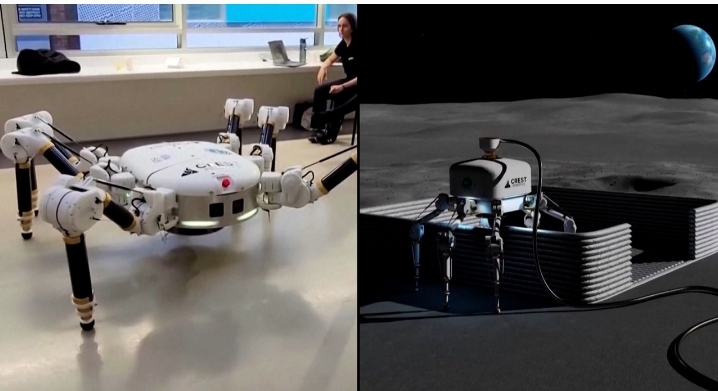
Photo Collage Showing Spider-like robot Charlotte used built to print 3D homes on the moon – Photo Credit: Fox News
Lunar regolith, the fine dust and rock covering the Moon’s surface, could serve as Charlotte’s primary building material. In a vacuum with low gravity and extreme temperature swings (-173°C to 127°C), traditional construction equipment would fail. Hydraulic systems are too heavy and prone to leaks or failures in such conditions.
Charlotte’s design is ideal for the lunar environment:
- Lightweight and Foldable: It can be compacted for launch and deployed easily.
- Legged Mobility: Six legs provide superior stability and adaptability on the Moon’s rocky, cratered terrain compared to wheeled or tracked vehicles.
- Autonomous Operation: Minimal need for constant human control, crucial in a place where communication delays with Earth can reach several seconds.
- Local Material Use: Regolith can be scooped, packed into fabric sleeves, compressed, and extruded into protective shelters, habitats, or storage facilities. Renders show Charlotte operating amid lunar domes, with Earth visible in the starry sky.
Future iterations could construct radiation-shielded bases, workshops, or even landing pads using compacted regolith layers. By building with 99% local materials, the robot drastically cuts mission costs and enables scalable infrastructure for scientific research, resource extraction, or even tourism.
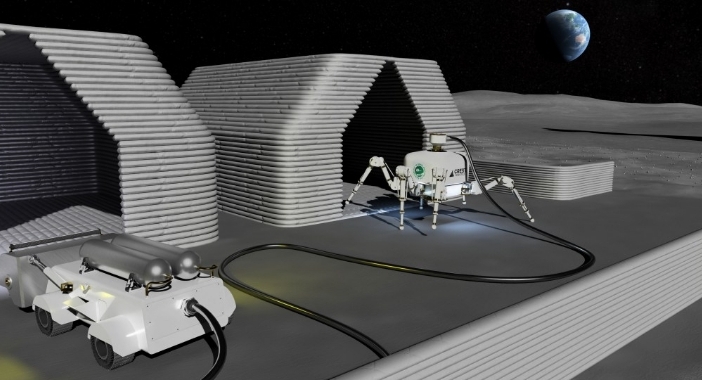
Similated Picture Showing Spider-like robot Charlotte used to build Moon bases – Photo Credit: Fox News
Experts note that Charlotte’s approach aligns perfectly with lunar challenges. Its ability to gather and process material on-site makes it a strong candidate for sustained presence, potentially supporting Artemis base camps or international lunar villages. While hydraulic rovers or heavy machinery would struggle with dust contamination and maintenance, Charlotte’s bio-inspired, low-maintenance legs offer reliability in harsh conditions.
Challenges and the Road Ahead
Charlotte is still in the prototype stage. Full-scale deployment on Earth may take several years as engineers refine autonomy, material binding for different conditions, and integration with finishing processes (like roofing, plumbing, and interiors). Safety certifications, regulatory approvals, and workforce training will also be essential.
On the Moon, additional hurdles include fine regolith’s abrasive nature, low gravity affecting compaction, and the need for radiation-hardened electronics. However, ongoing testing and collaboration with space agencies could accelerate progress.
Skeptics might worry about job displacement in construction, but proponents argue Charlotte will augment human labor handling dangerous, repetitive tasks while creating new roles in robot operation, maintenance, and design. It could also revive construction in aging workforces or high-risk zones.
A New Era of Building
Charlotte represents more than a clever gadget; it’s a glimpse into a future where construction is faster, greener, and accessible anywhere from bustling cities to the lunar surface. By tackling Earth’s housing shortages with sustainable speed and preparing for humanity’s multi-planetary future, this spider robot embodies ingenuity and ambition.
As space agencies push toward Moon bases and Mars missions, technologies like Charlotte will be critical. Imagine astronauts arriving to pre-built habitats printed from lunar soil, or disaster victims receiving homes in days rather than months.
The web Charlotte weaves isn’t just for houses—it’s for connecting our terrestrial needs with our cosmic aspirations. In a world facing population growth, climate pressures, and the call of the stars, robots like this could help us build not just shelters, but a more resilient and expansive future for humanity.
Whether on dusty Australian outback sites or the gray plains of the Moon, Charlotte is poised to spin a stronger, more sustainable world—one layered print at a time. The future of construction has legs, and it’s walking straight toward the horizon.
Disclaimer!
This publication is made for Educational and awareness purposes. It is not made for the sale of any product or service. The information provided here are based on verified human aided research and studies






Leave a Reply