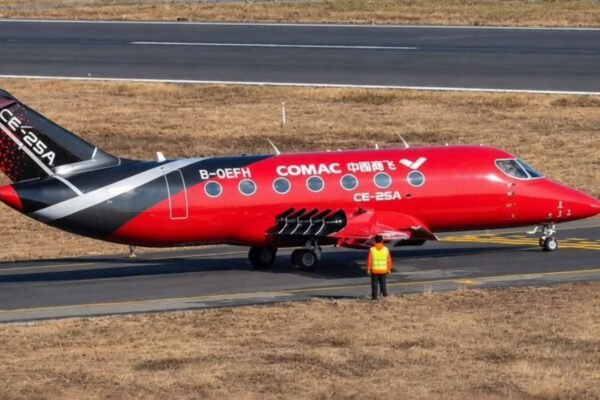
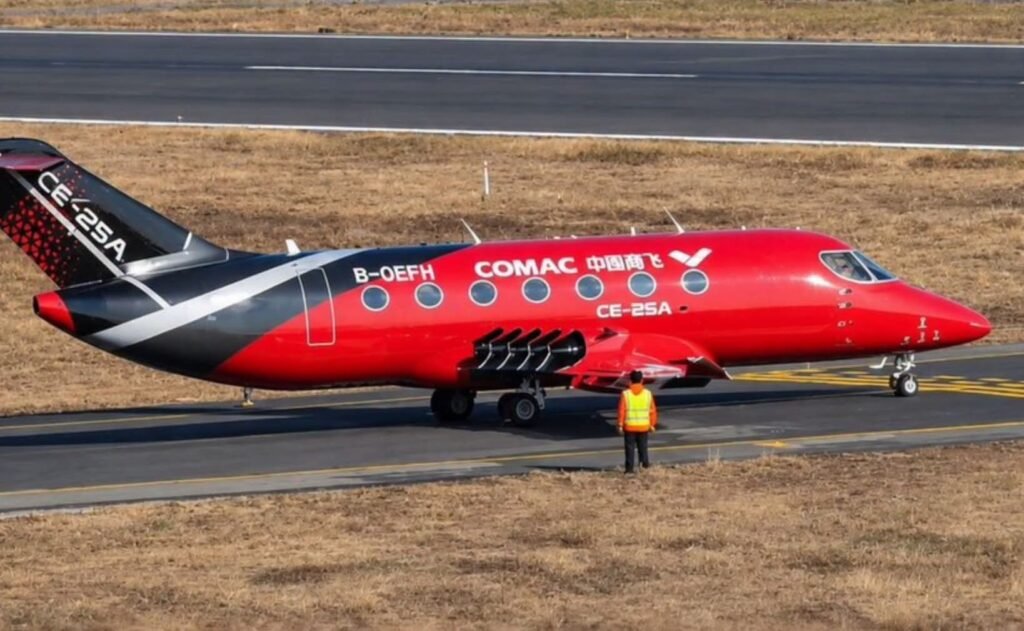
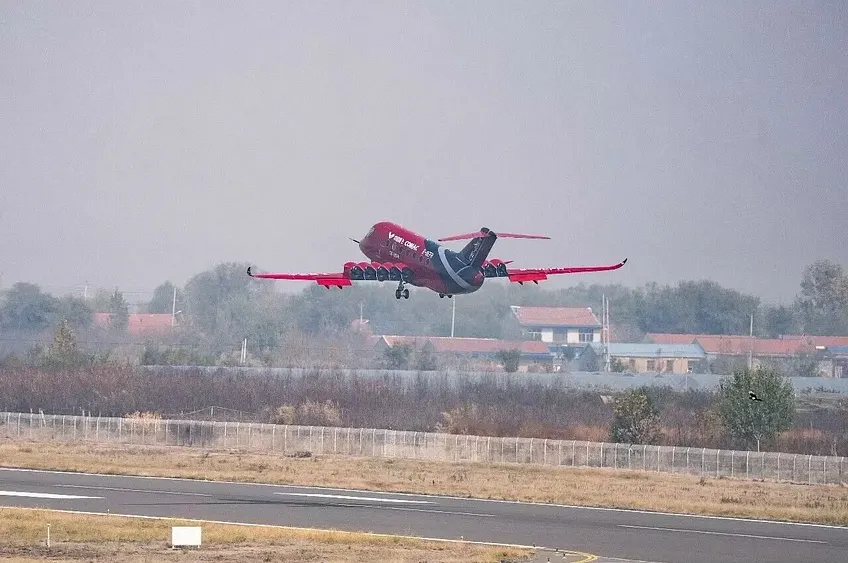
On November 14, 2026, the Commercial Aircraft Corporation of China (COMAC) successfully completed the first piloted flight of its CE-25A, a 10-tonne-class all-electric commercial aircraft designed for short intercity routes.
Two pilots and a flight-test engineer were aboard for the test in Binzhou, Shandong Province. The full test activity lasted 57 minutes and 46 seconds, including 16 minutes and 38 seconds airborne while covering about 60.4 kilometers. COMAC reported that the aircraft performed normally and that all performance indicators met expectations.
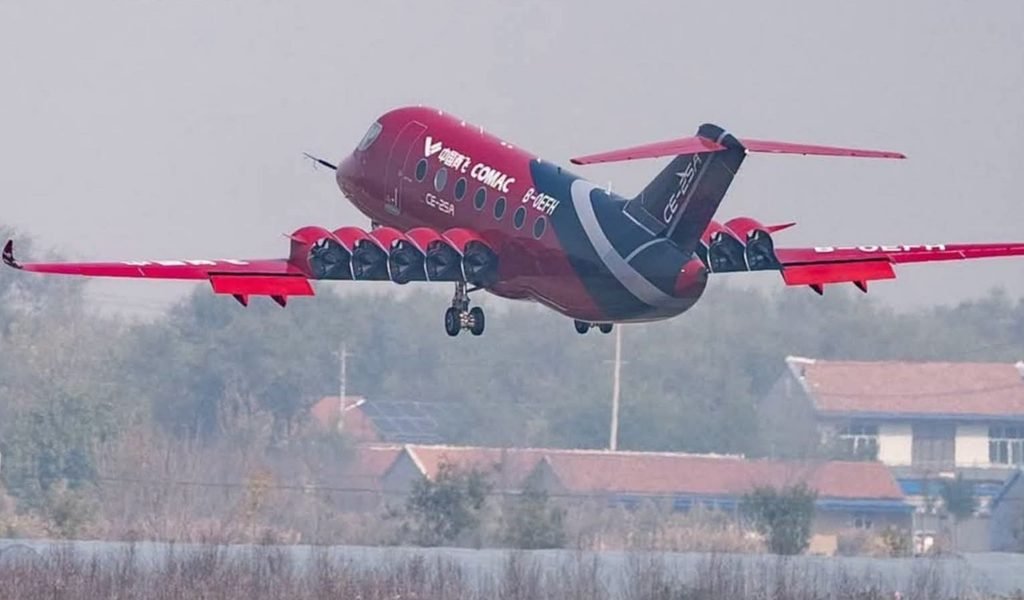
COMAC stated that in the CE-25A designation, “C” stands for COMAC; “E” stands for Electric, powered by a wing-mounted distributed electric ducted propulsion system; “25” denotes compliance with CCAR-25 transport category aircraft airworthiness regulations; and “A” stands for the first product.
This was not the aircraft’s first time in the air. It had already completed its first uncrewed autonomous flight on February 2, 2026, followed by a total of 19 uncrewed autonomous verification flights. The November flight marked the transition to crewed operations and is described in Chinese reporting as the first piloted “intelligent” flight of the type.
Design and Capabilities
The CE-25A is positioned as a 19-passenger regional aircraft with a maximum takeoff weight of roughly 10 tonnes. Design figures released by COMAC include a cruise speed of 300 km/h, a cruise altitude of about 2,400 meters, and a range of 400 kilometers. It is intended primarily for short commercial hops between cities rather than long-haul operations.
Propulsion comes from a distributed electric ducted-fan system with ten electric ducted fans mounted on the wings featuring five per side.
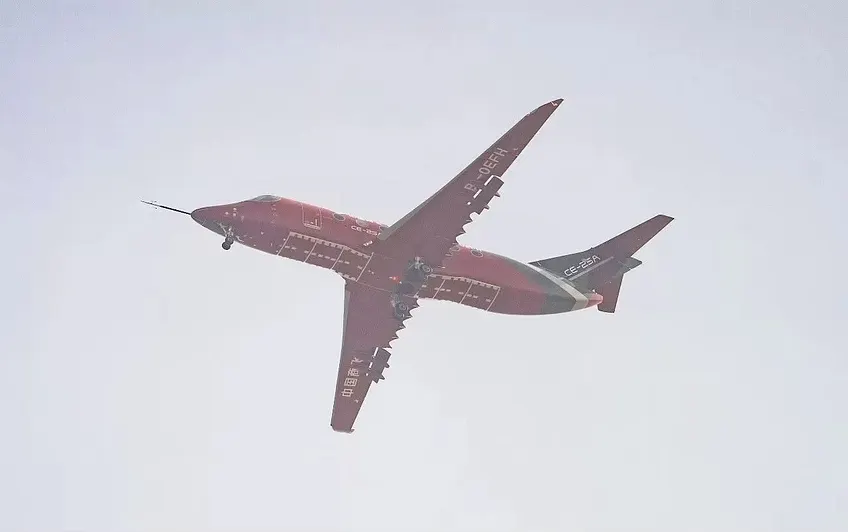
This replaces conventional jet engines or turboprops and is a key distinguishing feature of the design.
Chinese battery giant CATL is COMAC’s main industrial partner in the project, alongside Shanghai Jiao Tong University.
The battery maker, which already has a strong lead in the global electric vehicle market, is also making inroads into aviation.
CATL is a strategic investor in Chinese eVTOL developer AutoFlight and, at the 2023 Shanghai auto show, unveiled a battery with a cell-level energy density of up to 500 Wh/kg, which it said it was qualifying for aviation use however it is worth noting that COMAC has not disclosed which battery powers the CE-25A Electric Aircraft.
Development Partners and Status
The program is a collaboration involving COMAC, battery manufacturer Contemporary Amperex Technology Co. Limited (CATL), Shanghai Jiao Tong University, and other domestic partners.
A joint venture focused on electric aircraft development was established earlier with significant registered capital.
Battery details including it’s capacity, chemistry, weight, and exact energy density have not been publicly disclosed in the flight announcements, which remains an important open question for assessing real-world range and performance.
COMAC has reportedly already filed a type certificate application for the CE-25A with the he Civil Aviation Administration of China (CAAC).
China’s Civil Aviation Administration (CAAC) has accepted COMAC’s application for a type certificate. This begins the formal airworthiness review process under transport-category rules.
Acceptance of the application is a necessary step but does not equate to approval for commercial passenger service; no entry-into-service date has been announced.
The CE-25A represents China’s first domestically developed fixed-wing electric commercial aircraft in this size class and a notable step in applying battery-electric propulsion to a transport-category regional airliner concept.
Distributed electric propulsion offers potential advantages in efficiency, noise reduction, and simplified mechanical systems compared with traditional turbine engines, while aligning with broader efforts to reduce aviation emissions on short routes.
Challenges remain substantial. Battery energy density, thermal management, weight, safety under aviation certification standards, charging infrastructure at regional airports, and operational economics will all need to be proven at scale.
The 400 km range is a design target; the recent flight covered a much shorter distance under test conditions. Independent verification of performance claims, battery characteristics, and long-term reliability will be essential before commercial operations become realistic.
Still, the successful transition from uncrewed autonomous testing to a crewed flight, combined with the start of the type-certification process, marks clear progress.
For regional routes that fit within the aircraft’s intended envelope, an all-electric 19-seat platform could eventually offer quieter, lower-emission service if the remaining technical and regulatory hurdles are cleared.
The CE-25A is still firmly in the development and flight-test phase. Its next milestones will center on expanded flight testing, progressive demonstration of systems and performance, and the multi-year process of earning full airworthiness approval.