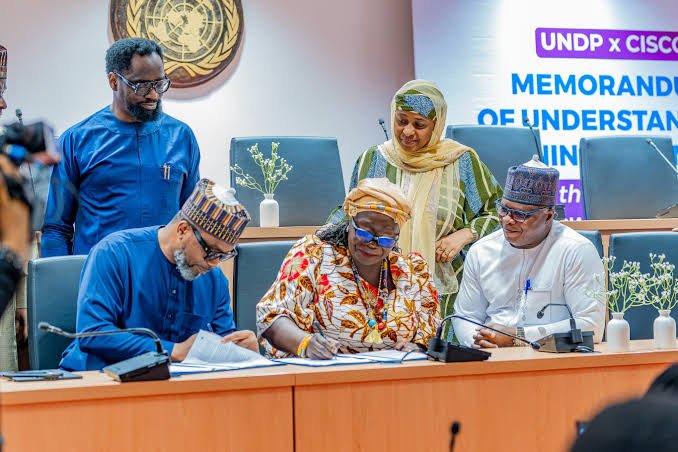
The Memorandum of Understanding was signed on Friday, 9 October 2026, at UN House in Abuja. It brings together the United Nations Development Programme (UNDP), global technology company Cisco, the Federal Government (through the Office of the Vice President’s Delivery Unit), and the European Union.
The goal is to equip NJFP fellows and alumni with industry-relevant digital competencies that complement their workplace experience and improve pathways into employment, entrepreneurship, and Nigeria’s growing digital economy.
Cisco will provide free access to its Networking Academy (NetAcad) platform for up to 50,000 NJFP fellows and alumni on a rolling basis.
The company anticipates reaching 50,000 unique learners each year, for a projected total of around 150,000 over the three-year period.
The in-kind contribution of digital learning content and training opportunities is valued at more than $50 million.
Courses cover high-demand areas including cybersecurity, networking, data analytics, data science, artificial intelligence, programming, IT support, and entrepreneurship.
These skills are designed to be relevant across sectors such as banking and financial services, telecommunications, agriculture, healthcare, manufacturing, education, and public administration.

This builds on Cisco Networking Academy’s existing footprint in Nigeria, where it has already reached more than one million learners.
The initiative sits within the NJFP, a flagship Federal Government youth employability programme funded by the European Union and implemented by UNDP. Launched in partnership with the Office of the Vice President, the NJFP connects recent graduates to structured, paid 12-month work placements in public and private organisations nationwide. Fellows receive a monthly stipend (reported at ₦150,000 under the current phase) along with mentorship and practical experience.
To date, nearly 35,000 fellows have been placed with more than 11,000 host organisations across Nigeria’s six geopolitical zones. The Cisco partnership adds a targeted digital skills layer to this model, aiming to strengthen the transition from “learning to earning” and help participants move from placements into sustained jobs, career advancement, or enterprise creation.

The EU has invested approximately €44 million in the NJFP and views the Cisco collaboration as an example of how development funding can crowd in private-sector resources for greater impact. Officials linked the effort to the EU’s Global Gateway strategy, which supports a more competitive, greener, digital, and inclusive Nigerian economy.
Senior Special Assistant to the President on Delivery and Coordination, Akubo Adegbe (representing the Office of the Vice President’s Delivery Unit), emphasised the broader ambition:
“The ambition is not simply to grow the economy, but to ensure that Nigerians, especially our young people, have the skills, opportunities and enterprise capabilities to participate in and drive that growth.”
Adegbe explained that through the Cisco Networking Academy, fellows and alumni will gain access to learning opportunities in cybersecurity, networking, data analytics, data science, artificial intelligence, programming, IT support and entrepreneurship.
He noted that the skills would be relevant across critical sectors, including financial services, telecommunications, agriculture, manufacturing, healthcare, education and public administration, as Nigeria accelerates its digital transformation.
Adegbe said the broader ambition was to build a national platform that brings government, development partners and the private sector together to develop the workforce needed for Nigeria’s economic transformation.
“Our ambition is not simply to prepare young Nigerians for the future of work. It is to prepare Nigeria for the future of its US$1 trillion economy,” he added.
He aligned the partnership with President Bola Tinubu’s Renewed Hope Agenda priorities of job creation, human capital development, and expanded economic opportunities, and called for more private-sector contributions in funding, technology, mentorship, training, internships, and jobs.
UNDP Resident Representative Elsie Attafuah highlighted the practical value of combining workplace experience with digital training. She noted that a young person’s first work opportunity can be transformative and stressed the need for inclusive access so that young women, persons with disabilities, and youths in underserved communities benefit equitably.
Cisco’s General Manager for Nigeria and Ghana, Abdulaziz Saidu, said the partnership reflects a shared commitment to unlocking the potential of Nigerian youth by linking internationally recognised digital learning with practical experience and professional development.
Yolanda San Jose, Head of Green and Digital Economy at the EU Delegation to Nigeria and ECOWAS, underscored that digital competencies are increasingly essential as technology reshapes agriculture, manufacturing, finance, healthcare, and public administration.
Nigeria’s large youth population around 70% of the total populace, faces persistent challenges of graduate unemployment and underemployment even as digital technologies reshape the labour market.
Programmes like the NJFP and this Cisco partnership attempt to close the gap between academic qualifications and the practical, industry-recognised skills employers demand.
By pairing paid work placements with free, high-quality digital training, the initiative seeks to improve individual employability while expanding the pool of digitally skilled talent available to businesses and the public sector.
Success will ultimately depend on how effectively participants convert training and experience into lasting jobs, career progression, or businesses, and on continued collaboration among government, development partners, and the private sector.
The MoU marks a concrete step in that direction: a substantial private-sector commitment of learning resources delivered through an established national youth employability platform.