
Africa’s Richest man Aliko Dangote has warned that Artificial intelligence AI could disrupt the global economy resulting in losses of jobs, old infrastructure and institutions
Key Takeaways
• Africa’s biggest Business Mogul Dangote warns that AI could cause a disruption in global economy and result in Job Losses
• The Richest Man in Africa calls for urgent Stakeholder Action to ensure a safe and sustainable AI future
• Africa’s diversified religious and cultural economy must adopt AI is such a way that opens more avenues for Job Creation and Business Opportunities
Aliko Dangote warns about the rise of AI in engineering, predicting it could replace human engineers and phase out traditional design systems.
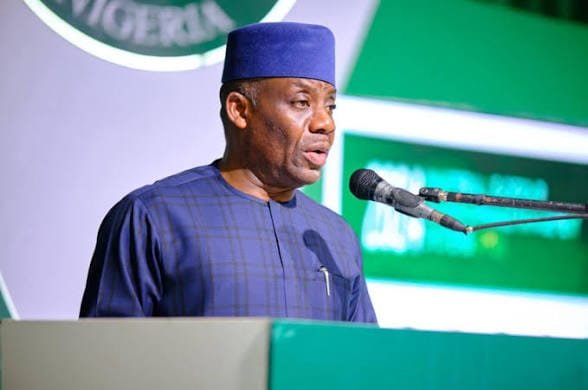
Dangote predicted the increasing role of AI during his address at his induction as a Honorary Fellow of The Nigerian Academy of Engineering in Lagos on Friday.
He said, “Today, we are witnessing the impact of artificial intelligence in virtually all spheres of life. It is gradually replacing human capability and hard-thinking characteristics of real human beings. “It is possible that AI will soon phase out engineering designs usually undertaken by human engineers.”
He urged innovation to sustain human applications. “I call on engineers to step in and lend their voice on the ramifications of AI to their profession on how it is being taught and practised,” the industrialist remarked.
This comes at a time global investors are throwing in Billions of Money into AI and Robotics. Alphabet (Google) leads the chart in terms of investment in AI with total investment sums towering above $200 Billion Dollars.
Nigeria too is making great strides in AI adoption with the National Information Technology Development Agency NITDA championing several AI Digital Literacy programs such as 3Million Tech Talents.
One thing history tell us is the fact that global industry change is constant and Big Corporations must adapt to the AI and Robotics Boom or risk becoming redundant. A good example is Nokia, a one time leader in Mobile Phone manufacturing who failed to embrace industry trends and this ultimately led to Nokia’s abruptly crumble.
Presently, the world’s top 3 investors in AI are primarily driven by massive corporate investments and venture capital. Leading companies investing in AI are Microsoft, Alphabet (Google), and NVIDIA, which together with other major tech firms, dominate AI infrastructure and application funding.
Microsoft, Alphabet (Google), and NVIDIA are driving an unprecedently high investment wave in Artificial Intelligence, with cumulative capital expenditures for these top Tech giants totalling over $300 billion in 2025 and predicted to rising even higher.
As of early 2026, the spending has accelerated to the point that four “hyperscalers”—Amazon, Microsoft, Meta, and Alphabet—are projected to invest roughly $650 billion in AI-related infrastructure in 2026 alone.
Artificial Intelligence is also transforming the oil and gas industry by enhancing operational efficiency, cutting costs, and improving safety across upstream, midstream, and downstream sectors. Key applications include predictive maintenance to avoid equipment failure, AI-driven seismic data interpretation for faster exploration, and automated, real-time optimization of drilling and production, with over 92% of companies investing in these technologies.
In Upstream Oil Exploration & Production, AI speeds up seismic data analysis and reservoir modeling, reducing exploration risks and identifying productive drilling sites. It enables autonomous drilling systems that adjust parameters in real-time to optimize performance.
However, Aliko Dangote who is the owner of Africa’s biggest refinery producing 650,000 Barrels of Oil per day fears that AI could replace human engineers, phase out traditional design systems and lead to Millions of Job losses.
Dangote reaffirmed the centrality of engineering to national development, declaring that industrialisation remains impossible without the profession.
Dangote said, “Engineering is more than a profession. It is a language of progress. Every bridge that connects a community, every heater that lights a home, and every drop of fuel that powers our economy began as a calculation by an engineer.
“In my decades of building businesses across this continent, I have come to a singular and unshakable conclusion: No nation can industrialise without the ingenuity of engineers. We are the silent architects of our national development.”
On capacity development, Dangote disclosed that the firm had invested heavily in training local engineers and exposing them to global best practices.
He said, “Recognising the need to bridge the gap between academic knowledge and industrial application, we established Dangote Academy, where young engineers undergo rigorous hands-on training before being integrated into our workforce. Hundreds of young engineers have been trained in Europe in the use of advanced technologies in large-scale complex industries.”
He said, “We have come to fully appreciate the central role of engineering in driving economic transformation and sustainable industrial growth. Today, we are proud to be Nigeria’s largest employer of engineering and technology graduates. Our engineers are central to our operations, making up to over 15 per cent of our workforce across Dangote Petroleum Refinery and Petrochemicals, Dangote Fertiliser, and all the other Dangote businesses.”
This Stark Declaration about AI and huge potential Job losses comes at a time Nigeria is rapidly accelerating it’s investment into AI, Data Centres and AI Infrastructure.
However, certain factors must be put into critical consideration given Nigerias chaotic level of cultural and religious diversity which slows its growth.
Recently, SouthAfrica crafted a Bill that enforces safe, smooth and sustainable deployment of AI in south africa. Nigeria too must follow this same suit to avoid AI collapse and future issues.
Presently, the Nigerian labour market is saturated with graduates from Universities, Polytechnics and Colleges of education. However, many of these graduates have turned to menial jobs like Bike riding, Farming, Cleaning, Catering, Tailoring and more just to pay the light Bill.
This means that Nigeria and Africa may not be fully ripe to employ AI Automation benefits that comes with Job losses and series of Court Cases.
Given Nigerias fragmented Nature, Authorities, Stakeholders, Institutions, Government and Organisations must come together to craft a sustainable path for AI deployment in Nigeria. This path must preferably built to foster the Creation of New Jobs and Opportunities for Businesses, Institutions and Individuals alike.




Leave a Reply