

Japan’s produce an Overnight Engineering Marvel. How a 3D-Printed Railway Station serving around 270 passengers daily on the Kisei Line, Was Built in Hours Using ABB Industrial Robots
Key Takeaways:
• Japan Create the World’s First 3D-Printed Train Station
• This unique 3D Printed Train Station was designed and produced in under 6 hours
• Japan is facing a rapidly ageing population and this Technology proves very helpful for Japan’s ageing economy
In the quiet coastal town of Arida, Wakayama Prefecture, a small railway station has quietly entered the history books. Hatsushima Station, serving around 270 passengers daily on the Kisei Line, once featured a simple wooden shelter erected in 1948.
Decades of exposure to the elements had taken their toll, leaving the structure deteriorated and in need of urgent replacement. Traditional construction would have meant weeks or months of disruption—closing platforms, rerouting trains, and deploying large crews amid Japan’s chronic labor shortages and rising costs. Instead, something extraordinary happened: the old shelter was replaced with Japan’s first 3D-printed railway station building, assembled almost entirely overnight between the last train departure and the first morning service, with zero disruption to rail operations.
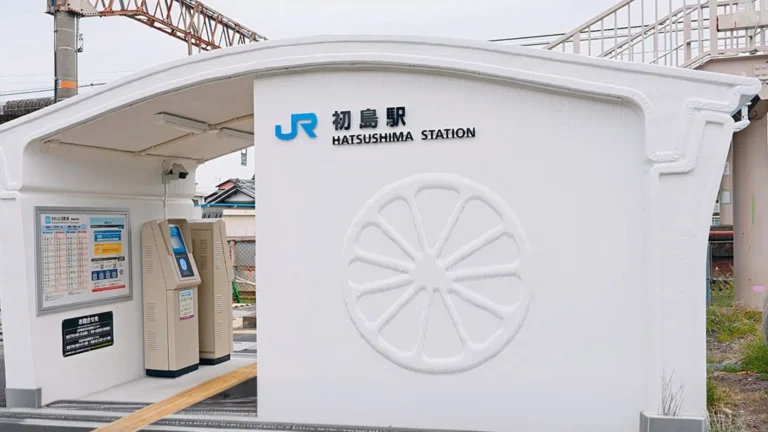
Japan unveils its first 3D-printed railway station
This groundbreaking project, completed in collaboration between West Japan Railway Company (JR West), construction innovator Serendix, architectural firm Neuob, and robotics giant ABB, showcases the transformative power of robotic 3D printing in infrastructure. What would traditionally take one to two months and cost significantly more was achieved through off-site prefabrication and lightning-fast on-site assembly. The new station isn’t just functional—it’s a symbol of how technology can solve real-world problems like ageing infrastructure, workforce decline, and the need for sustainable, customized designs.
The Challenge: Ageing Rails in a Shrinking Workforce Nation
Japan faces a perfect storm in its construction and transportation sectors. Many regional railway stations, built in the post-war era, are showing their age. Maintenance and renewal are essential but increasingly difficult due to a shrinking and aging workforce. Skilled labor is in short supply, material and labor costs are climbing, and any on-site work risks major service interruptions for commuters who rely on punctual trains.
JR West, responsible for a vast network, turned to innovative solutions for smaller stations like Hatsushima. “Our company faces significant ageing infrastructure, particularly at regional stations. Maintaining and renewing these facilities has become essential,” noted Mr. Masueda, a first-class architect at JR West. The goal was clear: replace the wooden shelter quickly, affordably, and without halting services. Conventional methods: erecting scaffolding, pouring concrete on-site, or even prefabricating in traditional ways—would demand extended closures and high expenses.
Enter Serendix, a Japanese firm specializing in 3D printing for construction
Their approach leverages robotic automation to print structural elements in a controlled factory environment, then transport and assemble them rapidly on-site. Partnering with ABB for precision robotics and Neuob for design, they tackled the project head-on.
How It Was Done: Off-Site Printing Meets Overnight Assembly
The process began in Serendix’s factory, far from the tracks. Over seven days, an ABB IRB 6700 industrial robot arm, equipped with advanced Vertico two-component (2K) nozzle technology, 3D-printed the station’s four main structural elements: a curved roof, a back wall, and two corner sections that form the side walls and floor.
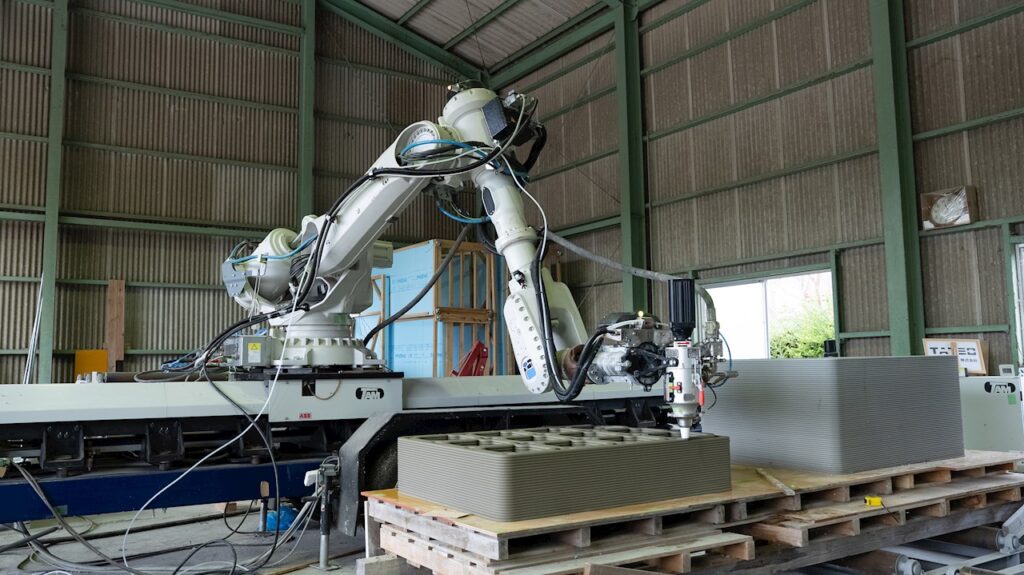
The ABB IRB 6700 High Precision robot arm
The ABB IRB 6700 is a heavy-duty, high-payload robot known for its reliability in industrial applications. Mounted on a mobile platform with a 7-axis system (including a travel axis), it offered the extended reach and flexibility needed for complex geometries. The Vertico nozzle was a game-changer—providing four times the accuracy of conventional single-component (1K) nozzles and reducing layer spread by 75%. This allowed precise deposition of fast-setting mortar, enabling intricate textures and overhangs without collapse. The mortar layers built up like precise digital sculpting, guided by pre-programmed designs.
Once printed, the components were reinforced with rebar and additional poured concrete for structural integrity, achieving earthquake resistance comparable to reinforced concrete houses. The entire printing phase minimized human intervention as the robot operated continuously with high precision, executing complex movements exactly as programmed. ABB’s control technology ensured consistent quality, reducing errors and waste.
The printed parts were light enough for transport. The magic happened during a narrow six-hour window after the last evening train departed. A small team, supported by the prefabricated modules, assembled the structure in approximately two hours. Cranes or specialized equipment lifted the four elements into place, securing them swiftly. By morning, the new station was ready, and trains resumed as scheduled. Passengers likely noticed little more than a fresh, modern shelter where the old wooden one had stood.
The finished building is compact yet elegant: 6.3 meters wide, 2.1 meters deep, with an arched roof rising to 2.6 meters. Its total area is about 10-108 square feet (depending on measurement), making it a practical waiting shelter rather than a full station hall. The design features soft curves and reliefs impossible or prohibitively expensive with traditional formwork: one side of the back wall displays a sculpted mandarin orange, the other a cutlassfish (or beltfish), both local specialties of Arida City. This freeform modeling reflects regional identity, turning a mundane shelter into a community landmark. The minimalist white exterior with its arched roof blends modern efficiency and subtle nods to traditional aesthetics.
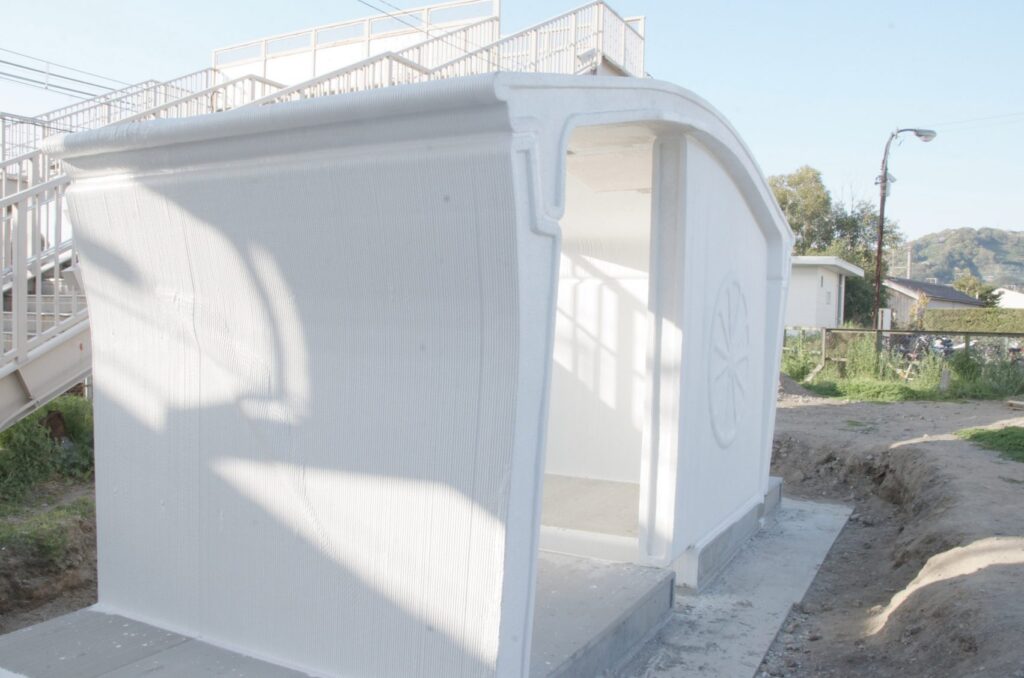
The 3D-printed parts were printed vertically with exquisite interiors
Interior finishing, including ticket machines and fare gates, followed later, with the station scheduled to fully open to passengers around July 2025.
Precision, Speed, and Sustainability
At the heart of this feat is the synergy between robotics and additive manufacturing. Traditional concrete construction relies on bulky formwork, extensive on-site labor, and weather-dependent pouring often leading to delays, waste, and inconsistencies. Robotic 3D printing flips the script: components are produced layer by layer in a factory, with minimal material waste (the 2K nozzle helps here too) and repeatable precision.
Serendix COO Mr. Sato highlighted the advantages: “Our 3D printer-based construction approach can reduce labor costs and produce all building materials from mortar. By cutting both labor and material expenses, we believe this initiative can address the challenge of rising prices.” He also praised ABB: “The appeal of ABB robots lies in their ability to build with high precision exactly as programmed… This is only possible thanks to ABB’s control technology.”
The project delivered dramatic gains:
– Time savings: On-site work slashed from months to hours.
– Cost reduction: Roughly half the price of a traditional wooden or reinforced concrete replacement, with 30-50% savings overall.
– Labor efficiency: Far fewer workers needed on-site, easing Japan’s skilled labor crunch.
– Quality and design freedom: Complex curves, textures, and local motifs are now feasible without prohibitive costs.
– Minimal disruption: No service interruptions for passengers or operations.
Additionally, the method reduces environmental impact through lower waste and more efficient material use. The fast-setting mortar allows rapid layering, while reinforcement ensures durability in Japan’s seismic zone.
Broader Implications: A New Era for Construction and Infrastructure
This overnight station build is more than a one-off stunt, it’s a proof-of-concept for revolutionizing how we build and maintain public infrastructure. Japan, with thousands of regional stations facing similar issues, could scale this approach to keep remote lines viable without massive taxpayer burdens or service cuts.
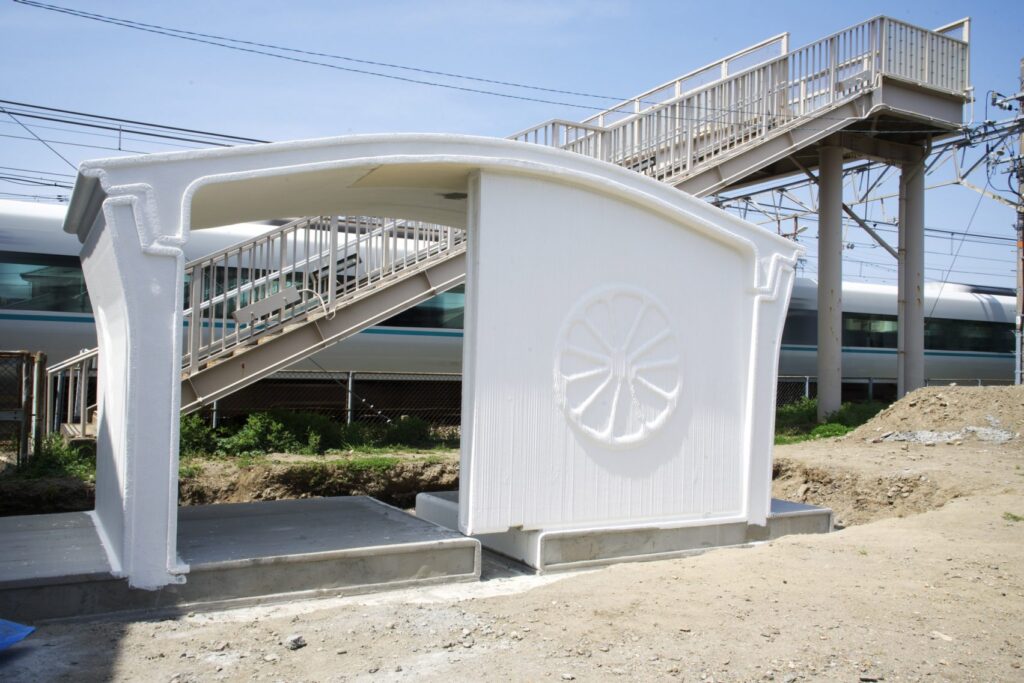
Serendix 3D printedshelter for Hatsushima Station
Globally, the construction industry grapples with the same pressures: labor shortages, urbanization demands, climate resilience needs, and calls for sustainability. Robotic 3D printing addresses them by enabling:
– Faster deployment for emergency repairs or disaster recovery.
– Customized designs that incorporate local culture or environmental adaptations.
– Safer worksites with less human exposure to hazards.
– Automation potential: Serendix envisions further AI integration, with sensors and cameras handling setup for near-full autonomy.
Video Showing AAB Industrial Robots in Action
Applications extend beyond stations to affordable housing, emergency shelters, hotels, villas, and high-end architectural features. Serendix has already seen interest in complex projects thanks to the enhanced capabilities of their robotic system.
Challenges remain, of course. Scaling for larger structures, ensuring long-term durability in varied climates, regulatory approvals, and initial technology investments are hurdles. Yet the Hatsushima success demonstrates feasibility and inspires confidence. As Mr. Sato noted, the technology already requires minimal human intervention during printing, paving the way for even greater efficiency.
Why This Matters for the Future of Building
Imagine a world where critical infrastructure upgrades happen invisibly overnight. Commuters arrive to improved facilities without delays. Costs drop, allowing more investment in maintenance. Designs become more creative and community-oriented. Robots and 3D printing don’t replace human ingenuity they amplify it, freeing workers for higher-value tasks while tackling grunt work with precision.
Japan’s project at Hatsushima Station proves that innovation isn’t about flashy megastructures alone; it’s about solving everyday problems elegantly. A 77-year-old wooden shelter gave way to a durable, beautiful, locally resonant concrete marvel built while the world slept.
As nations worldwide confront infrastructure backlogs and demographic shifts, technologies like ABB-powered robotic 3D printing offer a hopeful path. They promise not just faster builds, but smarter, greener, and more resilient ones. The next time you wait for a train in a remote station, you might just be standing inside a structure printed by robots in a factory and assembled under the cover of night.
This achievement highlights Japan’s leadership in blending tradition with cutting-edge tech. For railway operators, construction firms, and policymakers everywhere, it’s a blueprint worth studying. What other “impossible” overnight transformations await? The robots are ready.
Disclaimer!
This publication is made for Educational and awareness purposes. It is not made for the sale of any product or service. The information provided here are based on verified human aided research and studies



Leave a Reply