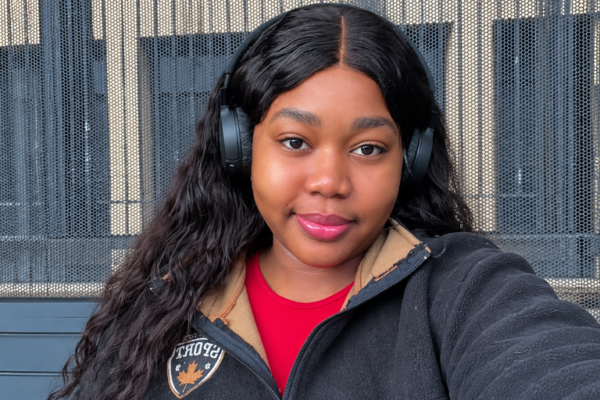
In the span of a single sleepless night, Nigerian software developer Shalom Rayhamen also known as Ijeoma Shalom Rayhamen or simply Shalom turned a long-held idea into one of the fastest-rising digital products in recent Nigerian tech history.
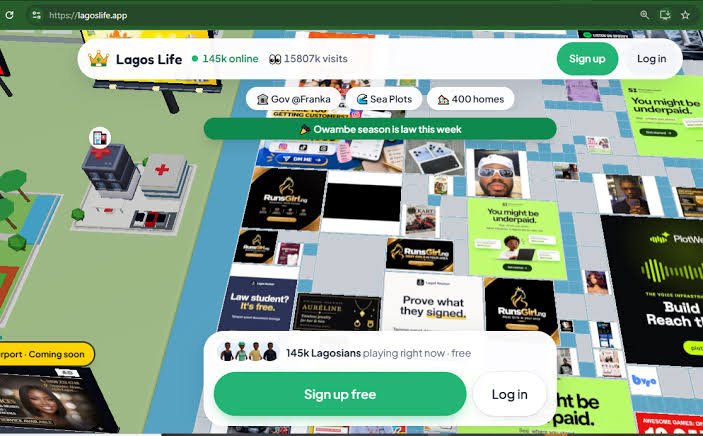
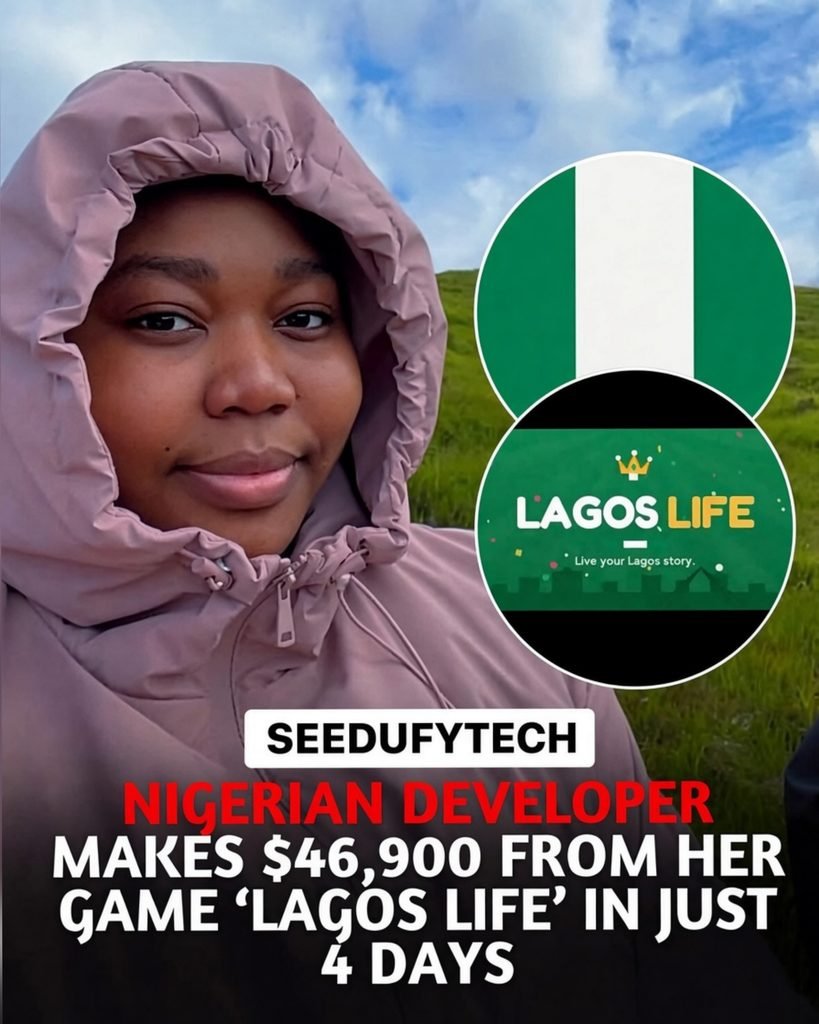
On October 1, 2026 Nigeria’s Independence Day she launched “Lagos Life“, a free, browser-based multiplayer life-simulation game. Within days it had become a cultural phenomenon. By the time she shared her first major revenue update, the game had generated $46,900 in just four days while attracting more than 1.8 million players and over 16.5 million visits.
The numbers continued to climb rapidly. Peak concurrent players exceeded 145,000 at points, and the game later passed 2 million, then 3 million, and by early reports crossed 4 million players, with tens of millions of total visits.
How Did She Do It?
Rayhamen, a 26-year-old UK-based Nigerian software engineer holds a Global Talent Visa. In an interview with SeedufyTech Rayhamen says she built the initial version in roughly eight hours (from about 9 p.m. until 5 a.m.), shared the link around 7 a.m., and woke up a few hours later to find it already trending with tens of thousands of plays.
“It’s trending!”
“What’s trending?” My husband asked on the phone.
“My game.”
In confusion, he sputtered, “You made a game?”
”He didn’t realise that I had just spent the last 8 hours coding something that would change our lives forever”
“And honestly? Neither did I. All I know is I started building a game for fun on a Wednesday night, and when I woke up the next day, it was the most trending thing in Nigeria. That game is Lagos Life”
“But even when I was young, I wanted to create, and that desire led me to coding. In 2018, at the age of 18, I got a six-month internship to learn to code in Abia, where my mum lives. My laptop, a Chromebook, was a birthday gift from my mum and wasn’t ideal for coding. That, mixed with light issues and network delays, initially made coding hell”
“But I was determined to be a software engineer. When the internship ended, I continued teaching myself. I spent a lot of time at tech hubs in Abba, mostly for the free Wi-Fi and light”
“My first real gig came in 2020, during COVID. A startup was building a medical booking app, and I built the front end. They paid me ₦60k. I remember looking at that money and understanding my skill was actually monetisable. It was a giddy feeling”
“That money got me my next laptop, the kind of bulky device that made noise the second you opened it. I was ashamed to use it in the hubs, knowing that people would laugh. But still, I kept going”

In 2021, a stranger on Facebook changed my life.
“I post a lot about my work on Facebook, and I teach kids to code. A Malaysian on Facebook found me through one of these posts and said his boss wanted to talk to me. We jumped on a WhatsApp call, and by the end of it, they had offered me a $1,000 (₦1.3m) a month remote job”
“I couldn’t comprehend that amount of money. I couldn’t even negotiate the offer. My answer was an immediate yes”
“Then, in 2023, my journey as a software engineer earned me a Global Talent Visa to the UK. That came as another pleasant surprise”
“Software engineering has given me so much, but it was Lagos Life that changed my life forever”
“Up until last week, game development was something I’d dabbled in as a hobby. Most of the things I made were just for playing with friends, and I never thought of commercialising my games. I liked The Sims franchise growing up, but I felt it wasn’t localised enough, and the characters were a little dumb. If I were going to make a game, it would be a Nigerian version of that. But, as I said, I wasn’t seriously considering doing it”
“However, on that faithful Wednesday night, I saw that someone had made a Danfo driving game that was trending on Twitter. Many people were talking about it and spinning up their own versions. Those spin-off creators kept claiming something that stuck with me: “I had the idea first.”
“Was that going to be me? A woman who had an idea like The Sims but waited until someone else did it first?”
”Inspired, I told my husband I wanted to start programming a game, but he said I should just focus on Eliy, my current AI project. Then, he slept.”
”But I didn’t sleep, nor did I take his advice. I coded”.
”Every time I looked at the clock, I told myself I’d go to bed soon, but I kept adding features and fixing issues as they cropped up.”
”I finished Lagos Life at about 5 a.m. on October 1, tweeted the link at 7 a.m., slept off, and by the time I woke up at 10 a.m., the game was trending on Twitter. It already had over 10k plays. I hadn’t expected my game to go far, but it was at that moment that I knew it was going to be huge”.
”So here I am, less than a week later, with over 1 million players, and on the path to building a billion-dollar company”
”Currently, I’ve earned over $46k, a figure I only disclosed after someone on Twitter pitched buying Lagos Life for $100k. I found it hilarious that he valued my company so lowly. How can I sell a business that is projected to earn $50m before December? That I know will be a billion-dollar venture very soon?”
”I say a billion-dollar company with full confidence because Lagos Life is the most profitable thing I’ve ever done. I started by selling in-game money that can be bought with real money. I put three bundles there: ₦500, ₦1,000, and ₦2,000 each. I didn’t think anything of it, but in my first three days, I earned about ₦150k to ₦200k from people who bought them. It would end there, but people demanded I add higher bundles, so we now have ₦10,000 and ₦20,000 packages that people buy every day”.
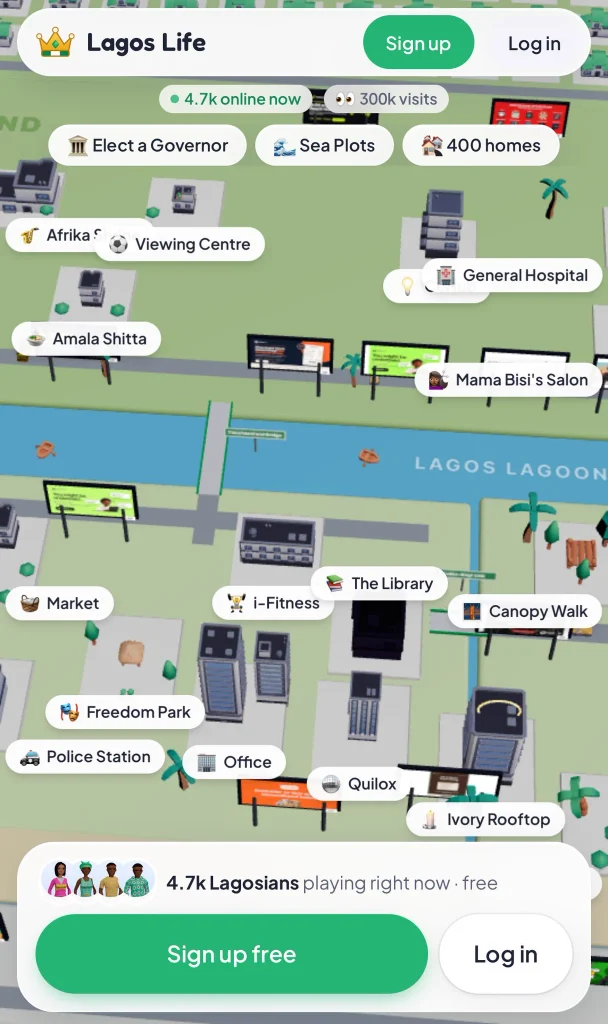
”The funniest part is that those top-up bundles are the least profitable things. I also promote real people’s music in the virtual clubs like Quilox. But my most profitable venture has been the virtual billboards”.
“About two days into the game’s launch, companies started reaching out to me, saying they wanted to promote their businesses in-game. I got so many offers that billboard space ran out, and I had to scale up my game to accommodate more ads”
”It hasn’t all been smooth sailing. Upscaling this fast has been hard, especially as I’m still the only coder on the game. There was a time when too many people had too much in-game money, and the game began lagging, so I had to rush in and fix it”
”I also had a situation where I accidentally wiped out everyone’s money. I made a feature that let the EFCC catch criminals, but a scripting error wiped out everyone’s funds. People were pissed, even insulting me on Twitter, but that’s okay. I understand they reacted so strongly because Lagos Life is an escape, and for a moment, I had messed with that”
”And yet, the wins have been life-changing. Right before I made Lagos Life, I was contemplating giving up on making my own projects. None of them seemed to do very well for very long, and even my husband agreed”
”I thought it would be better if I just focused on simply being an employee and getting promotions. But now, with the revenue from my game, I will quit my job and work on Lagos Life, along with other personal projects, full-time. People have said this is the game that is going to retire me, and with each passing day, I believe them more and more”
A Virtual Lagos That Feels Familiar
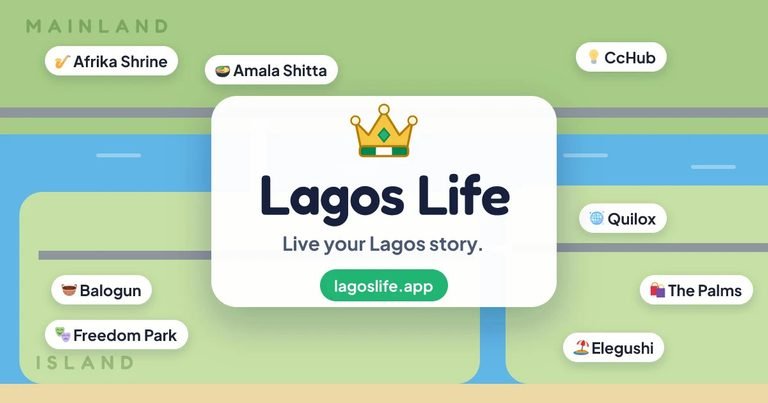
Lagos Life is a Sims-inspired multiplayer experience set in a stylized version of Lagos. Players create characters, manage everyday needs, take jobs, earn and spend virtual naira, pay rent (due on Saturdays), socialize, date, party, and explore recognizable spots such as Amala joints at Shitta, Quilox, and other local landmarks.
Starting profiles include “Nepo” (a nod to nepo babies with advantages) or “Lapo” (a harder-start path referencing LAPO Microfinance). The game runs entirely in the browser meaning no download or app required making it instantly accessible on phones and computers.
It was inspired by Rayhamen’s childhood love of The Sims 3 and by the earlier viral browser game Lagos Run a danfo-driving title by Opeyemi Adeniran. She has expanded it quickly to include Abuja Life and Port Harcourt Life, with connecting airports, turning the experience into a broader virtual Nigeria.
The appeal lies in its cultural specificity. Everyday Lagos realities—jobs, rent pressure, transportation, nightlife, money struggles, and social dynamics—are baked into the gameplay, giving players a shared, relatable digital playground that feels distinctly Nigerian.
How the Money Came In
Revenue arrived almost immediately through a mix of virtual currency purchases and in-game advertising. Rayhamen initially offered small in-game money bundles (₦500, ₦1,000, and ₦2,000). These generated roughly ₦150,000–₦200,000 in the first three days. Demand pushed her to add higher packages (up to ₦10,000 and ₦20,000). More lucratively, real businesses began renting virtual advertising space: roadside billboards (around ₦5,000 a week in early reports) and larger lagoon plots (around ₦18,000 a week). Advertisers have included payroll platforms, lifestyle brands, furniture marketplaces, and music distributors.
Rayhamen has emphasized that the $46,900 figure (self-reported) came primarily from these sources. She has also noted that virtual currency cannot be withdrawn for real cash, and the game remains free to play. She later disclosed the revenue number after receiving a $100,000 acquisition offer, which she rejected as far too low. In interviews she has valued the business far higher—projecting tens of millions in earnings and describing Lagos Life as a potential billion-dollar venture.
She has spoken openly about the intensity of scaling a solo-built product so quickly: server issues, economy exploits, accidental money wipes that angered players, and the need to keep shipping features while still being the primary coder. She has also compensated players after outages and continued iterating based on community feedback.
Broader Significance
Lagos Life arrives at a moment when Nigerian developers are showing that highly local, culturally resonant browser games can achieve massive reach and early monetization without traditional publishing pipelines or heavy marketing budgets. Its growth has been driven largely by organic sharing on X (formerly Twitter) and word of mouth. The game has sparked conversations about representation in gaming, the potential of lightweight web experiences in markets with variable connectivity and device access, and the ambitions of African creators building consumer products at scale.
Rayhamen has said the success has changed her trajectory. She plans to leave her job and focus full-time on Lagos Life and other personal projects. In her own words from interviews, the game is “going to retire me.” Whether it reaches the billion-dollar heights she envisions remains to be seen, but the first four days alone have already rewritten expectations for what a Nigerian browser game can achieve.
As the virtual city keeps expanding and players keep logging in by the hundreds of thousands, one thing is clear: a late-night coding session on the eve of Independence Day has given Nigeria and the wider interneta new digital landmark.