

Imagine zipping through the air on a sleek motorcycle, hovering effortlessly above traffic, forests, or valleys no roads, no congestion, just pure freedom. This isn’t a scene from Star Wars or a futuristic movie; it’s the promise of flying air bikes, the latest breakthrough in personal air mobility. At the forefront is the Volonaut Airbike, a jet-powered hoverbike that’s turning childhood dreams into reality.
Key Takeaways:
• A Polish Engineer Tomasz Patan Creates a Flying Air Bike thereby achieving a Major breakthrough in Air Mobility
• Billed as a “Superbike for the Skies” the Single-rider Air Bike is powered by jet propulsion
• The Ultralight Air Bike Model is priced at approximately $880,000 making it only accessible to wealthy high-income earners
Poland has solidified its position as a pioneer in personal air mobility with the groundbreaking debut of the Volonaut Airbike a jet-powered hoverbike that feels like it was ripped straight from a sci-fi blockbuster.
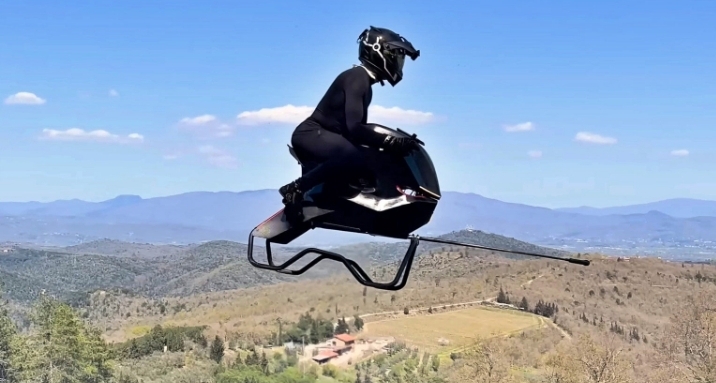
This Bonkers Hoverbike Can Hit a Top Speed of Almost 125 MPH – RevZilla
Developed by Polish startup Volonaut and spearheaded by visionary engineer and entrepreneur Tomasz Patan (the same innovator behind the popular Jetson ONE eVTOL aircraft), this sleek flying machine blends cutting-edge aerospace technology with an ultra-minimalist, motorcycle-inspired design. Patan, who kept the project in “stealth mode” for years before unveiling it in 2025, has long been obsessed with turning cinematic dreams of personal flight into reality.
What Are Flying Air Bikes?
Flying air bikes, also called hoverbikes or flying motorcycles, are compact, personal VTOL (Vertical Take-Off and Landing) vehicles designed to mimic the thrill of riding a superbike but in three dimensions. Unlike traditional aircraft with large rotors or wings, many modern concepts rely on advanced propulsion systems for vertical lift and forward flight.
These machines aim to bridge the gap between motorcycles and small aircraft, offering:
- Agility in tight spaces
- Low-altitude flight
- An open-air riding experience with unmatched views
Video Showing the AirBike developed by Volonaut in Air Motion
After years of secretive development (“stealth mode”), Patan unveiled the Airbike in 2025. It’s billed as a “superbike for the skies”—a single-rider vehicle powered by jet propulsion rather than noisy propellers or rotors. This design allows for a more compact form factor, enabling it to navigate narrow gaps barely wider than the vehicle itself.
What sets the Airbike apart from conventional aircraft or even other personal eVTOLs is its complete absence of exposed propellers or rotors. Instead, it relies on redundant jet turbines for propulsion, paired with a proprietary stabilization system and advanced flight computer.
This setup enables effortless vertical take-off, stable hovering, and intuitive control that feels more like riding a superbike than piloting a plane. Riders simply straddle the open-air frame, grip the handlebars, and lean into maneuvers thereby making it as accessible as an arcade game, according to Patan. The design also delivers unobstructed 360-degree views and the agility to weave through tight spaces, such as under tree canopies, that would challenge traditional rotorcraft.
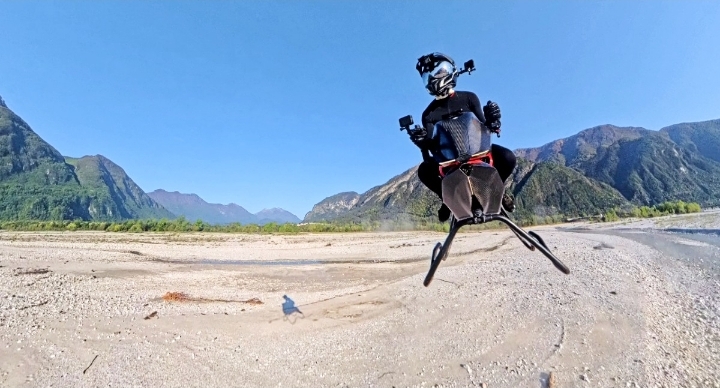
No Wings No Rotors: So How Does The Volonaut Airbike Fly? – duPont REGISTRY News
Crafted primarily from lightweight carbon fiber and 3D-printed components, the Airbike prototype weighs a startlingly low 30 kg (66 lbs) empty—roughly seven times lighter than a typical road motorcycle. In testing, it has demonstrated prototype speeds of up to 200 km/h (124 mph), while maintaining precise pilot control and a thrilling, responsive ride.
For regulatory compliance in its upcoming ultralight production version (aligned with FAA Part 103 standards in the US), top speed is capped at around 102 km/h (63 mph), with a maximum pilot weight of 95 kg (209 lbs). It runs on readily available fuels like diesel, biodiesel, Jet-A1, or kerosene, offering a quick refuel time of under one minute and up to 10 minutes of flight duration per tank.
Key Specifications
- Empty weight: 30 kg (66 lbs) — about 7 times lighter than a typical motorcycle, thanks to extensive use of carbon fiber, 3D-printed parts, and a minimalist design
- Pilot capacity: Up to 95 kg (209 lbs)
- Top speed: Up to 200 km/h (124 mph) in prototype testing; limited to 102 km/h (63 mph) for FAA Ultralight compliance in the US
- Flight time: Maximum 10 minutes (depending on rider weight and conditions)
- Propulsion: Redundant jet turbines (using diesel, biodiesel, Jet-A1, or kerosene)
- Refuel time: Under 1 minute
- Stabilization: Proprietary system with a flight computer for automatic hover and intuitive control
- License required: None in the US under ultralight regulations (for compliant versions)
- The riding position provides a 360-degree unobstructed view, giving riders a true sense of flying free like a superhero. No cage or enclosure—just you, the machine, and the open sky. Test footage shows the Airbike taking off vertically, gliding smoothly over landscapes, and landing with precision. Raw videos even include the authentic jet sound, adding to the raw, exhilarating experience.
This isn’t just a flashy concept; it’s a proven, functional prototype that has already logged real-world test flights. Volonaut is now gearing up for limited commercial production, with pre-orders open for the ultralight model priced at approximately $880,000. Buyers will receive professional training at the company’s US facility alongside delivery, and no full pilot’s license is required in compliant regions—only simplified instruction to get airborne safely. Redundant systems further enhance reliability, prioritizing both performance and peace of mind.
How It Works
The Airbike uses jet turbines for thrust, providing vertical lift and forward propulsion without traditional spinning blades. A sophisticated flight computer handles much of the stability work, making it more accessible than you might expect for such an advanced vehicle. The lightweight construction is key—it reduces power demands and enhances agility.
Patan has emphasized safety through redundant propulsion systems. While details on exact turbine tech remain somewhat guarded for excitement, the proof-of-concept flights demonstrate stable hover, controlled movement, and the ability to operate in challenging environments.
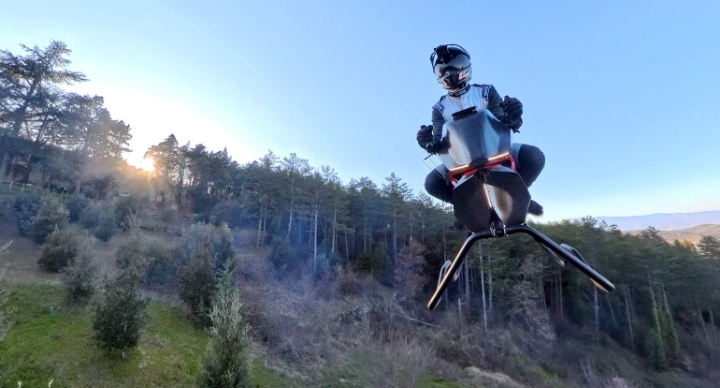
Volonaut Airbike takes flight: Does anyone really want a flying motorcycle? – RevZilla
Price and Availability
This isn’t a toy for everyone yet. Pre-orders for the Volonaut Airbike are available, with a price tag of approximately $880,000. Production is slated for limited runs, targeting enthusiasts, collectors, and high-net-worth thrill-seekers. Reservations reportedly opened in August 2025.
For context, this puts it in the realm of exotic supercars or private jets, but with a unique “speeder bike” appeal that money can’t easily buy elsewhere.
Patan’s track record with the Jetson ONE suggests he’s serious about bringing concepts to market. The Airbike could influence the next wave of eVTOL and personal flight tech.
Why Flying Air Bikes Capture Our Imagination
These machines tap into something primal: the desire for freedom, speed, and exploration unbound by gravity or roads. Whether you’re a motorcycle lover dreaming of the skies or a sci-fi fan, the Volonaut Airbike and the broader flying air bike category feels like the future arriving early.
As technology advances, we might see more practical versions for recreation, emergency response, or even short urban hops. For now, the Airbike stands as a bold prototype proving that hoverbikes aren’t just fantasy anymore.
The Airbike’s arrival has sparked global excitement, drawing comparisons to Star Wars speeder bikes and positioning Poland as a hub for next-generation transportation innovation. By making personal flight more intuitive, lightweight, and exhilarating than ever, Volonaut isn’t just building a vehicle—it’s accelerating the shift toward a future where hovering above traffic or exploring remote landscapes becomes an everyday possibility. With prototypes already turning heads and production on the horizon, the Airbike signals that the age of personal air mobility is closer than we ever imagined.
What are your thoughts about this Flying Bike? Are there any safety concerns that we must be wary of? Let us know your thoughts in the comments section below 👇
Disclaimer!
This publication is made for Educational and awareness purposes. The information provided here are based on verified human aided research and studies.





Leave a Reply