
South Africa’s rural communities are turning electronic waste into a lifeline with an ingenious solar water heating system built from old, rusted satellite dishes, copper tubing, and the abundant power of the sun.
Key Takeaways:
•South African Rural Communities Develop an innovative way of harnessing Solar Power for Cooking and Heating
•Old Satellite Dishes specially designed to generate Power directly from the Sun
•Experts say this new renewable energy generation source could be a game Changer for many Rural African Communities
In villages where the national power grid has never reached or where load-shedding makes electricity unreliable, these DIY devices deliver hot water in minutes, transforming daily life without fuel, electricity, or expensive imports. This is frugal engineering at its finest: resourceful, low-cost, and deeply sustainable.
From Satellite Waste to Solar Powerhouse
South Africa has thousands of discarded satellite dishes littering rooftops, yards, and landfills. Once essential for TV reception in the analog and early digital eras, these parabolic structures became obsolete as digital signals, streaming, and better infrastructure took over. Many sat rusted and forgotten until local innovators saw their hidden potential.
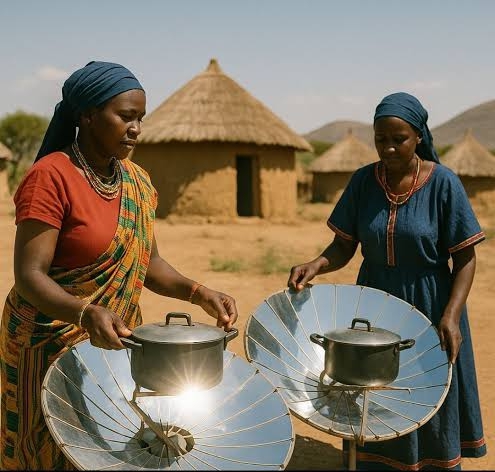
Picture Showing South African Women Cooking with Solar Powered Satellite Dishes – Photo Credit: David Kagama – AFP
The Parabolic shape is perfect for concentrating sunlight. A typical 1.8- to 2.4-meter dish can focus solar rays onto a small area at its focal point, dramatically increasing heat intensity. Instead of reflecting signals to a low-noise block downconverter (LNB), communities now harness that geometry to capture and intensify the sun’s thermal energy.
The basic build is remarkably simple and uses locally available or scavenged materials:
– An old satellite dish (often free or costing very little).
– Copper tubing coiled across the dish’s surface or positioned near the focal point.
– Black paint or heat-absorbing coating applied to the dish and/or tubing.
– Basic plumbing fittings, insulation where needed, and a simple frame or mount for sun-tracking.
Some versions paint the entire dish black to maximize absorption across its surface, while others line the inner curve with reflective material (like aluminum foil or mylar) to concentrate rays onto black-painted copper coils at the center. Water flows through the coiled tubing, absorbing concentrated heat rapidly. In full sun, temperatures can rise enough to produce near-boiling water or very hot usable water in just minutes, depending on flow rate and conditions.
Copper is chosen for good reason: it conducts heat exceptionally well, resists corrosion in water systems, and is relatively affordable or recyclable in many communities. The coils act as a heat exchanger. Sunlight strikes the black surface or concentrated focal area, rapidly heating the metal, which then transfers that thermal energy directly to the circulating water. No pumps are always necessary—thermosiphon (natural convection) or gravity flow works in many setups, keeping the system passive and maintenance-free.
Why Rural South Africa Needs This Innovation
Large parts of rural South Africa, especially in provinces like Limpopo, Eastern Cape, KwaZulu-Natal, and parts of the Free State, remain off-grid or suffer chronic energy insecurity. Many households rely on firewood for heating water, cooking, and warmth. Collecting wood is time-consuming often done by women and children leading to deforestation, health issues from indoor smoke (respiratory problems, eye irritation), and safety risks from venturing into the bush.
Hot water itself is a daily necessity for hygiene: bathing, washing clothes and dishes, and basic sanitation. Without it, families face higher risks of waterborne illnesses. Commercial solar water heaters exist but are prohibitively expensive for low-income households, often requiring professional installation, imported components, and reliable electricity for pumps in some models.
Enter the repurposed satellite dish system. It costs a fraction of commercial alternatives—sometimes just the price of copper tubing and paint if the dish is scavenged. It requires no grid connection, no moving parts in passive versions, and minimal skills to assemble with guidance from local workshops or community demonstrations. Each unit can heat dozens of liters per day, enough for a family’s needs, and scales for shared community use.
The Science Behind the Magic
Solar concentration is the key principle. A flat-plate solar collector absorbs sunlight over a broad area but delivers moderate temperatures. A parabolic dish, however, acts like a magnifying glass for heat. It reflects and focuses incoming solar radiation (insolation) onto a small receiver, achieving much higher energy density.
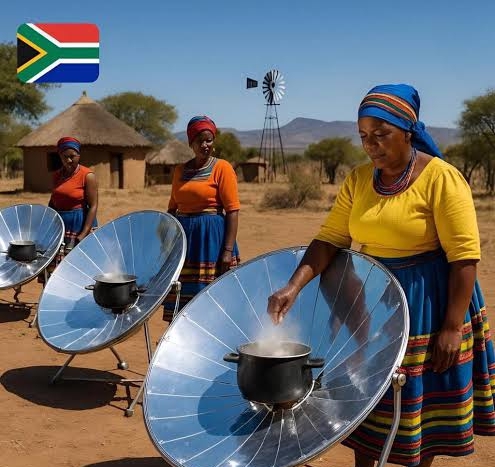
Picture Showing South African Solar Powered Satellite Cooking Pots Used for Solar Cooking – Photo Credit: David Kagama-AFP
In South Africa’s sunny climate many rural areas enjoy over 2,500 hours of sunshine annually—the potential is enormous. Direct normal irradiance in good conditions can exceed 800–1,000 W/m². The dish’s effective aperture multiplies this, delivering concentrated heat that quickly raises water temperature.
Black surfaces are critical because they absorb nearly all wavelengths of visible and infrared light rather than reflecting them. Copper tubing ensures efficient conduction: heat moves rapidly from the hot metal to the water inside. If water flows slowly or in a batch setup, it can approach boiling; for continuous flow (like a shower or tap), it delivers reliably hot water (50–80°C or more).
Variations exist. Some builders create true parabolic solar cookers by covering the dish with reflective foil and placing a pot at the focal point for direct cooking—reaching temperatures high enough to fry or boil. Others focus on water heating with coils. Academic work at institutions like Stellenbosch University has explored similar parabolic dish systems for cooking and heat storage, validating the approach under South African conditions.
Environmental and Social Wins
This innovation delivers multiple layers of benefit:
1. Waste Reduction: Diverts electronic scrap from landfills or informal dumping. Old dishes contain metal that would otherwise rust away or be burned.
2. Reduced Deforestation and Emissions: Less firewood collection means healthier woodlands and lower CO₂ from burning biomass. Indoor air pollution drops sharply, improving family health—especially for women and children who traditionally manage cooking and water heating.
3. Energy Independence: No reliance on erratic grid power, expensive LPG gas, or paraffin. The sun is free and reliable in most regions.
4. Economic Empowerment: Low upfront cost frees household budgets. Some communities build and sell units, creating micro-enterprises. Skills in basic plumbing, metalwork, and solar principles spread through workshops.
5. Health and Dignity: Hot water supports better hygiene, reduces disease, and eases daily chores. Children spend less time fetching wood or water, potentially improving school attendance.
Reports and viral social media posts highlight these systems providing hot water “in minutes” for bathing, cleaning, and even small-scale processing like sterilizing equipment or preparing food.
Challenges and Practical Considerations
Like any real-world solution, it isn’t perfect. The dish must face the sun optimally manual tracking (adjusting every hour or two) improves performance, though fixed mounts still deliver useful heat. Dust, rain, and wind require occasional cleaning and sturdy mounting to prevent damage. Copper can be stolen in some areas, so security or alternative materials are considerations.
Performance varies with weather: cloudy days reduce output, though thermal storage (insulated tanks) can help. Scaling for larger needs or integrating with existing plumbing takes experimentation. Safety matters—concentrated sunlight can cause burns or fire risks if not handled carefully, so education is essential.
Community adoption often starts with pilot projects, NGO support, or local “maker” groups demonstrating builds. Governments or organizations focused on renewable energy and rural development could accelerate spread through subsidies for copper or training programs.
A Model for Frugal Innovation Worldwide
South Africa’s satellite dish solar heaters exemplify appropriate technology: solutions tailored to local constraints, resources, and needs rather than high-tech imports. They echo historical examples like Indian box cookers or Chinese solar water heaters but add a uniquely resourceful twist by upcycling existing infrastructure waste.
Similar ideas appear elsewhere. Repurposed dishes used for solar cooking in other African countries or DIY parabolic reflectors globally but the combination with copper tubing for water heating in off-grid South African communities stands out for practicality and speed.
This approach aligns with broader goals: circular economy (reuse over recycling), climate resilience (low-carbon heat), and inclusive development (accessible to the poorest). It proves that profound impact doesn’t require billion-dollar investments or cutting-edge labs. Sometimes, it starts with seeing potential in what others discard.
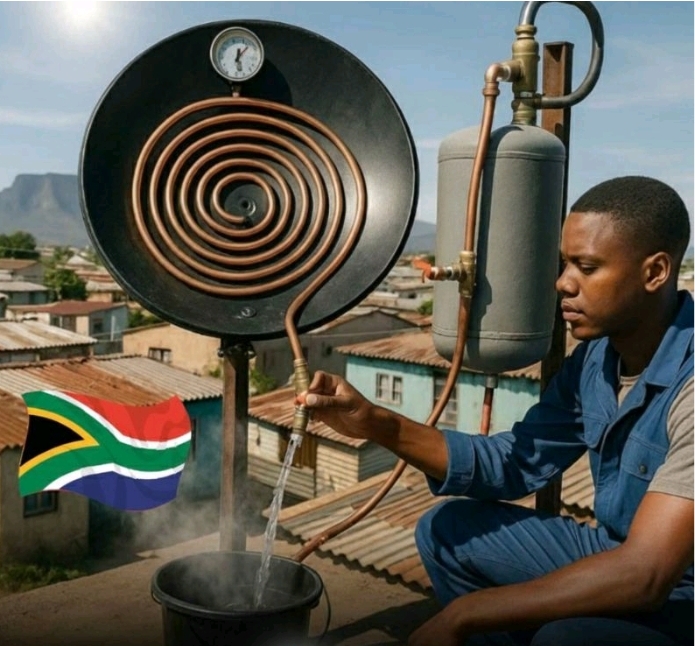
Picture Showing The SunFire solar heater which allows heat from the sun to be reflected and concentrated on a central point on the dish. Image Source : (SunFire)
Building Your Own: Basic Steps
While professional guidance is ideal, the core process is accessible:
1. Source a intact parabolic satellite dish (check scrap yards, old installations, or online marketplaces).
2. Clean and treat rust. Paint the surface black (high-temperature paint works best) or apply reflective film depending on design.
3. Coil copper tubing (typically 10–22mm diameter) in a spiral or serpentine pattern across the dish or concentrated at the focal point. Secure firmly.
4. Connect inlet and outlet pipes to a water source and storage tank. Insulate pipes to minimize heat loss.
5. Mount securely with ability to tilt/adjust for sun angle. Aim roughly south in the Southern Hemisphere and track manually.
6. Test with slow water flow on a sunny day. Monitor temperatures and adjust coil placement or flow rate.
Safety first: use food-grade materials if water is for consumption, add pressure relief if building pressurized systems, and supervise children around hot surfaces.
Communities often improve designs collaboratively—adding reflectors, better insulation, or hybrid elements.
Video Interviewing a Limpopo Man who invented a Solar Powered Stove – Photo Credit: YouTube
The Bigger Picture: Hope Through Ingenuity
In an era of climate anxiety and energy crises, stories like this restore faith in human creativity. Rural South Africans aren’t waiting for perfect grid extension or subsidized high-tech panels. They’re solving problems with what’s at hand: rusted metal, scavenged pipe, and sunshine.
These solar heaters won’t power an entire factory or replace all energy needs, but they address a critical daily gap by providing much needed hot water with elegance and minimal environmental footprint. They reduce pressure on overloaded grids, cut household costs, and foster self-reliance.
As more communities adopt and refine the idea, knowledge spreads through word of mouth, social media, and grassroots networks. What began as individual hacks could evolve into widespread programs supporting thousands of households.
South Africa’s dish-to-solar transformation is more than a clever hack. It’s a masterclass in frugal engineering, a testament to resilience, and a beacon for sustainable development. In places where the grid never arrived, the sun now delivers—thanks to visionaries who looked at rusting satellites and saw the future shining back.
This innovation reminds us that the most powerful solutions are often the simplest: observe, repurpose, adapt, and share. As the sun rises daily over South Africa’s rural landscapes, so does the promise of cleaner, hotter, brighter lives—one coiled copper tube at a time.
Disclaimer!
This publication is made for Educational and awareness purposes. It is not made for the sale of any product or service. The information provided here are based on verified human aided research and studies





Leave a Reply