
A Young Brilliant Nigerian student named Mudashiru Ayeni, In the early 1970s believed he had invented a battery-powered AI Robot office assistant and was asked to personally demonstrate it to the then head of state, Yakubu Gowon. later he, was sent to a psychiatrist home instead.
Key Takeaways:
• A Brilliant Young Nigerian Inventor Created an Artificial Intelligent Office Robot in 1971
• The Nigerian Government overwhelmed by his Brilliance Declared him Mentally unstable and sent him to a Psychiatric Hospital for medical investigation
• His robot machine worked at the press of a button, it told the caller whether the boss was busy, available, or away from the office
In the early 1970s, a young Nigerian Inventor believed he had invented Nigeria’s First Artificial intelligent Robotic Machine – a Battery-powered AI Robot office assistant and was asked to personally demonstrate it to the then head of state, Yakubu Gowon. later he, was sent to a psychiatrist home instead.
Archivi.ng one of Nigeria’s renowned Newsletter wrote about Ayeni in a flashback report, citing a 1971 story by TRUST Magazine.
The Young Nigerian innovator was forced to visit a psychiatrist no less than eight times before the doctor certified him as being in a sound mind.
He was Banned from attending classes and forced to quit schooling.
After that, the 20-year-old student seeing his brilliant innovative Technology talents going down the drain, wrote to his school principal about the expectations of Technology on young Africans in the development of the continent.
If only Mudashiru Ayeni had known the scale at which Technology will become in our World today. With countries like China now awarding PhD Degrees for inventing a fully functional Robots.
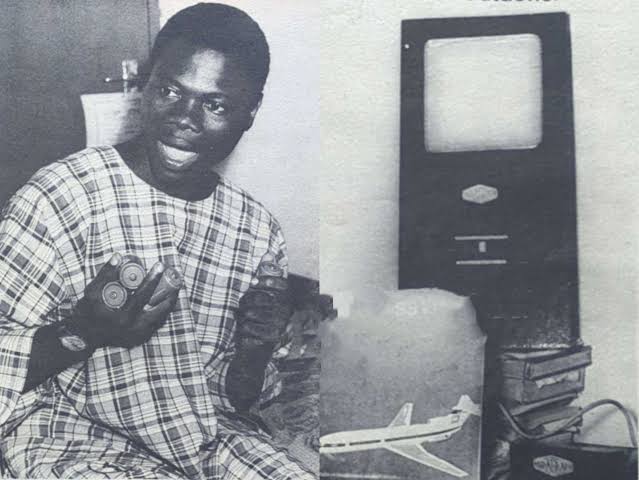
Picture Showing Inventor Mudashiru Ayeni pictured with his AI Office Assistant Robot – Photo Credit File Photo
Later, Ayeni got in touch with the then Federal Commissioner of Communication of Nigeria, Aminu Kano, who gave him the courage he needed and renewed his sense of purpose.
His robot machine worked at the press of a button; it told the caller whether the boss was busy, available, or away from the office. At the time the story was published, Ayeni said several businessmen had already expressed interest in his invention.
Nigerians react to report of Nigerian inventor’s dilemma The flashback story has started generating reactions from Nigerians.
Below are some reactions to the Destruction of Tech Talents in Nigeria:
Francis Zege said: “This would have put us on the map globally in the 70s, but our brain-dead leaders prefer to siphon rather than to invest in growth and innovation.”
Hakeem recounted the story of a Nigerian soldier: “I met a soldier in a barracks who is a mechanical engineer. This guy patented his work on his own Gun stronger than the AK-47 by far, did all the necessary calculations, strength of materials and everything. Guess who was against him, the Nigerian Military.”
Alex Kabari lamented the situation: “You’re tagged names when you possess skills and information your environment cannot understand. Some people are unlucky to be born ahead of time or in the wrong environment.”
Sandra Vaatiav said: Nigeria is too much culturaly, ethnically, and religiously multilated that Technology innovations are discarded as evil practices by many and Inventors often subjected to various range of scrutiny and public shaming.
According to the story:
-The young AI Robotic inventor made eight visits to the hospital before the psychiatrist certified him to be of sound mind.
-This time, he was banned from classes and forced to quit school entirely.
-Ayeni later reached out to Nigeria’s Federal Commissioner of Communications, Aminu Kano, who encouraged him and gave him a renewed sense of purpose.
-His AI Robot worked at the press of a button, it told the caller whether the boss was busy, available, or away from the office.
At the time the story was published, Ayeni said several businessmen had already expressed interest in his invention.
Nigerian Tech Talents Going Down the Drain:
Nigeria’s young technology talents represent one of the country’s most valuable untapped resources. With a median age around 18 and millions entering the workforce annually, the nation boasts a vibrant pool of developers, AI specialists, fintech innovators, and digital entrepreneurs.
Yet, many of these bright minds are “rotting away” — underemployed, underpaid, migrating abroad in droves via the “Japa” syndrome, or struggling in an ecosystem plagued by infrastructure deficits and limited opportunities. This brain drain and talent underutilization threaten Nigeria’s digital economy ambitions and long-term growth.
The Scale of the Crisis: Japa and Talent Exodus
The “Japa” phenomenon a slang for Mass emigration of skilled Professionals seeking better lives abroad — has hit the tech sector particularly hard. In recent years, thousands of Nigerian tech professionals have relocated to countries like Canada, the UK, and the US, drawn by higher salaries, stable infrastructure, and career growth. Reports indicate that tech emigration has tripled in some periods, with startups suffering the most as senior roles become harder to fill.
Root Causes: Why Talents Are Wasting Away
Several systemic barriers prevent Nigeria’s young tech talents from thriving locally:
- Infrastructure Deficits: Unreliable electricity, slow and expensive internet, and limited data centers cripple productivity. Many developers rely on generators and costly data bundles, making consistent remote work or innovation challenging. The country has far fewer data centers than needed to support a booming digital economy, with power capacity woefully inadequate.
- Skills and Employability Gaps: While coding bootcamps proliferate, a significant mismatch exists between training and industry needs. Employers report shortages in advanced digital skills, with only a small percentage of young Nigerians (aged 15-24) possessing marketable ICT competencies. Over 80% of local tech talents reportedly face barriers to global employability due to gaps in practical experience, soft skills, or exposure to cutting-edge tools.
- Low Pay and Poor Working Conditions: Local salaries often fail to match living costs or international benchmarks. A software engineer might earn far less in Nigeria than abroad, pushing talents toward foreign firms or migration. Startups struggle with retention amid funding winters and economic volatility.
- Limited Funding and Ecosystem Challenges: Nigerian startups face difficulties securing follow-on funding, with many ventures shutting down after raising initial capital. The ecosystem, concentrated in Lagos, lacks widespread support for scaling. Bureaucracy, policy inconsistencies, and weak enforcement of initiatives like the Nigeria Startup Act hinder progress.
- Broader Economic Pressures: High youth unemployment (around 23% actively seeking work, with many more underemployed or in survival “nano businesses”), inflation, and insecurity create a push factor. Many talents feel their potential is wasted in an environment that doesn’t reward innovation or hard work adequately.
The Human and Economic Cost
This wastage carries heavy consequences. Nigeria’s digital economy, projected to grow significantly, risks losing out on over $11 billion annually in unrealized value due to skills shortages. Startups face delayed projects, reduced innovation, and talent poaching by global tech giants. The country trains talents only for them to contribute to foreign economies — a classic brain drain that depletes universities, innovation hubs, and the broader workforce.
Socially, it fuels frustration among youth who see peers succeeding abroad via LinkedIn updates while grappling with Local realities. It also exacerbates inequality, as those with better networks or resources “Japa” successfully, leaving others behind.
On the flip side, some positives emerge: Diaspora remittances, remote work earnings flowing back, and occasional “brain gain” as returnees or virtual collaborators invest in local startups. Yet these rarely offset the losses.
Nigeria, It’s Time We Stop Disregarding Our Own Inventors!
Today Nigeria boasts about being the “Giant of Africa,” yet when our brightest minds create solutions tailored for our problems, we treat them like mentally deranged patients with crazy ideas.
Take Emeka Nelson from Awka, Anambra State. This young man, without a university degree, built a water-powered generator (Mgbanwe C12) from scrap materials he picked from dustbins. It runs for hours on just a litre of clean water, produces up to 1000W, and was inspired by the tragic death of his friend from generator fumes. No fuel, no noise, no pollution. Perfect for Nigeria’s power crisis, right?
Years later, it’s still sitting in his backyard powering just his two-bedroom apartment. No government contract. No investor backing. No scaling. Just silence.
This isn’t one case. It’s a pattern:
- Thousands of Brilliant hardware inventions gathering dust in ministry offices.
- Young innovators begging for prototypes funding while we spend Billions of Dollars to Import foreign tech.
- Talented creators forced to flee abroad or give up because of zero support and recognition.
While, countries like India, China, and even smaller African nations are turning their local inventors into national assets, We in Nigeria export our best brains and import their finished products.
Pathways to Rescue and Harness Nigerian Tech Talents
Nigeria must act urgently to stop the rot and convert potential into prosperity:
- Infrastructure Investment: Prioritize reliable power, affordable broadband, and data center expansion. Public-private partnerships could accelerate 5G and cloud capabilities essential for AI and digital growth.
- Skills Alignment and Education Reform: Scale targeted training in high-demand areas like AI, with industry collaboration. Emphasize practical projects, mentorship, and employability skills in universities and bootcamps. Programs addressing the gap between education and market needs are critical.
- Retention Incentives: Offer competitive salaries, tax breaks for tech firms, and startup support through effective implementation of the Startup Act. Create enabling policies for remote global work while encouraging local value addition.
- Funding and Ecosystem Building: Expand seed funds, grants, and venture capital access. Reduce bureaucratic hurdles and foster regional hubs beyond Lagos. Encourage circular migration through diaspora engagement, sabbaticals, and co-investment schemes.
- Policy and Leadership Focus: Government must tackle root causes — economic stability, security, and anti-corruption while prioritizing youth job creation. Youth-led input in policy (e.g., via digital economy strategies) would help. Initiatives curbing Japa through better conditions, rather than rhetoric, are needed.
- Mindset and Community Shift: Celebrate local builders, promote entrepreneurship from early education, and build a culture of resilience and problem-solving tailored to Nigerian realities (e.g., low-resource, high-impact innovations).
Turning brain drain into brain gain or “brain circulation” requires collective effort: government enabling the environment, private sector investing in people, educators aligning curricula, and talents committing to build despite odds.
Nigeria, enough is enough!
To our government: Create real innovation funds, protect patents, and fast-track local inventions into public projects.
To investors and corporates: Stop flying to Silicon Valley for “solutions” — the real ones are here in Lagos, Enugu, Port Harcourt, and villages across the country.
Our future is not in copying others. It’s in backing the Mudashiru Ayeni & Emeka Nelson’s among us.
Who else is tired of this disregard? Drop your thoughts below. Tag an inventor you know or share this if you believe we can do better.





Leave a Reply