

Toyota has revealed CUE7, its latest Basketball-playing robot. Standing at 219 cm tall and weighing just 74 kg, this sleek humanoid made its public debut on April 12, 2026, during halftime of a B.League game at Toyota Arena Tokyo. In front of 8,400 fans, CUE7 smoothly rose from a seated position, dribbled the ball with improved control, and sank a free throw, earning enthusiastic applause.
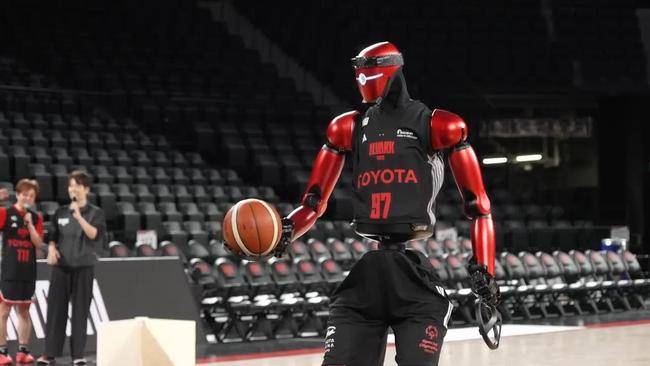
Toyota Humanoid Robot CUE7 at Toyota Arena Tokyo – Munemasa Horio
CUE7 represents a significant leap in Toyota’s robotics ambitions. It combines smart vision, advanced sensors, and AI to detect the basketball hoop, measure distances and angles precisely, and calculate the perfect shot trajectory. Far from a gimmick, this robot serves as a dynamic testbed for technologies that could transform manufacturing, logistics, and human-robot collaboration.
Key Takeaways:
• Toyota Invent a Humanoid Basketball Robot that’s works like a Professional Human Basketball Player
• This Robot called “CUE7” uses Smart Vision, Advanced Sensors and AI to function efficiently
• CUE7 has already broken two Gusiness World Records for Longest Basketball Shot
The Origins of the CUE Project: From Volunteer Side Hustle to World Records
The story of CUE began in 2017 as a voluntary project within Toyota’s Engineering Society. A small group of passionate employees wanted to push the boundaries of AI and robotics by tackling a challenging, visually compelling task: making a humanoid robot play basketball. What started with Lego prototypes and basic free-throw attempts evolved into a full-fledged research platform.
By 2019, the third-generation CUE3 achieved a Guinness World Record by sinking 2,020 consecutive assisted free throws by a humanoid robot. This feat demonstrated remarkable repeatability and precision, highlighting Toyota’s early mastery of motion control and consistency in a dynamic environment.
Subsequent generations pushed further. CUE6, unveiled in 2024-2025, set another Guinness World Record for the farthest basketball shot by a humanoid robot 24.55 meters (over 80 feet), nearly the full length of a regulation court. It required sophisticated ball handling, trajectory calculation for extreme distances, and robust stability. Foot-mounted cameras and redesigned hands improved tracking and grip during these ambitious attempts.
CUE7 builds directly on this legacy but marks a philosophical and technical reset. Developers, led by figures like Tomohiro Nomi, head of Toyota’s humanoid robot research, discarded much of the previous architecture. They embraced reinforcement learning and hybrid control systems, allowing the robot to learn complex movements through trial and error rather than relying solely on pre-programmed model predictive control.
This shift enabled smoother, more dynamic actions that were previously impossible. As Nomi noted, the team now feels they are “standing at the starting line of a new CUE.”

Toyota’s latest CUE7 humanoid robot sets up to shoot a free throw at Toyota Arena Tokyo on April 12. (Photo by Munemasa Horio)
How CUE7 Sees, Thinks, and Shoots
At its core, CUE7 excels because of its integrated perception-action loop powered by AI, vision systems, and sensors.
– Smart Vision System: A stereo camera mounted in the head provides depth perception and detailed visual input. This allows CUE7 to identify the basketball hoop even from varying angles and distances, tracking its position in real time as the robot moves or the environment changes slightly.
– Advanced Sensors: Lidar (light detection and ranging) sensors embedded in the torso detect surrounding objects, helping the robot navigate the court, avoid obstacles, and maintain spatial awareness. Additional sensors likely monitor joint positions, force feedback from the hands, and ball contact.
– AI-Driven Decision Making: Once the hoop is detected, the AI measures distance and angle. It then calculates the optimal launch velocity, release angle, and arc needed for a successful shot, factoring in gravity, air resistance, and spin.
Reinforcement learning plays a key role here as the system refines its policy through simulated and real-world trials, adapting to slight variations in ball weight, court conditions, or robot posture.
– Precision Actuation and Release: Specialized end effectors (hands) grip and guide the ball, imparting consistent backspin for better accuracy. Motorized arms and knees execute the motion with high repeatability. The release is timed perfectly, converting computational commands into fluid physical action. Toyota engineers designed the arms for highly repeatable basketball-specific motions, minimizing variability.
CUE7’s locomotion represents another major upgrade. Previous versions used four wheels for stability, but CUE7 adopts an inverted two-wheel structure. This change, combined with a dramatic weight reduction from around 120 kg (CUE6) to 74 kg (a roughly 38-40% drop), boosts speed and agility while maintaining balance. High-performance batteries, originally developed for Toyota’s race cars, provide the power density needed for dynamic movements without excessive bulk. Fewer axles and optimized components contributed to the lighter design.
A hybrid control system merges reinforcement learning (for adaptive, learned behaviors) with model predictive control (for precise trajectory planning). This combination allows CUE7 to handle unexpected situations more gracefully which is very crucial for real-world applications beyond the basketball court.
The robot’s design also emphasizes aesthetics and functionality. Its sharp, athletic silhouette evokes a professional player while prioritizing functional beauty: every curve and joint serves performance and durability.
CUE7’s Evolution Across Generations
The progression from early CUE models to CUE7 illustrates rapid iteration in robotics:
– Early Generations (CUE1–CUE3): Focused on stationary or semi-stationary free throws. Emphasis on consistency, leading to the 2,020-shot record. Basic vision and control systems proved the concept.
– Mid Generations: Expanded range and introduced dribbling. Participation in B.League All-Star events brought public engagement.
– CUE6: Emphasized extreme distance shooting. Redesigned hands and additional cameras improved ball manipulation. Achieved the 24.55m record on the second attempt, showcasing robustness.
– CUE7: Prioritizes fluidity, adaptability, and efficiency. Smoother movements, better dribbling, lighter weight, two-wheel mobility, and deeper AI integration. It can transition from sitting to standing, dribble while balanced, and execute shots with greater grace.
Each version has served as a platform for testing embodied Artificial Intelligence where intelligence is tightly coupled with physical form and real-world interaction. Basketball provides an ideal challenge: it demands perception (seeing the hoop and ball), cognition (planning the shot), and actuation (precise body control) under time pressure and with physical variability.
Why Basketball as a Testbed for Humanoid Robotics ?
Basketball is more than entertainment for Toyota’s engineers. It encapsulates many challenges robots face in unstructured environments:
– Dynamic Perception: Tracking a moving ball or adjusting to hoop position under varying lighting or angles.
– Precise Manipulation: Gripping, dribbling, and releasing an object with exact force and spin.
– Balance and Mobility: Maintaining stability on two (or more) points of contact while generating power for shots.
– Adaptation: Handling slight differences in ball inflation, floor friction, or fatigue in actuators.
– Repeatability with Grace: Performing the same action thousands of times without degradation, yet looking natural.
Success on the court translates to factory floors, where robots must pick, place, and assemble parts with similar precision while adapting to minor variations. CUE7’s technologies—vision-based targeting, AI trajectory planning, hybrid control, and lightweight actuation directly inform safer, more capable collaborative robots (cobots) that work alongside humans.
Tomohiro Nomi and the team emphasize that Basketball is a visible demonstration of broader robotics capabilities. The project accelerates development in areas like sensor fusion, learning-based control, and energy-efficient design, all critical for Toyota’s vision of future mobility and automation.
Broader Implications: Robotics, AI, and the Future of Work
CUE7 arrives at a pivotal moment in robotics. Humanoid robots are gaining traction across industries, from Tesla’s Optimus to Figure and Boston Dynamics platforms.Toyota’s approach stands out for its focus on practical, learnable AI rather than purely scripted behaviors.
The weight reduction and two-wheel design hint at more mobile, energy-efficient humanoids suitable for warehouses or homes. Reinforcement learning allows robots to improve autonomously, reducing the need for exhaustive manual programming which is a major bottleneck in scaling robotics.
In manufacturing, similar systems could enable robots to adapt to new assembly tasks with minimal retraining. In logistics, vision and planning tech could optimize picking in chaotic environments. Even in healthcare or eldercare, precise, gentle manipulation learned from ball handling could prove valuable.
Toyota’s race-car-derived batteries underscore synergies between its automotive expertise and robotics. High power density supports bursty movements (like jumping or quick dribbles) without compromising endurance.
Challenges remain: CUE7 still operates in relatively controlled settings, and full autonomy in chaotic real-world scenarios requires further advances in generalizable AI and robust hardware. Cost, safety, and ethical considerations around job displacement will shape adoption.
Yet the trajectory is clear. Projects like CUE demonstrate that playful, public-facing challenges can drive serious technological breakthroughs. By making the robot entertaining and relatable, Toyota builds excitement and gathers valuable data from real performances.
Public Reaction and Cultural Impact
The April 12, 2026 debut generated immediate buzz. Videos of CUE7’s smooth motions and successful free throw circulated widely, drawing comparisons to sci-fi depictions of athletic robots. Fans at Toyota Arena Tokyo reacted with applause and amazement, humanizing the machine through its basketball prowess.
Social media highlighted the precision: “Machine-level accurate every time.” Others noted the athletic silhouette and fluid transitions from sitting to action. The robot’s affiliation with Alvark Tokyo (jersey number 96 in earlier generations) adds a fun, team-spirit element.
This visibility helps demystify robotics. When people see a robot dribble and shoot with grace, it shifts perceptions from “threat” to “impressive tool.” It also inspires younger generations to pursue STEM fields, showing how engineering can merge with sports and entertainment.
Looking Ahead: What’s Next for CUE and Toyota Robotics?
CUE7 is described as the start of a new era. Future iterations may incorporate more human-like legs for greater versatility, enhanced learning for multi-tasking (dribbling while defending, passing, etc.), or integration with larger Toyota ecosystems like autonomous vehicles.
The underlying technologies will likely feed into Toyota’s broader humanoid efforts, potentially including the T-HR3 platform or new collaborative systems for factories. Long-term goals include robots that not only perform repetitive tasks but adapt intelligently to support human workers, enhancing productivity and safety.
Toyota’s Frontier Research Center continues to attract talent excited by such ambitious projects. The voluntary origins remind us that innovation often sparks from intrinsic curiosity before scaling to corporate strategy.
As AI and robotics converge, demonstrations like CUE7 remind us of the potential: machines that perceive, reason, and act with increasing sophistication. Basketball may be the showcase, but the real game is advancing technology that benefits society more efficient production, new mobility solutions, and tools that augment human capabilities.
CUE7 doesn’t just make perfect shots. It embodies Toyota’s commitment to pushing technological frontiers through creativity, precision engineering, and relentless iteration. In a world racing toward smarter automation, this basketball-playing robot offers a compelling glimpse of what’s possible when vision, sensors, and AI come together on the court and beyond.
The CUE series proves that ambitious, fun projects can yield profound engineering insights. As CUE7 dazzles crowds and refines its skills, it carries forward Toyota’s legacy of innovation, one precise shot at a time. Whether sinking free throws or powering future factories, the fusion of smart vision, sensors, and AI in CUE7 signals an exciting chapter in humanoid robotics.
Disclaimer
This post is for Educational and informational purposes only and reflects publicly available reporting as of April 2026.



Leave a Reply