
In a significant development for African defense cooperation, the United States has announced plans to establish a regional drone manufacturing & training center in Morocco. This initiative positions the North African kingdom as a key hub for building advanced unmanned aerial capabilities across the continent, amid escalating security challenges from terrorism, insurgency, and transnational threats.
Key Takeaways:
•US to setup a Drone Training & Manufacturing Centre in Morocco thereby expanding US Drone Structures to African Territory
•Increasing Demand for Unmanned System Programs pushing this new initiative
•Morocco Strategically perched at the crossroads of Africa, Europe, and the Middle East, offers ideal geography for regional training and Surveillance coordination
•Low Cost Drones proving to be the edge in the Middle-East War
• U.S insists Morocco hub is not about establishing a permanent U.S. strike base but empowering African partners with skills in surveillance, reconnaissance, precision operations and tools
Announced just days ago at the 13th African Land Forces Summit in Rome (March 23–24, 2026), the move underscores Washington’s deepening commitment to tech-driven partnerships in Africa—focusing on sustainable, locally led solutions rather than direct intervention.
The Announcement: From Rome to Rabat
During opening remarks at the summit sponsored by the U.S. Army’s Southern European Task Force–Africa (SETAF-AF) and attended by over 300 participants from 47 countries, Gen. Christopher Donahue, commander of U.S. Army Europe and Africa, laid out the vision.
The center will serve as a collaborative hub where African forces can train together, share intelligence, and tackle shared security problems. “It is about a sustainable, enduring capability that, once we prove its effectiveness, we can take to other parts of Africa,” Donahue emphasized. He added that the Morocco-based facility offers “a different approach to train each other, to learn from each other and to share information to solve a problem.”
The program kicks off small but strategically: a pilot drone training module for about 16 participants during the upcoming African Lion 2026 exercises (April 20–May 8, 2026). This will test frameworks for drone integration into military planning and hands-on operations using multiple systems.
The Rise of Drone Warfare and US Vulnerabilities
Adversaries like China, Russia, Iran, and North Korea are advancing capabilities that directly challenge US interests, from the Indo-Pacific to the Western Hemisphere and beyond. In response, the Pentagon is aggressively expanding its unmanned systems programs, with a heavy emphasis on scaling up domestic drone manufacturing to maintain military overmatch in an era of attritable, AI-enabled warfare.
Drones have proven decisive in recent conflicts, offering persistent ISR (intelligence, surveillance, reconnaissance), precision strikes, and swarm capabilities at lower cost than manned aircraft.
China dominates global commercial drone production (often cited at 70-90% market share), including critical components like batteries, motors, and electronics. This creates a strategic vulnerability: reliance on potential adversaries for supply chains in a conflict scenario.
Russia and Iran in recent times have supplied drones to proxies and allies, demonstrating how accessible technology enables asymmetric threats. The US has historically led in high-end systems like the MQ-9 Reaper from General Atomics, but it lags in mass-producing low-cost, attributable “one-way” Drones and collaborative Drones needed for peer competition.
Nuclear and Missile Proliferation: New START expires in February 2026, heightening nuclear risks. China and Russia are expanding missile arsenals and counterspace capabilities, while Iran and North Korea advance their programs. Hybrid threats, including drones and cyber operations, blur lines between peace and conflict.
Regional Instabilities and Non-State Actors: Conflicts in the Middle East, ongoing terrorism risks, narco-trafficking in the Western Hemisphere, and migration pressures strain US resources. Recent mysterious drone incursions over US military bases have raised alarms about potential foreign surveillance or signaling, possibly linked to escalating tensions with Iran or China.
Furthermore, Incidents of sophisticated drones over US bases underscore the dual-use nature of the threat—adversaries can use the same technology for espionage or attack. This has led to Counter-UAS (unmanned aircraft systems) investments rising, but offense must keep pace with defense.
What Makes African Lion 2026 a Launchpad?
African Lion is already the Largest U.S.-led Military exercise on the continent, involving forces from 19 African nations, European partners, and now over 40 Defense technology companies. The 2026 edition spanning multiple Moroccan sites including Agadir, Tan Tan, and Kenitra will embed cutting-edge systems in real-world scenarios, from mission command platforms to counter-attack tools.
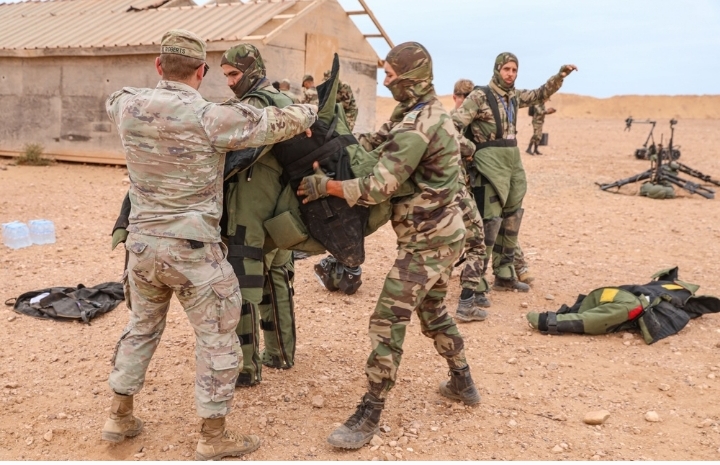
Picture Showing US & Moroccan Soldiers testing bomb suits at African Lion 2025: Photo Credit VIDS Images
Drones will play a starring role, bridging the gap between emerging technology and warfighters on the ground. As Lt. Col. Ramon Leonguerrero of SETAF-AF’s Advanced Capabilities Directorate put it: “Our goal is to close the gap between emerging technology and the warfighter.”
The Push for Domestic Military Drone Manufacturing Centers
Recognizing these gaps, the US Department of Defense (now sometimes referred to with a “Department of War” designation in strategy documents) is driving a major expansion of domestic drone production. Key initiatives include:
- Replicator Initiative and Drone Dominance Programs: Aimed at fielding thousands of autonomous systems quickly, with tranches focusing on attritable air, land, and sea platforms. The Pentagon has selected companies like Anduril, General Atomics, AeroVironment, and others for rapid prototyping and scaling.
- SkyFoundry and Army Targets: The Army aims for facilities capable of producing up to 10,000 small UAS per month, with ambitions scaling toward 1 million drones annually in some proposals. This includes government-owned innovation and production sites operated by Army Materiel Command.
- Collaborative Combat Aircraft (CCA): The Air Force is advancing programs like the YFQ-42A (General Atomics) and YFQ-44A (Anduril) — autonomous “wingmen” to accompany manned fighters. Production is ramping up at new facilities.
- Policy and Budget Support: Executive orders, NDAA provisions, and FCC restrictions on foreign (especially Chinese) drones and components are forcing a “Blue UAS” compliant domestic base. The FY2026-FY2027 defense budgets allocate billions for autonomy, with proposals reaching tens of billions for unmanned systems overall. New manufacturing hubs, 3D-printing pilots, and partnerships with startups aim to build resilient supply chains free of foreign dependencies.
Companies like Anduril are opening facilities (e.g., Arsenal-1) for high-rate production of systems like Fury. Traditional players like General Atomics leverage existing lines for both Reapers and next-gen CCAs. The goal is “drone dominance” through volume, autonomy, and integration across domains.
Why Morocco? Strategic Location Meets Proven Partnership
Morocco’s selection is no accident. As America’s oldest treaty ally (dating back to the 1786 Treaty of Peace and Friendship), the kingdom has hosted African Lion for years and maintains deep military ties with the U.S. AFRICOM Commander Gen. Dagvin R.M. Anderson has visited Morocco twice since taking command in 2025, highlighting ongoing work on counterterrorism centers of excellence in Morocco and Tunisia described as “force multipliers” across the continent.
Strategically perched at the crossroads of Africa, Europe, and the Middle East, Morocco offers ideal geography for regional training and Surveillance coordination. The kingdom is also rapidly advancing its own military UAV (unmanned aerial vehicle) industry, making it a natural fit for technology transfer and joint innovation.
U.S. Officials frame the partnership holistically: “Security leads to stability; that stability creates opportunities for investment; and that investment creates prosperity,” Anderson has stated.
Broader Context: America’s Evolving Africa Security Strategy
Africa faces a complex threat landscape jihadist groups in the Sahel, Boko Haram in the Lake Chad Basin, and spillover instability from conflict zones. Traditional U.S. approaches have faced challenges, prompting a pivot toward capacity-building and technology.
Drones have already proven their value in intelligence gathering and counterterrorism, as noted by Nigerian Maj. Gen. Saidu Audu at the Rome summit: “African security issues are not just African concerns.”
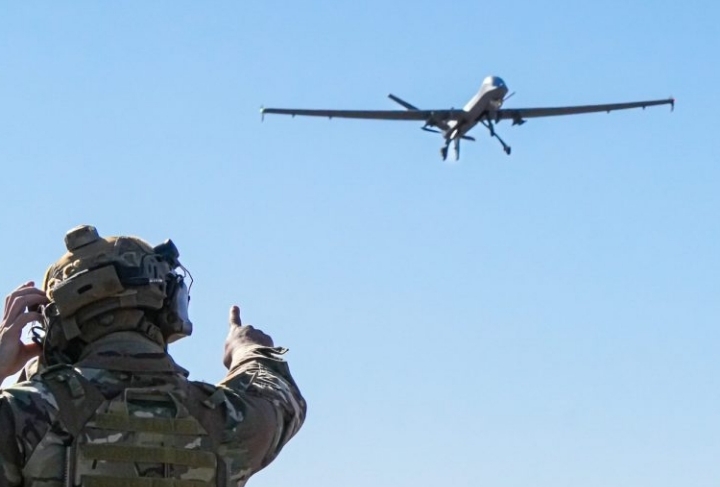
Picture Showing US deploying MQ-9 drones and troops to Nigeria for intelligence support – Photo Credit Military Africa
This Morocco hub builds on that momentum. It’s not about establishing a permanent U.S. strike base but empowering African partners with skills in surveillance, reconnaissance, and precision operations—tools that can be scaled continent-wide.
Implications: Reshaping Regional Security Architecture
Analysts see this as a game-changer. The center could accelerate intelligence sharing, expand surveillance coverage, and foster deeper U.S.-Africa defense ties. It reinforces Morocco’s role as a stable gateway for continental security efforts while signaling to partners (and competitors) that Washington is investing in long-term, collaborative solutions.
For African nations, the benefits are clear: modern tools to combat asymmetric threats without over-reliance on foreign forces. Success here could spawn similar hubs elsewhere, creating a networked approach to security.
Critics may raise questions about sovereignty, arms proliferation, or great-power competition in Africa. Yet proponents argue the focus on training and sustainability prioritizes African ownership.
Why This Matters: Securing the Future
investing in domestic drone manufacturing centers is not just about hardware; it’s about deterring conflict through credible overmatch. By reducing reliance on vulnerable supply chains and enabling mass deployment of autonomous systems, the US can better defend the homeland, project power in the Indo-Pacific, support allies, and counter hybrid threats.
As global security unravels, with risks of escalation in multiple theaters, the push for drone centers represents a pragmatic adaptation: leveraging American innovation, industry, and allies to stay ahead in the next era of warfare. Policymakers, defense leaders, and industry must sustain this acceleration to turn strategy into capability before threats outpace preparedness.
Coming years will test whether the US can truly unleash its drone potential. Success could redefine deterrence; failure risks ceding initiative to adversaries who have already embraced mass unmanned operations.
Challenges Ahead
Scaling African Drone Might face manufacturing faces including:
- Supply Chain Gaps: Even domestic assemblers often rely on foreign parts for electronics, rare earths, and batteries. Full “Made in America” compliance requires massive investment in upstream industries.
- Workforce and Infrastructure: Building new African Drone centers demands skilled labor, secure facilities, and rapid certification processes.
- Cost and Culture: Shifting from exquisite, expensive platforms to cheap, expendable ones requires overcoming bureaucratic risk aversion and legacy procurement habits.
- Allied Coordination: Encouraging African partners to boost their own production and burden-sharing while maintaining interoperability.
Looking Ahead: A New Chapter in U.S.-Africa Defense Ties
As African Lion 2026 unfolds this spring, the world will watch closely. The drone training center in Morocco could mark the start of a more agile, technology-forward era in African security where partnerships deliver enduring capabilities against tomorrow’s threats.
In an era of rapid Technological change, as Lt. Gen. John W. Brennan Jr. noted at the summit, “The ongoing technical revolution is relentless.” Morocco’s emerging role as a drone hub may prove exactly the kind of forward-thinking collaboration the continent needs.
What do you think this means for Africa’s future security landscape? Drop your thoughts in the comments below👇
Disclaimer!
This publication is made for Educational and awareness purposes. It is not made for the sale of any product or service. The information provided here are based on verified human aided research and studies






Leave a Reply