
Report shows that AI Isn’t Yet Pushing Chinese Companies to Lay Off Workers as Aggressively as Their U.S. Peers
Key Takeaways:
• China witnessing fewer Jobs Lost to AI softwares compared to US
• China’s AI Governance and Policy setting the tone for AI Adoption and Regulation
• Chinese Government favouring People First Artificial intelligence wide scale deployment thereby retaining labour force
• Trending #AIAnxiety keeping Social Media Users in the US on edge with regards to potentially Looming Large Scale Job Losses
In early 2026, U.S. tech like Oracle, Amazon, Meta, and Salesforce have announced thousands of layoffs, many explicitly tied to AI-driven efficiencies and cost-cutting. Yet across the Pacific, Chinese companies from Alibaba to Tencent and Huawei aren’t following the same playbook. While some workforce adjustments are happening, AI isn’t triggering the aggressive, headline-grabbing job cuts seen in the United States.
What Explains this Divergence?
It’s not that China is ignoring AI. The country is racing ahead with adoption in manufacturing and enterprise tools. But a mix of government priorities, lower labor costs, cultural norms, and business structures is creating a buffer against rapid displacement at least for now.
The U.S. Layoff Wave citing AI as the Catastrophic Catalyst
American tech firms have been blunt. In the first quarter of 2026 alone, U.S. tech employers announced over 50,000 job cuts, with AI cited as a top reason in roughly 25% of cases. Oracle is slashing thousands amid heavy AI infrastructure spending. Amazon cut 16,000 corporate roles in January 2026 (following 14,000 the prior fall). Meta, Salesforce, Dell, and others have followed suit, with CEOs framing the moves as necessary to redirect resources toward AI.
Some analysts argue these cuts are more about anticipation of AI’s Potential than current performance leaving Companies trimming in expectation of future gains. Still, the message is clear: AI is reshaping white-collar work faster than many expected, hitting roles in Coding, Customer support, Data analysis, and even Middle Management.
China’s Measured Approach: Stability Over Speed
The US and Chinese approaches to AI represent two fundamentally different philosophies in the global race for technological supremacy. While both nations invest heavily and aim for leadership, their strategies diverge in governance, innovation models, priorities, and global ambitions. The US leans on private-sector dynamism and frontier breakthroughs, whereas China emphasizes state coordination, rapid deployment, and economic integration.
For example, Alibaba’s headcount dropped sharply in 2025 (over 30%), but the cuts stemmed largely from divesting non-core retail businesses like Sun Art and Intime to refocus on AI and cloud not blanket AI replacements. Tencent saw a modest ” increase ” in employees last year. Huawei’s R&D headcount edged up slightly to 114,000. Baidu made targeted reductions in some departments, but these were framed as broader restructuring rather than pure AI purges.
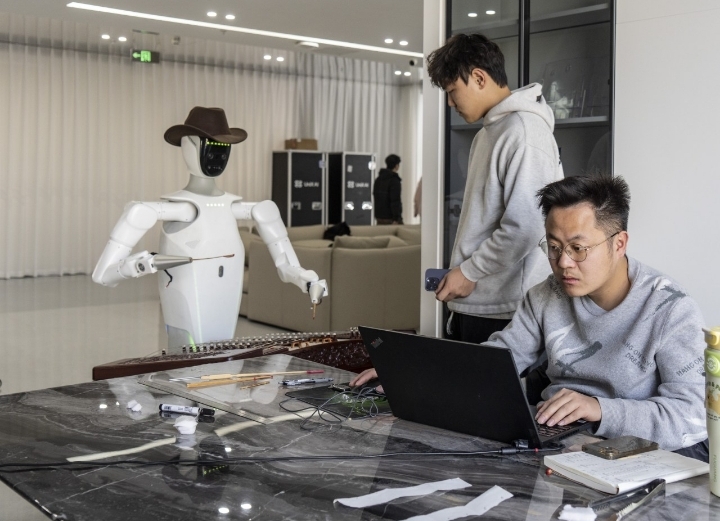
Chinese Engineers Jiang Li and Tai Ho training an AI Robot – Photo Credit: WSG
Governance and Policy: Market-Driven vs. State-Led
The United States adopts a decentralized, participatory, and largely market-driven model. The government provides voluntary guidelines (e.g., through NIST frameworks), executive actions, and targeted support, but innovation primarily comes from private companies. This approach fosters competition and agility, with minimal top-down mandates to avoid stifling creativity. Recent shifts under various administrations have focused on deregulation to accelerate growth, export promotion, and “America First” priorities in infrastructure and deals.
China by contrast, employs a top-down, centralized strategy. The government sets national plans (like the 2017 New Generation AI Development Plan aiming for world leadership by 2030) and coordinates across ministries, local governments, and industry. Policies blend promotion of innovation with strict oversight, including pre-approvals for generative AI services and requirements for alignment with “socialist values,” national security, and social stability. This enables swift implementation but ties AI closely to state goals.
Chinese firms are deploying AI aggressively especially in Manufacturing “Dark Factories” with minimal Human oversight—but the emphasis is on augmentation and new Job Creation rather than Mass Elimination. Policymakers explicitly view AI as a tool to offset an aging population and drive growth, not a license for disruption.
Why the Gap? Five Structural Differences
- National Employment Goals: Beijing sets explicit Urban Unemployment targets (around 5.5%). Stability is a Political imperative. A Beijing Labor arbitration ruling last year declared that “AI replacing the job function” is not a valid legal reason for termination. It’s a voluntary business choice, not an unforeseeable event like a natural disaster. Therefore, Companies must explore retraining or reassignment first.
- Lower Labor Costs: Algorithm Engineers in China earn roughly $35,000 annually on average—far below U.S. equivalents (often $300,000+ for Mid-Level roles). When Human talent is relatively affordable, the ROI on full automation drops. This is because, Many Factories still rely on Skilled Workers because automation equipment can be costly to run at scale.
- Business Structure and Digital Maturity: Chinese companies are often less Digitized than U.S. peers. Enterprise Software is less pervasive, and roles tend to be broader—engineers juggle coding plus marketing, operations, or customer facing tasks. This makes jobs harder for narrow AI tools to fully replace. State-owned enterprises (SOEs) also act as a social buffer, providing “iron rice bowl” stability.
- Cultural and Operational Norms: Office-centric cultures, long hours, and a preference for large in-person teams emphasize human oversight. Post-pandemic remote work never took off as strongly in China. Leaders often value visible teams and assistants, slowing pure automation plays.
- Talent Flows and Competition: U.S. Layoffs have ironically boosted China’s tech talent pool. Many Chinese engineers in Silicon Valley are returning home due to visa uncertainty, though they sometimes struggle with China’s intense work culture.
- China mirrors an “Android” approach: more open-source, lower-cost, and customizable models from firms like DeepSeek, Alibaba (Qwen), and Tencent. These prioritize “good enough” performance for broad accessibility, fast iteration, and quick monetization through adoption. Chinese labs frequently release model weights openly, leading to thousands of derivatives and faster global diffusion. Constraints like US export controls on advanced chips have pushed efficiency innovations, such as energy-efficient designs and domain-specific optimizations.
The Risks Ahead: Anxiety Is Rising
This doesn’t mean China is immune. Youth unemployment remains stubbornly high (mid-to-high teens), and social media is buzzing with #AIAnxiety. Delivery drivers have protested robotaxis, and knowledge workers worry about roles in programming, accounting, and editing. Some firms are quietly downsizing non-core units amid economic headwinds like property sector woes.
Policymakers are responding with calls for reskilling, AI-focused education starting in middle school, and proposals like specialized unemployment insurance. The message from the top: AI should create jobs and serve human needs, not just chase efficiency.
What This Means Globally
The U.S. and China are running parallel AI experiments with different priorities. America’s shareholder-driven model favors quick productivity wins and cost cuts. China’s state-guided system prioritizes social harmony and long-term diffusion therefore resulting in potentially slower disruption, but faster real-world integration in factories and services.
China focuses on practical integration and productivity gains across the “real” economy. AI serves as an enabler for manufacturing, logistics, energy, agriculture, healthcare, robotics, and public services. The goal is rapid, economy-wide adoption to boost efficiency and modernize industries, often through “civil-military fusion” where civilian tech feeds military applications (and vice versa). Beijing aims for a “fully AI-powered” society, with five-year plans targeting tangible societal benefits over speculative frontiers. Public sentiment in China tends to be more optimistic about AI integration compared to mixed views in the US.
Ultimately, these are not identical races with one finish line. The US bets on superior “brains” and innovation moats, while China bets on “bodies”—mass deployment, ecosystem effects, and compounding real-world advantages. The outcome may hinge on who better translates AI into sustained economic and geopolitical power. As both evolve (with US plans leaning more open-source/export-friendly and China balancing controls with pragmatism), hybrid influences or new tensions could reshape global AI norms.
For now, Chinese Workers appear more shielded. But as AI agents and robotics mature, that buffer could erode. The real test will come in the next 2–3 years: Will China’s approach Lead to Smoother transitions and new opportunities, or will delayed adjustments create bigger shocks later?
One thing is certain—AI’s impact on jobs isn’t universal. It’s shaped as much by policy, economics, infrastructure, and culture as by the technology itself. Companies and governments everywhere should watch the China experiment closely. The future of work may look very different depending on which playbook wins.
What do you think? will China’s stability-first model prove smarter in the long run, or will U.S.-style agility win out? Share your thoughts in the comments section down to 👇






Leave a Reply