InnoWeek 2026, Uzbekistan’s flagship International Week of Innovative Ideas, took place October 27–29 at the CAEx Uzbekistan exhibition complex in Tashkent under the theme “Advanced Innovations for a Changing World.”
Organized by the Agency for Innovative Development under the Ministry of Higher Education, Science and Innovation, the event drew researchers, startups, companies, students, investors, and government representatives.
It featured roughly 265 exhibitors (225 local and 40 international), more than 240 stands, and around 750 innovative products across an exhibition space exceeding 15,000 square meters. Participants came from more than 30 countries, with attendance expected to exceed previous editions that drew over 15,000 people.
While the program covered artificial intelligence, biotechnology, digital transformation, and industrial engineering, several practical advances in robotics, unmanned aviation, and clean energy stood out as innovators sought pathways from prototypes to commercial production and export markets.
A Remotely Operated Firefighting Robot
One of the most attention-grabbing exhibits was a tracked firefighting robot developed in cooperation with Uzbekistan’s Ministry of Emergency Situations. Designed for high-risk scenarios such as fires at petrol or gas stations, the prototype can be controlled from 500 to 800 meters away, allowing emergency crews to stay clear of the most dangerous zones while directing a water cannon at the blaze.
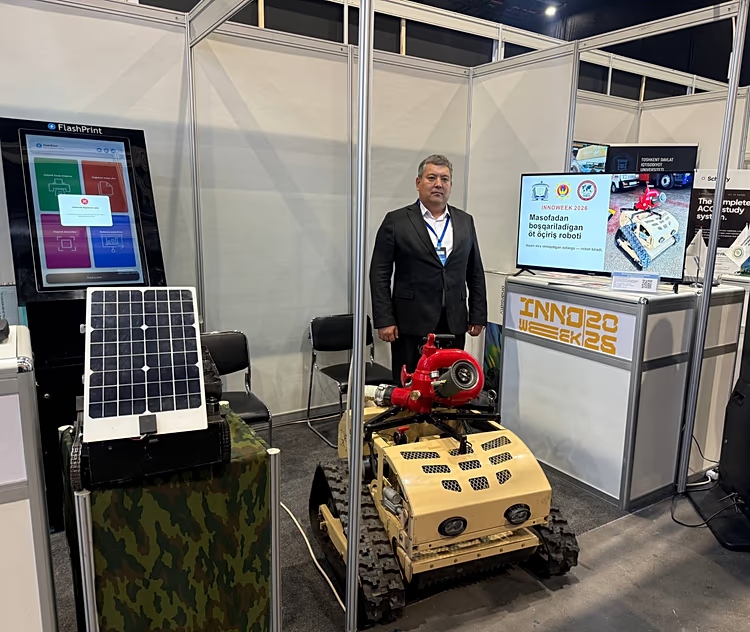
Its tracks are engineered to withstand temperatures of at least 500°C, with a metal-track version intended to handle up to 1,000°C. Developers are also working to integrate artificial intelligence for automated water-cannon control. The project remains at the prototype stage, with a patent application filed. Economist Qudratjon Yusupov, involved in the effort, estimated the production cost at roughly €8,100 which is significantly lower than a comparable Chinese model priced around €15,300. Potential customers include filling stations, and the team is exploring exports to neighboring countries such as Kyrgyzstan and Tajikistan.
Multipurpose Drones for Agriculture and Emergencies
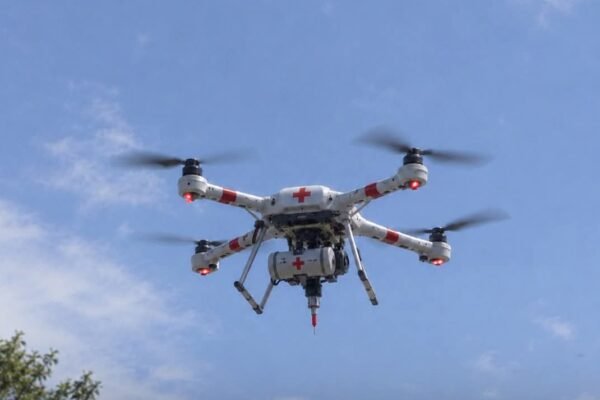
Uzbek manufacturer Sahro Drone Industry showcased a multipurpose unmanned aerial vehicle capable of carrying up to 50 kilograms. By swapping platforms and tanks, the same airframe can be configured for agricultural spraying (distributing fertilizers or treatments over mature crops without damaging plants with ground vehicles) or firefighting operations.
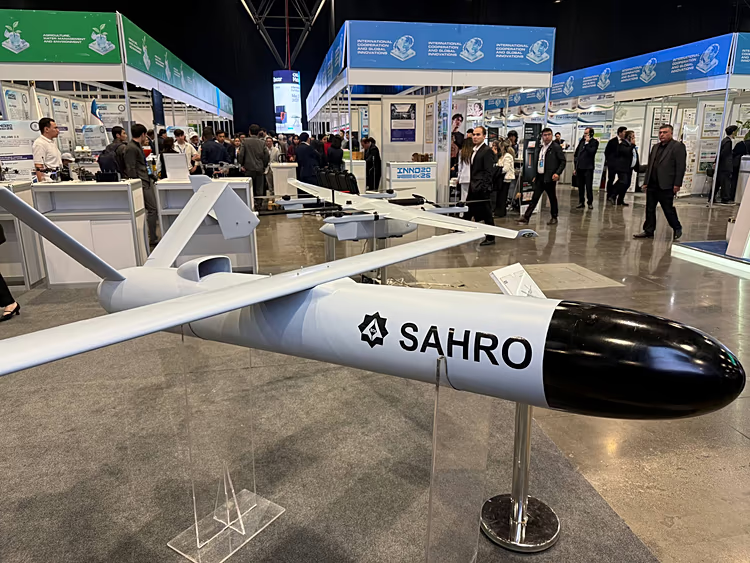
The company already produces military drones about 90% of its output with roughly 70% of components localized. The remaining capacity is directed toward civilian uses including agriculture and emergency response. Sahro plans to begin exports in 2027 and projects potential annual production of around 100 larger drones and up to 60,000 smaller models depending on demand.
Student-Driven Clean Energy and Efficient Mobility
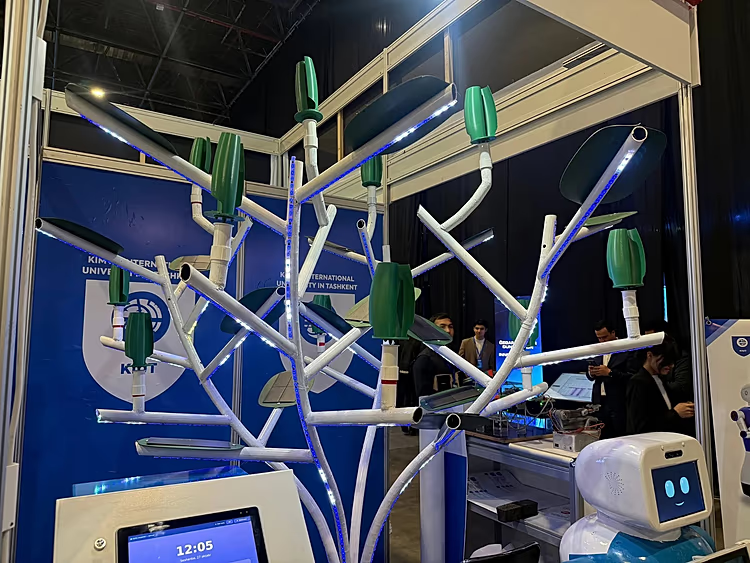
Universities highlighted efforts to convert student projects into deployable products. At Kimyo International University in Tashkent, students developed a tree-shaped renewable-energy installation that combines solar panels and small wind turbines. The system generates electricity for outdoor lighting and security cameras and includes battery storage. The university estimates manufacturing costs at about $2,000 per unit, with a potential selling price of $2,200–$2,500. Under the university’s model, it can act as the first customer, purchasing and installing selected student innovations on campus while channeling revenue back into research and development.
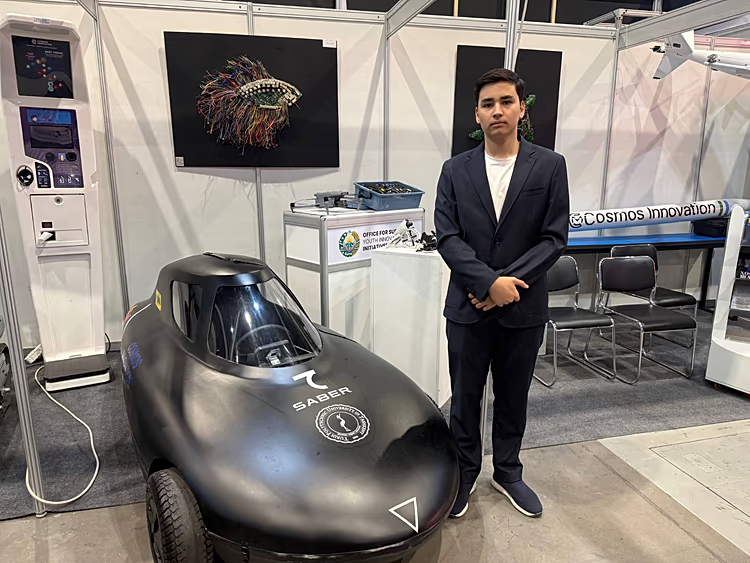
Separately, students from Turin Polytechnic University in Tashkent (the Cosmos Innovation team) presented a 250-kilogram electric vehicle built for energy-efficiency competitions. It reports energy consumption of 0.6 kilowatt-hours per 10 kilometers, and the team aims to compete in the 2027 Shell Eco-marathon in the United States.
Bridging Research and Industry
Beyond individual exhibits, InnoWeek underscored the ongoing challenge of moving inventions from the lab into wider use. Officials from the Agency for Innovative Development pointed to mechanisms such as spin-off companies (20 of which participated) and shared research-funding programs between government and business. International experts, including from Germany’s Leibniz University Hannover, emphasized the need for closer collaboration among scientists, innovators, and industry.
The event also included forums on Germany–Central Asia and EU–Central Asia science and innovation cooperation, startup competitions, hackathons, and Demo Days, reinforcing its role as a platform for both domestic capability-building and international partnerships.
InnoWeek 2026 illustrated a pragmatic strand of Uzbekistan’s innovation push: focused, application-oriented technologies in robotics, unmanned systems, and distributed renewables that address local needs in safety, agriculture, and energy while eyeing regional and global markets. Whether these prototypes scale into commercial products will depend on continued support for manufacturing, testing, and market access—but the exhibition made clear that the pipeline of ideas is active and increasingly outward-looking.
Qudratjon Yusupov presents a remotely operated firefighting robot developed in Uzbekistan. Euronews
A military surveillance drone developed by Uzbekistan’s Sahro DI. Euronews
A student-developed renewable energy installation in the shape of a tree, combining solar panels and small wind turbines to generate electricity. Euronews
Muzaffar Karimov presents an energy-efficient electric racing vehicle developed by students from Turin Polytechnic University in Tashkent. Euronews