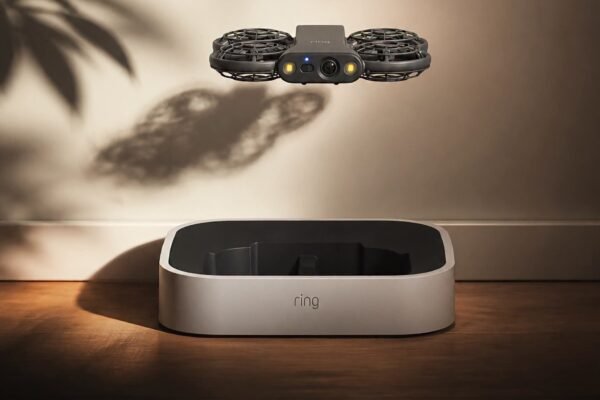
Amazon’s Ring has finally brought its long-promised indoor flying security camera to market. On November 10, 2026, the company announced the Ring Drone Cam, a $249.99 autonomous indoor drone and an autonomous robot designed to patrol homes, investigate suspicious activity, and provide mobile coverage where fixed cameras fall short. It is the centerpiece of the new Ring Robotics line for homes and businesses.
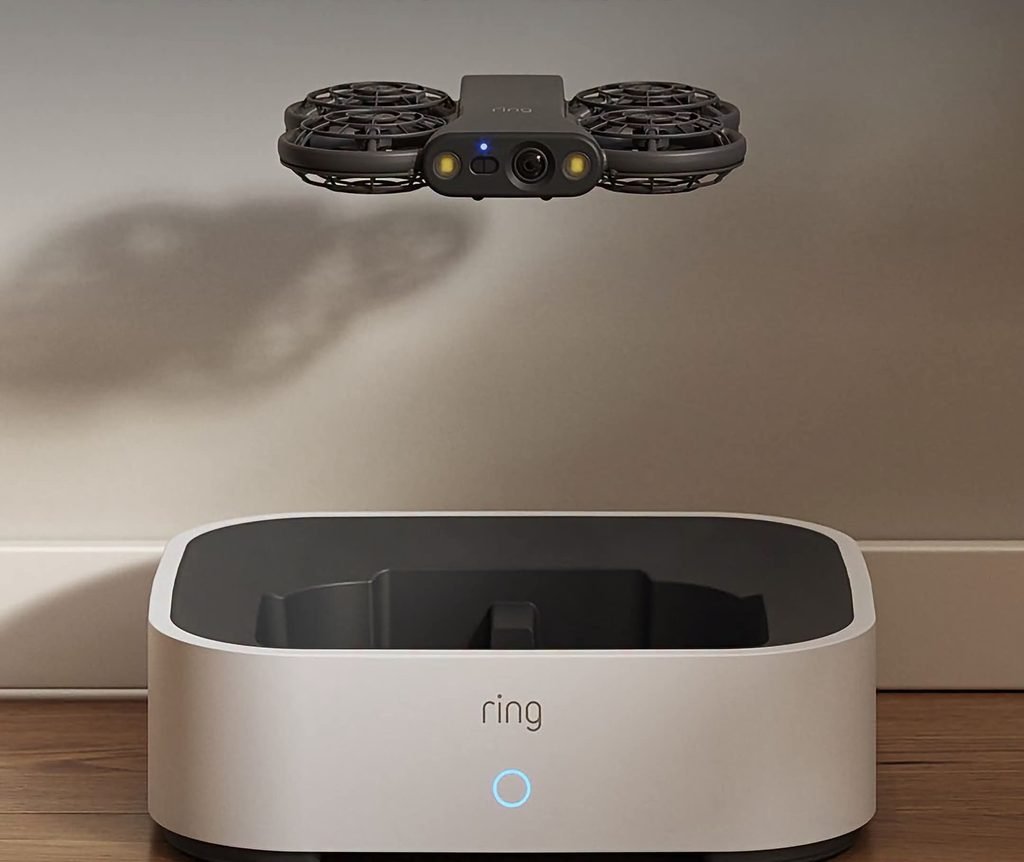
At a demo in New York on Monday, Ring CEO Jamie Siminoff said the drone could be used as a home monitoring tool and as a crime “deterrent” due to the device’s built-in LED lights.
“If someone is going around your house at night, and your motion detector goes off on your Ring doorbell, imagine if you see spotlights and something flying across the window,” Siminoff said. “You’re probably not going to go into that house.”
This marks the culmination of more than six years of development. Ring first revealed a similar concept, the Always Home Cam, in September 2020 at the same $249 price point, promising a 2021 launch.
An invitation-only limited release followed, but the product never reached wide availability. Earlier versions struggled with the trade-offs of onboard sensors, weight, battery life, and reliable indoor navigation. The new model offloads most intelligence to the cloud via Ring’s AI Pilot system, enabling a lighter, more practical design.
How the Ring Drone Cam Works
The textbook-sized drone roughly 164 grams sits in a charging dock with its camera covered and powered off until activated. During setup, the owner carries it through the home so AI Pilot can map the floor plan, identify rooms, and suggest patrol points such as doors, windows, and hallways. Users can customize routes, schedule regular flights, or deploy it on demand through the Ring app.
It integrates with the broader Ring ecosystem. When a connected camera, door/window sensor, or alarm triggers, the drone can automatically fly a preset path to investigate and stream live 2K video.
It features a 148-degree field of view, 360-degree rotation capability, dual cameras and bright LED lights for low-light or night recording. The LEDs and the loud propeller buzz are intentionally designed as deterrents that serven as visible and audible cues that something is monitoring the space.
Flight time is limited to about 5–8 minutes per charge before the drone returns autonomously to its dock. Recharging takes roughly an hour.
Amazons flying security drone is restricted to indoor use only, with software guardrails preventing outdoor flight, which would violate aviation rules. Ring says it can cover homes up to around 3,500 square feet.
Scheduled flights, video storage, and certain advanced features require a Ring Protect subscription. The camera remains off while docked, and footage uses Ring’s TAKE (Throw Away the Key Encryption) system, which rotates keys frequently.
Pricing, Availability
The Ring Drone Cam is priced at $249.99 and is scheduled to begin shipping in the U.S. on January 27, 2027, pending Federal Communications Commission authorization. Ring is currently collecting email interest rather than taking full pre-orders in many reports.
Amazon’s Ring Rover Autonomous Robot Cam
The company on Tuesday also debuted the $1,000 Ring Rover Cam. The device repurposes Amazon’s Astro home robot, which had a short life as a business device and has seen few upgrades since its 2021 debut, for companies to use to patrol offices, warehouses and other workspaces.

Ring repurposed Amazon’s Astro consumer robot, first unveiled in 2021, to be a business security device Photo Credit: CNBC
The companion Ring Rover Cam, a $1000 wheeled autonomous robot aimed at businesses with a periscope-style camera for viewing over obstacles, is set to ship earlier, on December 16, 2026. Both rely on the same AI Pilot navigation technology.
Ring said it “leveraged the best of Astro” to build the Ring Rover Cam, which it describes as a “purpose-built security robot.”
Similar to the Astro, the device is a display mounted on a two-wheeled base with an extendable periscope camera. It also features a “built-in siren,” two-way audio and a “light tower” that shines onto the ceiling to help users keep track of its whereabouts.
Siminoff said in an interview that the drone and the robot allow users to monitor multiple areas of their home or business with just one device.
“People like indoor cameras, but they don’t necessarily want them everywhere around their home,” Siminoff said.
Ring said privacy is the “default” mode for both the drone and the robot, which flash an LED light when they’re recording.
The announcement reflects Ring’s push beyond fixed cameras into “autonomous, mobile security.” For homeowners tired of installing multiple indoor cameras or worried about blind spots, a single flying unit that responds to alerts offers an appealing alternative. For others, the idea of a camera that maps and flies through private living spaces feels like an escalation of always-on monitoring culture.
Whether the Ring Drone Cam becomes a practical home-security tool or remains a niche product will depend on real-world reliability, battery and navigation performance over time, the ongoing cost of the required subscription, and how comfortably people adapt to a flying camera in their daily environment. Availability is still contingent on regulatory clearance, so the true market test begins in early 2027.
As with any connected security device, prospective buyers should weigh the convenience and coverage benefits against the privacy trade-offs and the need for an ongoing subscription to unlock the core features.