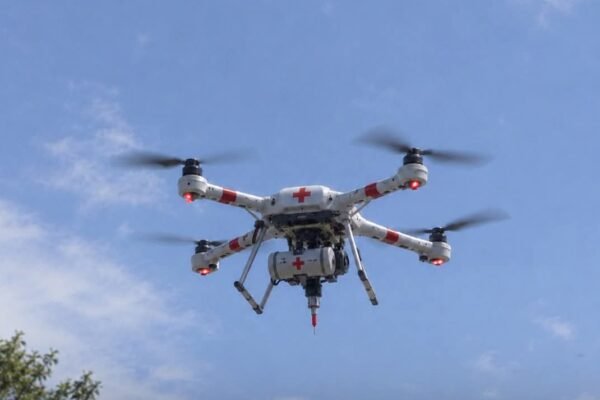
China’s Air Force Medical University has developed what it describes as the military’s first casualty-search drone and made progress in using unmanned aerial vehicles (UAVs) to administer emergency medication to wounded personnel from a distance, state broadcaster CCTV reported Wednesday.
China’s military publicly demonstrated a drone designed to locate wounded soldiers and inject emergency medication remotely via a dart, without requiring medics to approach under fire.
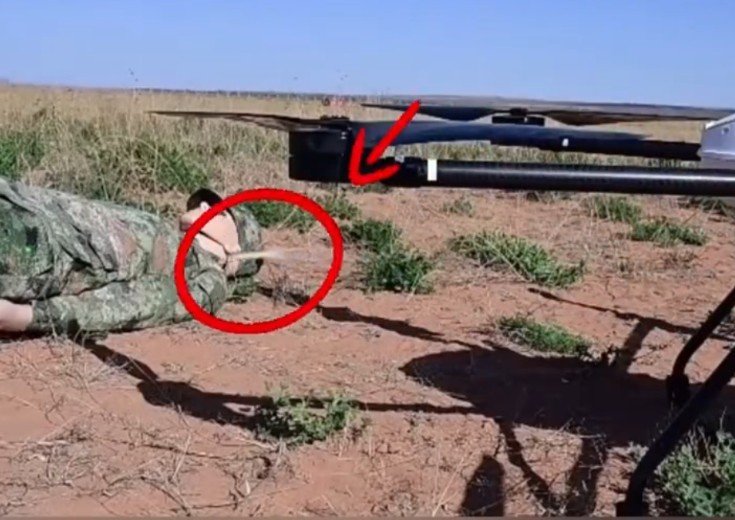
Picture Showing China’s New Medication Delivering Drone in Action – Photo Credit: Global Times
At the Aerospace Medicine Summit Forum-2026 in Xi’an, Wang Jianqi of the Air Force Medical University stated that the university had developed the Chinese military’s first casualty-search drone and achieved breakthroughs in remote treatment.
He described the system as enabling injection of life-saving emergency medication into a wounded person’s muscle “from a considerable distance,” wherever the drone can fly, in order to buy critical time before fuller medical care arrives. Chinese coverage refers to the injection capability as “thousand-li flying needle”.
”We have developed the military’s first casualty-search drone, and have also made some breakthroughs in treatment. For example, we can use drones to inject medication into wounded personnel from a considerable distance,” Wang Jianqi, a representative of Air Force Medical University, was quoted as saying in the report.
”Wherever our drone can fly, we can deliver life-saving emergency medication into a wounded person’s muscle, buying valuable time for treatment,” he said.
Military commentator Song Zhongping told the Global Times on Wednesday that the changing nature of modern warfare has made battlefield medical rescue increasingly challenging, as the distinction between the front lines and the rear has become less clear.
”One of the biggest problems in modern warfare is that it has blurred the concept of the front lines and the rear. The two have even merged into one, meaning that the areas where casualties may occur have become extremely extensive,” Song told the Global Times.
He cited the Russia-Ukraine conflict and conflicts in the Middle East as examples, saying attacks can take place in areas far beyond what would traditionally be considered the front lines, making the distribution of casualties less predictable.
Against this backdrop, drones can help deliver medication and medical supplies to wounded personnel in areas that are difficult or dangerous for rescue teams to reach in time, Song said.
Video Showing China’s New Medication Delivering in Tests: Video Credit: CCTV
”The drone-based injection of medication is essentially an extension of using drones to deliver medicine. It helps ensure that wounded personnel on the battlefield receive initial treatment,” he said. In the video, a UAV can be seen releasing a dart toward a soldier lying on the ground.
In traditional battlefield rescue operations, medical personnel often have to expose themselves to considerable danger to reach wounded personnel. The use of unmanned equipment could reduce the need for medical teams to enter high-risk areas, while also helping stabilize casualties before evacuation, Song said.
”Some wounded personnel at the front lines need pain relief before they can be moved back,” Song said. “If drones and other unmanned equipment are used to transport them, it is also necessary to stabilize their condition in advance, so that no secondary danger arises during transportation.”
He added that the approach could also be useful in civilian emergency response, particularly in areas affected by landslides, collapsed roads or rivers that prevent rescue teams from reaching people in need.
”Using drones to transport people or deliver medication into such areas is a relatively good approach,” Song said, adding that unmanned equipment could help address urgent rescue needs without exposing helicopters and their crews to the same level of risk.
Footage released with the CCTV report shows a UAV releasing a small dart toward a soldier lying on the ground in a demonstration. The dart is intended to deliver the medication intramuscularly. No independent verification of operational performance, accuracy under field conditions, or clinical outcomes has been released.