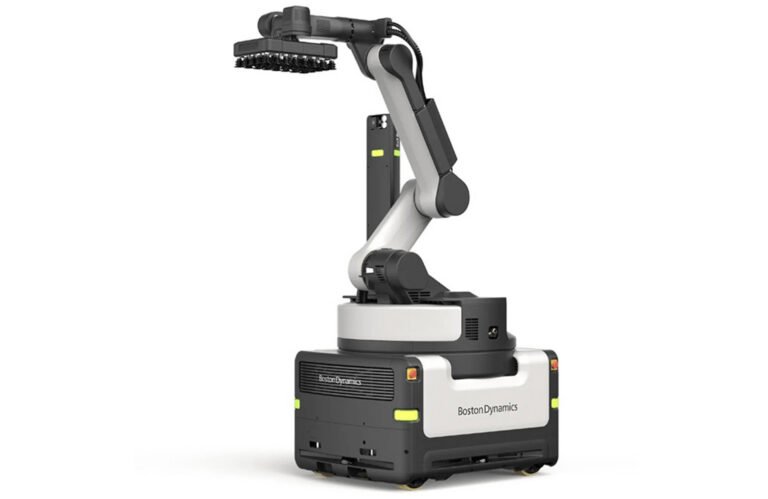
Boston Dynamics has unveiled Stretch Gen 2, the next generation of its autonomous mobile robot designed for unloading trailers and containers in high-volume logistics operations.
Announced on November 3, 2026, the redesign prioritizes durability, easier maintenance, and higher operational availability based on real-world data from the first-generation fleet.
The new Stretch robot features an updated modular design that enables “plug and play” part swaps, says Boston Dynamics.
Stretch has established itself as a leader in robotic trailer unloading since its commercial introduction.
The company reports that the first-generation robots have accumulated more than 100,000 operating hours and handled tens of millions of boxes.
Engineers used this data to identify the most frequent causes of unplanned downtime and redesign the system around those insights.
“Our customers count on Stretch to keep freight moving, and every hour a robot sits idle is an hour of work that piles up on the dock,” said Brian Donnelly, Vice President and General Manager of Logistics Robotics at Boston Dynamics. “With Gen 2, we focused on the things that actually took robots offline in the real world. We made it tougher, we made it simpler to service, and we made sure it keeps getting better long after it’s deployed.”
Key Hardware Upgrades for Reliability
The most significant changes target common failure points observed in the field:
Cabling reduction: Internal cabling has been cut by 81% that’s roughly half a mile of wiring. Cabling was identified as a primary source of intermittent electrical faults and wear from constant motion.
Connectors and joints: Heavy-duty automotive-grade connectors better withstand vibration from high-torque box handling and uneven warehouse floors. Continuous-rotation joints that move beyond 360 degrees eliminate the mechanical stress previously caused by hitting hard stops.
Gripper and sensing: An upgraded gripper with improved valve systems and more precise sensing enhances grasping accuracy and placement during fast-paced picks.
Protective design: The emergency stop is lower and recessed, while exterior panels use new materials so that a falling box is less likely to trigger an unintended safety stop or damage the robot.
These changes produce a more modular architecture that supports “plug-and-play” component swaps.
Faster Maintenance and Serviceability
When service is required, repairs are designed to be substantially quicker. A full swerve-drive mobility module replacement now takes about one hour instead of a full day. Dynamic cables and complex harnesses have been eliminated, and standardized high-strength fasteners reduce tool changes and hands-on time. New onboard diagnostics and maintenance tools enable customer teams to handle more routine servicing themselves, reducing reliance on external technicians.
Performance Specifications
Stretch Gen 2 is rated to unload up to 1,000 cases per hour under favorable conditions. Throughput depends heavily on factors such as case weight, how neatly or disorderly boxes are stacked, and the presence of a multipick capability that allows simultaneous handling of multiple cases when loads permit.
The battery supports two shifts of operation. A fast charger can restore the battery to approximately 90% in about 75 minutes. Onboard lighting enables work inside unlit trailers.
An upgraded onboard computing platform supports ongoing software improvements. Boston Dynamics releases software updates roughly monthly on average; these can enhance case detection, motion planning, and pick strategies without requiring hardware changes.
Market Context and Deployments
Stretch Gen 2 is already operating at multiple customer sites. Early adopters of the Stretch platform have included major logistics and retail operators such as DHL Supply Chain, Gap, H&M, and Maersk’s Performance Team. DHL has previously signed agreements pointing toward large-scale deployments. Cumulative box handling by the Stretch fleet has exceeded 20 million units since commercial launch, according to earlier Hyundai Motor Group statements.
In high-volume dock environments, unplanned downtime directly translates into delayed freight, labor bottlenecks, and higher operating costs. By focusing on the actual failure modes observed across more than 100,000 hours of operation, Boston Dynamics has shifted the product emphasis from peak theoretical speed toward sustained, reliable performance and faster recovery when issues do arise.
Stretch Gen 2 represents a maturation of warehouse robotics from early commercial deployment to a more production-hardened platform. The combination of reduced failure points, modular serviceability, continuous software improvement, and practical throughput improvements positions it to better meet the demands of multi-shift logistics operations.
For warehouse and distribution operators evaluating robotic unloading solutions, the real measure of value will be sustained cases handled per shift after accounting for availability, maintenance time, and real-world load variability not just peak demonstration rates. Stretch Gen 2 is explicitly engineered with those operational realities in mind.